

Foreign Gain-of-Function Research Prevention Act of 2021 This bill prohibits the use of federal funds to conduct or support gain-of-function research involving potential pandemic pathogens by China, Russia, Iran, North Korea, or other foreign adversaries. Gain-of-function research is any research that is anticipated to confer an attribute on a pathogen to enhance its pathogenicity or transmissibility in mammals. If the Department of State finds that an entity has used funds for prohibited research, the entity may not receive any federal funding for a period of five years.
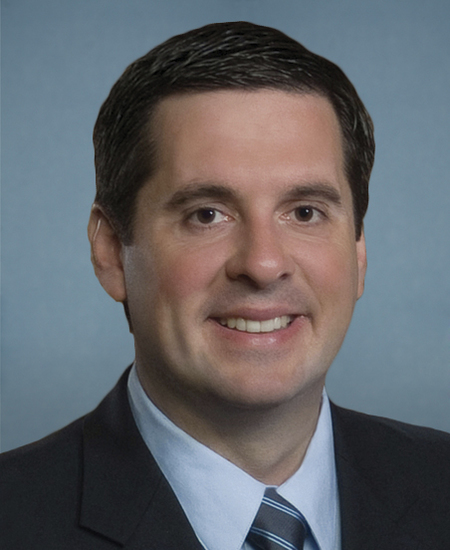
Rep. Devin Nunes
Sponsored bills
Trade Preferences and American Manufacturing Competitiveness Act of 2021 This bill reauthorizes and revises specified U.S. trade programs and provisions. Specifically, the bill extends through January 1, 2027, the Generalized System of Preferences (GSP), which provides duty-free treatment to products imported from designated beneficiary countries. The bill makes various changes to the GSP, including by (1) adding human rights, environmental, and other criteria for designation as a beneficiary developing country; (2) requiring an assessment of how the GSP supports worker and gender rights; and (3) requiring a study on rules of origin and GSP utilization rates. Additionally, the bill provides through December 31, 2023, and retroactively applies to 120 days before this bill's enactment, temporary duty suspensions or reductions to eligible imported products. This authorization is commonly known as the Miscellaneous Tariff Bill (MTB). The last version of the MTB was enacted in September 2018 and the temporary treatment for those products listed in the MTB expired on December 31, 2020. The bill also extends the American Manufacturing Competitiveness Act of 2016 for two future MTB cycles (one in 2022 and one in 2025). This extension allows the U.S. International Trade Commission to conduct the MTB petition, review, and recommendation process for those additional cycles. The bill extends customs user fees through June 21, 2031.
Trillion Trees Act This bills establishes a variety of requirements and incentives to plant trees and conduct other land management practices for the purposes of capturing and storing carbon in domestic and international trees and forests. Additionally, the bill provides incentives to research or develop other carbon sequestration tools. Specifically, the bill directs the Department of Agriculture (USDA) to set targets to increase forest carbon stock through January 1, 2100, for the purposes of sequestering and storing carbon in U.S. forests. It also establishes and provides funding for the Trillion Trees Challenge Fund to provide grants to nonfederal entities for activities related to reforestation efforts on public or private lands. In addition, it raises the cap on the Reforestation Trust Fund to enhance forest health in the National Forest System and requires the USDA to establish a Tree City USA Grant Program. The bill also allows the U.S. Agency for International Development to enter into an agreement with a nonprofit organization to establish an International Forest Foundation to promote reforestation and prevent deforestation. Additionally, it establishes requirements and incentives to address seedling shortages and support nurseries. Finally, the bill provides market incentives to research or develop other carbon sequestration tools relating to biochar, sustainable building practices, biochemical and bioplastic products, and biomass energy.
Protecting American Innovation Act This bill establishes certain limitations on modifying trade agreements, including those related to the TRIPS Agreement (i.e., the Agreement on Trade-Related Aspects of Intellectual Property Rights). The TRIPS Agreement contains obligations for World Trade Organization members to protect patents and other intellectual property rights. Specifically, the bill prohibits the President (or any U.S. official, employee, or agent) from negotiating or concluding any withdrawal, suspension, or modification to a trade agreement that adversely affects the rights of the United States or U.S. persons under a trade agreement with China or Russia. Additionally, the bill states that a TRIPS waiver to address the COVID-19 pandemic shall not take effect if (1) the President does not submit required reports from the Department of Commerce and the Department of Defense (DOD), (2) the Commerce report concludes that the TRIPS waiver will not result in an increase in global vaccine access, or (3) the DOD report concludes that the TRIPS waiver would adversely impact U.S. national security. Prior to entering into a negotiation with a trading partner concerning a suspension of or modification to a trade agreement, the bill requires (1) the U.S. Trade Representative to publish certain information in the Federal Register and allow for public comment, and (2) the President to provide written notice and consult with Congress. Further, the President shall not enter into any suspension of or modification to a trade agreement unless the President has complied with such consultation requirements and receives congressional approval.
This resolution expresses support for the designation of Portuguese National Heritage Month. The bill also esteems the integral role of the Portuguese-American community and the manifold heritage of Portugal in the economy, culture, and identity of the United States.
Helping American Victims Afflicted by Neurological Attacks Act of 2021 or the HAVANA Act of 2021 This bill specifically authorizes the Central Intelligence Agency, the Department of State, and other agencies to provide payments to agency personnel who incur brain injuries from hostilities while on assignment. Specifically, the bill allows agency personnel and their families to receive payments for brain injuries that are incurred (1) during a period of assignment to a foreign duty station; (2) in connection with war, insurgency, hostile acts, terrorist activity, or other agency-designated incidents; and (3) not as the result of willful misconduct. The bill's authority applies to injuries incurred before, on, or after the date of the bill's enactment. Agencies must submit classified reports on the bill's implementation, including the number of payments made and the amount of each payment. Since 2016, some intelligence, diplomatic, and other governmental personnel have reported experiencing unusual cognitive and neurological impairments while on assignment (particularly abroad), the source of which is currently under investigation. Symptoms were first reported by personnel stationed in Cuba and have since been collectively referred to as Havana Syndrome .
Ghost Army Congressional Gold Medal Act This bill directs the Speaker of the House of Representatives and the President pro tempore of the Senate to award a Congressional Gold Medal to the 23rd Headquarters Special Troops and the 3133d Signal Service Company, known as the Ghost Army , collectively, in recognition of its service during World War II.
Combatting COVID Unemployment Fraud Act of 2021 This bill requires additional documentation for individuals seeking pandemic unemployment assistance, requires state unemployment agencies to use designated fraud prevention tools, and otherwise addresses pandemic-related unemployment benefits.
This bill revises the Redbank and Fancher Creeks flood control project in California to authorize the U.S. Army Corps of Engineers (USACE) to allow a nonfederal interest to establish conservation pools in the Big Dry Creek Reservoir and the Fancher Creek Reservoir. Under this bill, a nonfederal interest that intends to establish a conservation pool must (1) perform any dam safety study that the USACE deems appropriate for determining whether the pool will affect flood protections or injure the public, and (2) submit the plan to the USACE for establishing and engineering the pool so it will not affect flood protections or injure the public. For these pools, the USACE may accept and expend funds provided by the nonfederal interest for reviewing any study, engineering, or plan to ensure compliance with federal standards. Further, the USACE may revise the water control manual for the flood control project. The bill requires the nonfederal cost share to be 90%.
This resolution commemorates the centennial of the establishment of the state of Jordan, expresses admiration and gratitude for the friendship of the Jordanian people, and looks forward to continued cooperation with Jordan on shared national priorities.