

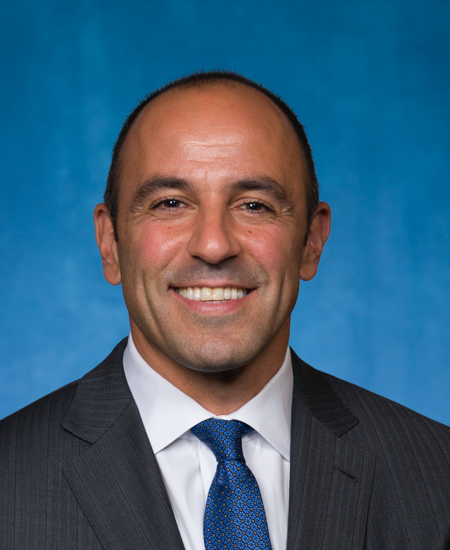
Photo of Jimmy Panetta
D United States House · District 19 · California On the 2026 ballot

Rep. Jimmy Panetta

Compare
Total votes
2,837
all sessions
Attendance
100%
5 missed
Higher than 96% of chamber peers
With party
95%
of cast votes
Lower than 86% of chamber peers
Bipartisan score
3%
crosses aisle rarely
Higher than 84% of chamber peers
Sponsored
2,210
bills & resolutions
Higher than 94% of chamber peers
Committees
3
assignments
2,210 bills and resolutions

Sponsored bills

Total
2,210
Primary
159
Co-sponsor
2,051
This page
2,210
matching current filters
Co-sponsor HR 6721
In committee · United States House · Co-sponsor
Rent Relief Act of 2023

Maddy summaryThe Rent Relief Act of 2023 creates a new refundable tax credit for renters whose rent exceeds 30% of their adjusted gross income. It directly affects low-to-moderate income renters in their principal residence, with credit percentages ranging from 100% (for incomes under $25,000) down to 0% (for incomes over $100,000). The credit is limited to rent within HUD's fair market rent guidelines, and the IRS will make monthly advance payments starting July 2024 for eligible taxpayers who elect this option. The bill requires no additional tax filing for the credit but includes $50 million for outreach to help eligible households enroll.

In committee Dec 12, 2023 1 co-sponsor
Co-sponsor HR 5988
In committee · United States House · Co-sponsor
United States-Taiwan Expedited Double-Tax Relief Act

Maddy summaryThis bill establishes tax relief for qualified residents of Taiwan earning income in the United States by reducing tax rates on interest, dividends, and royalties to 10% or 15% (instead of the standard 30%). It also exempts certain wages and income from entertainment activities under $30,000 from U.S. taxation. To qualify, individuals must meet specific residency requirements, and entities must demonstrate substantial business activity in Taiwan. The bill modifies withholding tax procedures to implement these new rates and requires reciprocal tax benefits from Taiwan to be in place.

In committee Dec 12, 2023 1 co-sponsor
Co-sponsor HR 3063
In committee · United States House · Co-sponsor
Retirement Fairness for Charities and Educational Institutions Act of 2023

Maddy summaryHR 3063, the Retirement Fairness for Charities and Educational Institutions Act of 2023, modifies securities laws to clarify exemptions for certain retirement plans. It expands the definition of exempt retirement plans under the Investment Company Act, Securities Act of 1933, and Securities Exchange Act of 1934 to include 403(b) plans used by charities and educational institutions. These plans must meet specific conditions, such as being subject to ERISA or having employers act as fiduciaries for investment choices. The bill directly affects eligible organizations by reducing regulatory barriers for offering retirement benefits to their employees. This change simplifies compliance without altering the core structure of retirement plans.

In committee Dec 12, 2023 1 co-sponsor
Co-sponsor HR 6556
In committee · United States House · Co-sponsor
SNORE Act of 2023

Maddy summaryHR 6556, the SNORE Act of 2023, requires San Francisco International Airport (SFO) to create a program mitigating aircraft noise for nearby residents. The bill mandates SFO to soundproof at least 200 homes annually in areas where excessive noise (measured as 10+ instances of 75 dBA or higher between 10 p.m. and 7 a.m.) is recorded. SFO must fund this program using its own revenue (like passenger fees) without typical restrictions, and if it fails to meet the 200-home target, it must remit funds to affected cities for noise mitigation. This directly affects residents near SFO and requires the airport to manage noise reduction through residential soundproofing.

In committee Dec 11, 2023 1 co-sponsor
Primary HR 6560
In committee · United States House · Lead sponsor
NOTIFIED Act

Maddy summaryThe NOTIFIED Act requires the FAA to notify local officials and community groups 30 days before implementing new or modified flight paths below 18,000 feet near airports. It mandates specific details in notifications, including flight path maps, altitudes, and contact information, to help officials assess impacts on their communities. Directly affecting residents and local leaders in cities/counties within 5 miles of proposed changes, the bill targets flight procedures under the FAA's NextGen modernization program. This aims to improve transparency before changes take effect, allowing communities to provide input early in the process.

In committee Dec 11, 2023 0 co-sponsors
Co-sponsor HR 6549
In committee · United States House · Co-sponsor
F-AIR Act

Maddy summaryHR 6549, the F-AIR Act, amends federal aviation law to change the Federal Aviation Administration's (FAA) airspace priorities. It requires the FAA Administrator to prioritize aircraft safety first, then treat efficient airspace use and minimizing aviation noise/health impacts on nearby residents and communities as equally important secondary goals. The bill mandates the FAA review its regulations and update its mission statement within one year of enactment to reflect these new priorities. This directly affects communities living under flight paths and the FAA's decision-making process regarding airspace assignments.

In committee Dec 11, 2023 1 co-sponsor
Primary HR 6562
In committee · United States House · Lead sponsor
REST Act of 2023

Restore Everyone's Sleep Tonight Act of 2023 or the REST Act of 2023 This bill authorizes an airport to impose an access restriction (i.e., a prohibition on the landing or takeoff of aircraft) between the hours of 10 p.m. and 7 a.m. for aircraft, with exceptions. The authorization to impose the restriction does not apply to exceptional circumstances, such as (1) a scheduled flight that is delayed in takeoff or landing due to weather; (2) emergency flights; and (3) flights for the purpose of preserving life, health, or safety. An airport may impose a noise deterrence penalty on an air carrier or aircraft operator for a violation of the access restriction. The restriction does not apply to the operation of military, law enforcement, and U.S. Coast Guard flights. Further, the bill specifies that an airport may impose the restriction without approval or comment by the Federal Aviation Administration, the Department of Transportation, any air carrier or aircraft operator, or any other entity.

In committee Dec 11, 2023 0 co-sponsors
Primary HR 6561
In committee · United States House · Lead sponsor
RESPECT Act

Responsive Employees Support Productive Educated Congressional Talk Act or the RESPECT Act  This bill requires the Federal Aviation Administration (FAA) to respond in writing within 90 days to requests for data and information from Congress. Specifically, the FAA must substantively respond if the data is within the control of the FAA; and the data would be otherwise appropriate to provide if requested by an airline, an airport, a flight procedure proponent, an Aviation Roundtable, anyone not employed by the FAA, or via a Freedom of Information Act request from any individual or any entity. The FAA must also provide staff at a private or public meeting with a Member of Congress if certain conditions are met.

In committee Dec 11, 2023 0 co-sponsors
Primary HR 6559
In committee · United States House · Lead sponsor
APPRISE Act

Maddy summaryThe APPRISE Act (HR 6559) requires the FAA to ensure communities highly impacted by aviation noise can appoint technical representatives to participate equally in FAA working groups developing new flight procedures. It directly affects communities near airports where noise from proposed flight paths falls within 5 miles of their jurisdiction. The bill mandates that these community representatives join core or full working groups on the same terms as industry or airport representatives, ensuring their technical input is considered during procedure planning.

In committee Dec 11, 2023 0 co-sponsors
Co-sponsor HR 6622
In committee · United States House · Co-sponsor
Clean Competition Act

Maddy summaryThe Clean Competition Act establishes a carbon intensity charge on covered primary goods produced domestically or imported into the United States, affecting companies in specific industries including petroleum refining, steel, cement, and chemical manufacturing. The charge is calculated based on a facility's carbon intensity (greenhouse gas emissions per unit of production) compared to industry averages, with the charge amount determined by how much a facility's carbon intensity exceeds a percentage of the industry average. Domestic producers and importers of covered primary goods will pay charges calculated using an annual carbon price that increases with inflation, with exemptions for goods from least developed countries that produce at least 3% of global exports of that good. The bill also includes a rebate program for exports of covered primary goods and establishes a grant program to help companies invest in technologies that reduce carbon intensity.

In committee Dec 8, 2023 1 co-sponsor
Showing 1,001 to 1,010 of 2,210 bills