

Maddy summaryThis bill establishes new federal requirements for employers to prevent heat-related illness and injury among workers. It mandates that employers provide safe work environments by implementing specific measures, including access to cool water, scheduled rest breaks in shaded areas, employer-paid cooling equipment, and training for employees and supervisors on recognizing heat illness symptoms. The Secretary of Labor must create these standards within one year, requiring employers in high-heat occupations (like construction, agriculture, and outdoor labor) to adopt engineering controls, administrative schedules, and health protocols. Key provisions include ensuring hydration, rest, and language-accessible training, while preserving existing safety protections and allowing for updates as scientific evidence evolves.
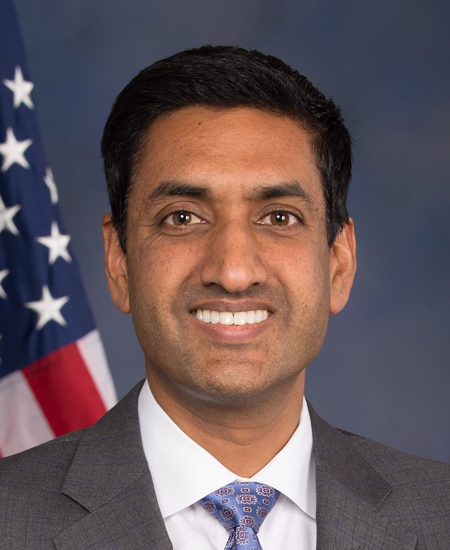
Rep. Ro Khanna
Sponsored bills
Maddy summaryHR 4952 establishes the Office of Strategic Capital within the Department of Defense to manage national security investments. The Office provides loans, loan guarantees, and equity investments to eligible entities (including businesses, states, tribal governments, and public agencies) for projects involving "vital" tangible or intangible assets critical to national security, such as infrastructure or technology. Key mechanisms include setting interest rates (with potential waivers for national security projects), requiring credit ratings, and limiting loan terms to 50 years from project completion. The Office must report annually to Congress and its authorities expire on October 1, 2028.
Maddy summaryHR 4900, the Fair College Admissions for Students Act, bans colleges receiving federal financial aid from favoring applicants based on family connections to donors or alumni. Specifically, it amends the Higher Education Act to prohibit institutions from giving preferential treatment in admissions to students whose parents or relatives donated money to the school or are alumni. This applies to all colleges participating in federal student aid programs under the Higher Education Act. The rule takes effect for the second award year starting after the bill's enactment date.
Maddy summaryThis bill expands employee ownership in S corporations by extending tax deferral for selling company stock to employee ownership plans (ESOPs), creating a Treasury Department office to provide education and technical assistance for ESOPs, and amending small business rules to maintain eligibility for government programs after ESOP ownership exceeds 49%. It establishes a new Labor Department "Advocate for Employee Ownership" to coordinate federal efforts, educate stakeholders, and recommend policy improvements. The bill directly affects S corporations using ESOPs, their employees who become owners, and small businesses that might lose government program access due to ESOP acquisitions. Key provisions include tax incentive extensions, new support offices, and updated small business classification rules.
Maddy summaryHR 1776, the End Tuberculosis Now Act of 2023, would amend U.S. foreign assistance law to strengthen global tuberculosis (TB) programs. The bill requires U.S. assistance to align with the World Health Organization's End TB Strategy, aiming to reduce TB deaths by 95% and incidence by 90% by 2035. It mandates annual reporting on TB diagnosis and treatment progress, prioritizes research for new diagnostics and treatments, and emphasizes integrating TB services into primary health care. The legislation affects U.S. government agencies, global health partners, and countries with high TB burdens, particularly focusing on low- and middle-income nations.
Maddy summaryHR 984, the Commitment to Veteran Support and Outreach Act, authorizes $50 million annually (2024-2028) for grants to states and tribes to improve outreach to veterans and their families. The bill provides funding to hire more county/Tribal veterans service officers, expand existing outreach programs, and ensure equitable access to benefits for vulnerable groups like American Indian veterans, elderly veterans, and women veterans. States and tribes must submit detailed plans, track how quickly veterans receive benefits, and report annually on progress toward outcome measures set by the Veterans Affairs Secretary. Grants must supplement, not replace, existing state/local funding and prioritize areas with critical officer shortages or high veteran suicide rates.
Maddy summaryHR 4893, the Scientific Integrity Act, requires federal agencies that fund, conduct, or oversee scientific research to adopt policies preventing political interference in science. The bill mandates these agencies to prohibit suppression or distortion of research findings, establish Scientific Integrity Officers to enforce policies, and implement training and reporting systems. It directly affects scientists and engineers employed by or contracted with covered agencies (like the EPA or NIH), ensuring their work remains free from political pressure. Key mechanisms include annual public reporting on misconduct complaints, whistleblower protections, and requiring scientific conclusions to be based on evidence, not ideology.
Food Supply Chain Capacity and Resiliency Act This bill allows the Department of Agriculture (USDA) to expand the Food Supply Chain Guaranteed Loan Program. The program may guarantee loans to support new investments in the start-up or expansion of projects in the United States that will increase U.S. food supply chain capacity to aggregate, process, manufacture, store, transport, wholesale, or distribute food. In awarding loan guarantees under this bill, USDA must give preference to loans for projects that create jobs in economically distressed communities or to help create a more resilient, diverse, and secure U.S. food supply chain. USDA must prescribe such regulations as may be necessary to carry out this program. The bill specifies that USDA must use the amounts made available to carry out this bill to supplement, and not supplant, funds provided under other federal, state, or local law.
Maddy summaryHR 4870, the Wall Street Tax Act of 2023, imposes a 0.1% tax on most securities transactions occurring on U.S. exchanges or involving U.S. persons. It directly affects financial institutions, brokers, and investors participating in covered transactions like stock, bond, and derivative trades. The tax applies to the fair market value of transactions (excluding initial security issuances and short-term debt under 100 days), with payment responsibility falling on U.S. exchanges, brokers, or U.S. parties depending on the transaction type. Exceptions include certain real property contracts, insurance products, and derivatives used in normal business operations. The tax takes effect for transactions after December 31, 2023.
Maddy summaryHR 4889, the Raise the Wage Act of 2023, would gradually increase the federal minimum wage for most workers to $15.50 per hour by 2027, with specific annual targets: $9.50 starting in 2023, rising to $11.00 after one year, $12.50 after two years, and $15.50 after four years. It would also phase out the separate lower minimum wage for tipped employees (starting at $6.00/hour) by aligning their pay with the regular minimum wage by 2028, while requiring employers to let workers keep all tips. The bill includes similar phased increases for workers under 20 and transitions toward fairer wages for workers with disabilities under special certificates, which would sunset after 2028. Future annual increases after 2028 would tie the minimum wage to the median hourly wage of all workers.