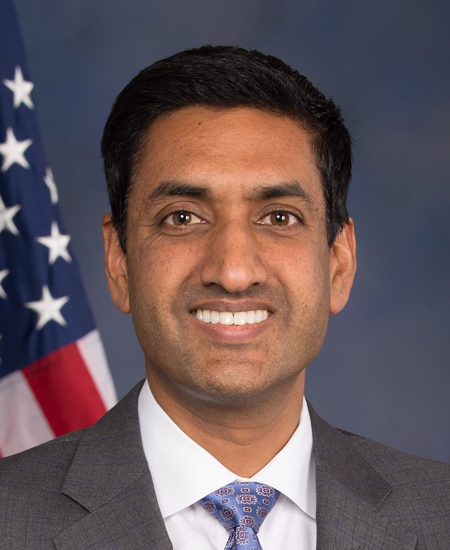
Photo of Ro Khanna
D United States House · District 17 · California On the 2026 ballot

Rep. Ro Khanna

Compare
Total votes
2,837
all sessions
Attendance
99%
29 missed
Near the chamber average
With party
98%
of cast votes
Near the chamber average
Bipartisan score
1%
crosses aisle rarely
Near the chamber average
Sponsored
2,023
bills & resolutions
Higher than 87% of chamber peers
Committees
7
assignments
2,023 bills and resolutions

Sponsored bills

Total
2,023
Primary
138
Co-sponsor
1,885
This page
2,023
matching current filters
Co-sponsor HR 8568
In committee · United States House · Co-sponsor
First Rhode Island Regiment Congressional Gold Medal Act

Maddy summaryThis bill authorizes Congress to award a gold medal to the First Rhode Island Regiment, a historically significant Revolutionary War unit composed of Black, Indigenous, and white soldiers who served together. The medal, designed by the Treasury Secretary, will be displayed at the Rhode Island State Library, with bronze duplicates available for sale to cover costs. The bill recognizes the regiment's role as one of America's first integrated military units, formed in 1778 when Rhode Island allowed enslaved people to enlist and gain immediate freedom. The medal serves as a commemorative honor, not a policy change, with no direct effect on current individuals or legislation.

In committee May 24, 2024 1 co-sponsor
Co-sponsor HR 619
In committee · United States House · Co-sponsor
NAPA Reauthorization Act

Maddy summaryThis bill reauthorizes the National Alzheimer's Project Act through 2035 (extending the previous deadline of 2025) and adds new requirements to promote healthy aging and reduce Alzheimer’s risk factors. It mandates the program to provide information on healthy behaviors that may lower cognitive decline risk and expands the advisory group to include representatives from agencies like the Department of Justice, FEMA, and Social Security Administration, plus experts with diverse clinical trial experience. The bill directly affects Alzheimer’s research, care programs, and the federal advisory group overseeing national efforts. Key changes include requiring annual evaluations instead of initial ones and adding a focus on reducing health disparities in Alzheimer’s initiatives.

In committee May 24, 2024 1 co-sponsor
Co-sponsor HR 8522
In committee · United States House · Co-sponsor
Agriculture and National Security Act of 2024

Maddy summaryHR 8522 establishes a new Senior Advisor for National Security within the U.S. Department of Agriculture (USDA) to integrate national security concerns into the department's work. The bill requires the USDA to submit biennial reports to Congress and the National Security Council assessing vulnerabilities in food and agriculture, including foreign ownership of farmland, control of agricultural data, cybersecurity risks, and supply chain dependencies. It mandates the USDA to coordinate with defense and intelligence agencies, increase security-clearanced staff, and identify gaps in protecting the food system from threats. The law directly affects USDA operations and aims to strengthen national security planning for the agricultural sector.

In committee May 23, 2024 1 co-sponsor
Co-sponsor HR 5754
Passed · United States House · Co-sponsor
To designate the United States courthouse located at 350 W. 1st Street, Los Angeles, California, as the "Felicitas and Gonzalo Mendez United States Courthouse".

Maddy summaryHR 5754 renames the U.S. courthouse at 350 W. 1st Street, Los Angeles, California, as the "Felicitas and Gonzalo Mendez United States Courthouse." The bill updates all federal references - such as legal documents, maps, and records - to use the new name. This is a ceremonial designation with no policy changes or direct impact on citizens or laws. The bill solely affects the courthouse's official name and related federal paperwork.

Passed May 22, 2024 1 co-sponsor
Co-sponsor HR 8485
In committee · United States House · Co-sponsor
No Foreign Emoluments Without Congressional Consent Act

Maddy summaryHR 8485, the "No Foreign Emoluments Without Congressional Consent Act," prohibits senior federal officials - including the President, Vice President, Cabinet members, Members of Congress, and high-level presidential staff - from accepting foreign payments (such as from foreign governments or entities controlled by them) without prior congressional approval. It requires officials to submit detailed written notices to the Office of Government Ethics before accepting such payments, triggering a 90-day congressional review period during which Congress must approve via a specific concurrent resolution. The bill covers payments received during official service and for two years after leaving office, with strict penalties including civil fines up to $5,000 plus the payment's value or criminal charges for violations. Excluded are standard gifts or decorations under existing law and certain large investment entities meeting specific SEC criteria.

In committee May 21, 2024 1 co-sponsor
Primary HR 8311
In committee · United States House · Lead sponsor
Medical Debt Cancellation Act

Maddy summaryThis bill creates a federal grant program to cancel eligible medical debt owed to hospitals by patients. Hospitals can apply for competitive grants to eliminate debt for low-income patients, prioritizing safety-net hospitals serving emergency care patients with debt under 15 months old. It also establishes new rules requiring clear billing statements, banning interest on overdue medical bills, and restricting credit reporting of medical debt. The program aims to reduce financial barriers for patients while expanding to other providers within two years. Patients with specific medical debt types - like emergency care costs from uninsured or low-income individuals - would directly benefit from these changes.

In committee May 17, 2024 0 co-sponsors
Co-sponsor HR 8323
In committee · United States House · Co-sponsor
Comprehensive Addiction Resources Emergency Act of 2024

Maddy summary# Summary of Legislative Text This is a comprehensive legislative proposal focused on addressing substance use disorder through public health approaches, with significant funding and program requirements. Key elements include: 1. **Major Funding Programs:** - **Subtitle A (Local Grants):** $3.0 billion annually (2024-2033) for local entities to provide prevention, treatment, and recovery services - **Subtitle B (State/Regional Grants):** $4.6 billion annually (2024-2033) for state-level programs - **Subtitle C (Other Grants):** $1.0 billion annually (2024-2033) for specific entities and underserved populations - **Subtitle D (Innovation/Training):** $1.5 billion annually (2024-2033) for training, research, and capacity building 2. **Key Program Requirements:** - Mandates for evidence-based treatment services across multiple levels of care - Requirements for cultural competency, particularly for Native American communities - Specific focus on harm reduction, prevention, and recovery support - Provisions for naloxone distribution and overdose reversal programs 3. **Regulatory Changes:** - New certification requirements for covered manufacturers, distributors, and dispensers of Schedule II controlled substances - Penalties for failure to submit certifications or submitting false certifications - Creation of a "Comprehensive Addiction Resources Fund" for penalty revenues 4. **Focus Areas:** - Prevention services (including trauma-informed approaches) - Early intervention services - Recovery support services - Harm reduction programs - Workforce development for treatment providers - Special attention to underserved populations (rural communities, racial minorities, formerly incarcerated individuals) 5. **Funding Priorities:** - 10% of funds for Native American communities - Specific requirements for cultural competency and language access - Mandated data collection and reporting systems This legislation represents a significant shift toward public health approaches to substance use disorder, emphasizing prevention, treatment, and recovery support rather than punitive measures, with substantial funding commitments over a decade.


In committee May 17, 2024 1 co-sponsor
Co-sponsor HRES 1234
In committee · United States House · Co-sponsor
Celebrating the East Bay Regional Park District's 90th anniversary.

Maddy summaryThis resolution (HRES 1234) is a ceremonial gesture celebrating the East Bay Regional Park District's 90th anniversary. It recognizes the district's work preserving 126,000 acres of parks, trails, and shoreline across Alameda and Contra Costa Counties for environmental conservation and public recreation. The House commends the district for its 90-year commitment to protecting open space and enhancing community well-being, and encourages East Bay residents to participate in anniversary events. As a commemorative resolution, it has no policy or funding impact.

In committee May 16, 2024 1 co-sponsor
Co-sponsor HR 8426
In committee · United States House · Co-sponsor
Public Service Freedom to Negotiate Act of 2024

Maddy summaryThe Public Service Freedom to Negotiate Act of 2024 establishes federal minimum standards for collective bargaining rights for public employees and supervisory employees. The Federal Labor Relations Authority will determine if each state's laws "substantially provide" for these rights, and if not, federal standards will apply to that state. These standards include the right to self-organization, collective bargaining, recognition of labor organizations, and procedures for resolving disputes. The bill preserves existing collective bargaining agreements and excludes certain employee categories like emergency services workers from some provisions.

In committee May 16, 2024 1 co-sponsor
Co-sponsor HR 681
In committee · United States House · Co-sponsor
READ Act Reauthorization Act of 2023

Maddy summaryThe READ Act Reauthorization Act of 2023 extends the authorization period for the Reinforcing Education Accountability in Development Act (commonly known as the READ Act) from five to ten fiscal years. This change allows U.S. international education programs, administered by agencies like USAID, to operate without annual reauthorization for a longer period. The bill directly affects programs providing educational support in developing countries, such as teacher training and literacy initiatives. The key mechanism is amending Section 4(a) of the existing law to adjust the funding duration, ensuring continued program stability.

In committee May 16, 2024 1 co-sponsor
Showing 721 to 730 of 2,023 bills
Previous 1 … 72 73 74 … 203 Next