

Maddy summaryThe Equality Act (HR 15) amends federal civil rights laws to explicitly prohibit discrimination based on sexual orientation and gender identity in employment, housing, public accommodations, credit, and jury service. It expands existing protections under the Civil Rights Act of 1964 by adding sexual orientation and gender identity as protected characteristics under sex discrimination prohibitions. The bill clarifies that discrimination against LGBTQ people is a form of sex discrimination, consistent with the Supreme Court's Bostock decision, and adds specific definitions for gender identity and sexual orientation. This legislation directly affects businesses, employers, housing providers, financial institutions, and government entities that serve the public. The bill creates a more comprehensive legal framework to address discrimination that LGBTQ people face in multiple aspects of daily life.
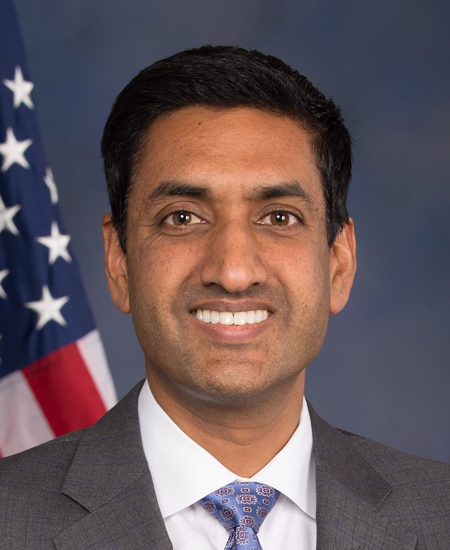
Rep. Ro Khanna
Sponsored bills
Maddy summaryHR 3067, the Arctic Refuge Protection Act, repeals the existing oil and gas program for the Arctic National Wildlife Refuge (ANWR) and designates approximately 1.56 million acres of the refuge's Coastal Plain as wilderness. This directly affects federal management of the ANWR, halting potential oil drilling in the designated area. The bill requires the Secretary of the Interior to administer the newly designated wilderness area under the Wilderness Act, treating it as part of the existing wilderness within ANWR. The change prevents future oil and gas development on this specific portion of the refuge.
Maddy summary# Summary of the Agriculture Resilience Act of 2025 This comprehensive legislative proposal aims to transform U.S. agricultural systems to be more resilient, sustainable, and climate-smart while addressing food waste and improving food safety labeling. ## Key Provisions ### Conservation & Climate Resilience - **Conservation Reserve Program** (Section 504): Expands enrollment targets through 2030 and establishes a new "Grassland 30" contract option for long-term grassland conservation. - **Private Grazing Land Conservation** (Section 503): Focuses on soil health, climate resilience, and transitioning from confinement systems to managed grazing systems. - **Alternative Manure Management Program** (Section 505): Supports dairy and livestock producers in adopting practices that reduce methane emissions and improve carbon sequestration. ### Renewable Energy - **Rural Energy for America Program** (Section 601): Expands to support renewable energy development and greenhouse gas emissions reductions. - **Agrivoltaic Systems** (Section 602): Mandates research on integrated solar energy and agricultural production systems. - **AgSTAR Program** (Section 603): Maintains and expands the anaerobic digestion program to reduce methane emissions from livestock waste. ### Food Loss & Waste Reduction - **Standardized Food Date Labeling** (Section 701-705): Establishes uniform "BEST If Used By" (quality date) and "USE By" (discard date) phrases to reduce confusion and food waste. - **Composting as Conservation Practice** (Section 711): Officially recognizes composting as a conservation practice under USDA programs. - **Federal Food Donation Act Amendments** (Section 712): Requires federal contractors to donate excess food and report on food waste. - **School Food Waste Reduction** (Section 714): Creates grant program for schools to measure, prevent, and reduce food waste. - **Food Waste Research Program** (Section 716): Establishes regional research centers to study food waste reduction strategies. ### Funding - Multiple funding allocations for conservation programs ($50 million/year for grazing land conservation, $1.5 billion for alternative manure management program). - $20 million/year for meat processing system resilience grants (Section 502). - $100 million/year for food waste-to-energy projects (Section 713). This legislation represents a holistic approach to creating a more sustainable food system that addresses climate change, reduces food waste, supports farmers and ranchers, and improves consumer understanding of food labeling.
Medicare for All Act This bill establishes a national health insurance program that is administered by the Department of Health and Human Services (HHS). Among other requirements, the program must (1) cover all U.S. residents; (2) provide for automatic enrollment of individuals upon birth or residency in the United States; and (3) cover items and services that are medically necessary or appropriate to maintain health or to diagnose, treat, or rehabilitate a health condition, including hospital services, prescription drugs, mental health and substance abuse treatment, dental and vision services, long-term care, gender affirming care, and reproductive care, including contraception and abortions. The bill prohibits cost-sharing (e.g., deductibles, coinsurance, and copayments) and other charges for covered services. Additionally, private health insurers and employers may only offer coverage that is supplemental to, and not duplicative of, benefits provided under the program. Health insurance exchanges and specified federal health programs terminate upon program implementation. However, the program does not affect coverage provided through the Department of Veterans Affairs or the Indian Health Service. The bill also establishes a series of implementing provisions relating to (1) health care provider participation; (2) HHS administration; and (3) payments and costs, including the requirement that HHS negotiate prices for prescription drugs. Individuals who are age 18 or younger, age 55 or older, or already enrolled in Medicare may enroll in the program starting one year after enactment of this bill; other individuals may buy into the program at this time. The program must be fully implemented two years after enactment.
Maddy summaryHR 906 requires the Federal Communications Commission (FCC) to publish and maintain a public list of communications entities (like radio or cable companies) holding FCC licenses that have ownership ties to "covered countries" (nations designated under U.S. law). This affects FCC license holders with foreign ownership from those countries, as the FCC must identify them using ownership rules or national security agency determinations. The bill mandates the FCC to update this list annually, with an initial list due 120 days after enactment and full implementation within 18 months. The law aims to increase transparency around foreign influence in U.S. communications infrastructure without changing licensing standards.
Maddy summaryThe Protecting America's Workers Act (HR 3036) strengthens workplace safety protections for all employees, including public sector workers and voluntary emergency responders, by expanding coverage under the Occupational Safety and Health Act. Key provisions include enhanced whistleblower protections against retaliation for reporting safety concerns, mandatory employer reporting of work-related injuries and deaths, and increased civil penalties for violations (up to $70,000 per violation). The bill also establishes new rights for victims and families of workplace incidents, requiring employers to preserve evidence after fatalities, and creates procedures for faster resolution of safety complaints through improved inspection and enforcement mechanisms. These changes directly affect employers across all industries, employees reporting safety concerns, and families of workers injured or killed on the job.
Maddy summaryHR 3045, the West Bank Violence Prevention Act of 2025, imposes U.S. sanctions on foreign individuals and entities responsible for violence, displacement, or property destruction in the West Bank. It targets those directly involved in attacks on civilians, forced displacement, or property seizures, including settler leaders or officials of groups engaged in such activities. Key provisions require freezing assets of sanctioned individuals within U.S. jurisdiction and blocking their entry into the United States via visa restrictions. The law applies to foreign nationals meeting specific criteria outlined in the bill, not U.S. citizens or entities.
Maddy summaryThe Victims of Agent Orange Act of 2025 provides U.S. government assistance to Vietnamese residents affected by Agent Orange exposure during the Vietnam War (1961-1975), their children, and Vietnamese Americans with exposure-related health issues. It directs USAID to fund medical care, caregiver support, home repairs, and environmental cleanup of contaminated sites in Vietnam, prioritizing military bases and heavily sprayed areas. The Department of Health and Human Services must also conduct health assessments and establish treatment centers for Vietnamese Americans in the U.S. affected by Agent Orange. The bill requires implementation within 18 months of enactment and mandates quarterly progress reports to Congress.
Maddy summaryThe TAKE IT DOWN Act makes it a crime to intentionally share intimate images or digital forgeries of people without their consent, with penalties of up to 2 years in prison for adults and 3 years for minors. It requires major online platforms to establish a 48-hour process for victims to request removal of such content, with platforms protected from liability when acting in good faith. The bill defines "digital forgery" as AI-generated content that appears authentic and applies to websites and apps primarily hosting user-generated content, excluding email services and broadband providers. The Federal Trade Commission will enforce these notice and takedown requirements. This legislation directly affects victims of nonconsensual intimate content, the platforms hosting such material, and individuals who distribute it.
Maddy summaryHR 2994, the Child and Dependent Care Tax Credit Enhancement Act of 2025, increases financial support for families covering childcare costs. It raises the credit rate to 50% (reduced for higher incomes), boosts the maximum creditable amount from $3,000 to $8,000 per child under 13 (or $6,000 to $16,000 for other dependents), and adjusts these limits annually for inflation starting in 2026. The bill also ensures married couples filing separately calculate their credit as if filing jointly, preventing reduced benefits. It directly affects low- and middle-income taxpayers with childcare expenses who itemize deductions. The changes take effect for tax years beginning after December 31, 2024.