

Maddy summaryThe Mental Health Services for Students Act of 2025 would establish a federal grant program to fund school-based mental health services for students in grades K-12, particularly those experiencing trauma, grief, suicide risk, or violence. It directly affects schools (including Bureau of Indian Education schools), students, and community mental health providers through partnerships that must include school districts and local mental health entities. Key provisions require services to be culturally appropriate, trauma-informed, and integrated with positive behavioral supports, with grants capped at $2 million per award for 5 years (renewable) and funded at $300 million annually for 2027-2028. Recipients must report annually on program outcomes, ensure equitable access across urban and rural areas, and comply with privacy laws like HIPAA and FERPA.
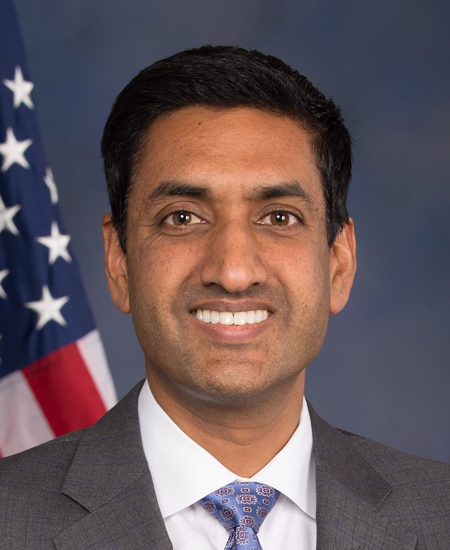
Rep. Ro Khanna
Sponsored bills
Maddy summaryHCONRES 50 is a symbolic resolution recognizing the yellow flag with three red stripes - formerly the flag of the Republic of Vietnam (1949-1975) - as a symbol for the Vietnamese-American community in the U.S. It affirms the flag's meaning to over 1.5 million Vietnamese Americans who fled after 1975, representing shared sacrifices with U.S. forces during the Vietnam War and their ongoing commitment to democratic values. The resolution does not create legal obligations or policy changes; it solely serves to acknowledge this flag as a unifying emblem for the community. This is a procedural recognition, not a legislative act with concrete policy effects.
Maddy summaryThis resolution condemns the use of federal regulatory agencies (like the FCC) or lawsuits to suppress lawful speech critical of political parties or the President, specifically referencing concerns about tactics mirroring authoritarian practices. It does not create new laws but formally warns that such actions undermine First Amendment protections and democratic norms. The resolution directly affects media organizations, journalists, and public discourse by calling on government agencies to avoid using their power for political retaliation. It reaffirms the House’s commitment to protecting free expression and urges officials to refrain from pressuring media to silence criticism.
Maddy summaryThis bill freezes U.S. import tariffs on coffee products at their existing rate as of January 19, 2025, preventing any future increases. It directly affects businesses importing coffee into the United States, including roasted beans, coffee husks, and coffee-based substitutes, from countries with normal trade relations. The law ensures tariffs on these items cannot exceed the current baseline, regardless of new trade policies or emergency situations. This creates certainty for importers by maintaining the status quo for coffee-related tariffs.
Maddy summaryThe HEADACHE Act establishes a National Headache Disorders Initiative (NHDI) under the Department of Health and Human Services to address conditions like migraines, cluster headaches, and other headache disorders affecting vulnerable groups including children, pregnant women, and older adults. It creates an Advisory Council with patient advocates, healthcare providers, and federal agency representatives to guide research, improve diagnosis protocols, and reduce disparities in care. The bill requires federal agencies to share headache-related data and mandates an annual congressional report evaluating progress, disparities across demographics, and recommendations for better access to treatment and stigma reduction, with the initiative set to expire after five years.
Maddy summaryHRES 746 is a non-binding resolution passed by the U.S. House of Representatives condemning all political violence - including attacks on elected officials, candidates, and public figures - and rejecting rhetoric that dehumanizes opponents. It specifically urges law enforcement to investigate and prosecute such violence, calls on public officials and media to avoid inflammatory language, and references recent incidents like the 2025 assassination of activist Charlie Kirk and targeted shootings of Minnesota legislators. The resolution does not create new laws but formally expresses the House’s commitment to protecting public servants and promoting peaceful political discourse. It directly affects the House’s public stance and serves as a call to action for officials, media, and communities to foster civil engagement.
Maddy summaryThe Tyler Clementi Higher Education Anti-Harassment Act of 2025 requires U.S. colleges and universities participating in federal financial aid programs to create and distribute clear anti-harassment policies covering harassment based on race, color, national origin, sex (including sexual orientation and gender identity), disability, or religion. These policies must explicitly prohibit harassment in all settings - including online, on campus, off-campus housing, and during school-sponsored activities - and outline reporting procedures and support services for victims. The bill also establishes a $50 million annual grant program to fund schools developing prevention programs, victim support services, or staff/student training on recognizing and addressing harassment. Grants are competitive, require annual reporting on effectiveness, and must be used to improve existing efforts without replacing existing civil rights laws like Title IX.
Maddy summaryThe Redistricting Reform Act of 2025 requires states to use independent redistricting commissions for congressional redistricting, banning partisan gerrymandering and requiring plans to comply with constitutional and Voting Rights Act standards. The bill establishes ranked criteria for redistricting, prioritizing population equality, voting rights protections, and community preservation over partisan advantage. It mandates multi-partisan commission composition with public input and transparency requirements, with states facing court-developed plans if they miss deadlines. The law would apply to redistricting after the 2030 census, affecting all 50 states' congressional district maps.
Maddy summaryHJRES 123 is a congressional disapproval resolution targeting a specific rule by the Centers for Medicare & Medicaid Services (CMS). It seeks to nullify CMS's June 2025 rule titled "Patient Protection and Affordable Care Act; Marketplace Integrity and Affordability," which was published in the Federal Register (90 Fed. Reg. 27074). If passed, the resolution would block this rule from taking effect under procedures outlined in Title 5, U.S. Code. The bill directly affects the CMS regulation governing the Affordable Care Act's health insurance marketplace, not the broader law itself.
Maddy summaryThe POP Act (HR 5433) prohibits any entity from owning both a Medicare-focused health insurance company and certain healthcare providers (like clinics or outpatient facilities, excluding hospitals, pharmacies, and durable medical equipment suppliers). It requires violators to divest one business within 1-2 years of the law's enactment or acquisition. The Federal Trade Commission and state attorneys general can enforce this through civil actions, including ordering divestment and recovering revenue from violations. The law also updates Medicare rules to ban such ownership for Medicare Advantage plans starting in 2026, treating violations as false claims. This directly affects health insurers and provider networks operating under Medicare.