

Maddy summaryThis bill restores access to VA housing loans and educational benefits for Black World War II veterans who were denied GI Bill benefits due to racial discrimination, as well as for their living spouses, children, grandchildren, or direct descendants. It defines eligibility by requiring applicants to certify that their veteran relative was denied GI Bill benefits on racial grounds, with a five-year application window starting from the bill's enactment date. The VA must process these applications within 90 days and report to Congress on the number of recipients and total benefit value within one year. This addresses historical discrimination by creating new pathways to benefits for affected individuals and their families.
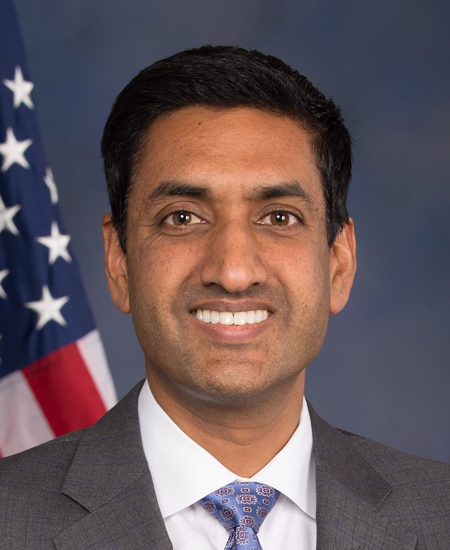
Rep. Ro Khanna
Sponsored bills
Maddy summaryHR 1723, the Abortion is Health Care Everywhere Act of 2023, amends the Foreign Assistance Act to remove restrictions on using U.S. foreign aid funds for abortion services. It explicitly allows U.S. foreign assistance programs to fund comprehensive reproductive health care, including abortion services, training, and equipment. This change directly affects U.S. international health programs and recipient countries, enabling them to integrate safe abortion care into broader reproductive health services. The bill aims to align U.S. policy with global health guidelines by making abortion services a standard part of reproductive health care funded through foreign assistance.
Maddy summaryThis bill modifies federal highway funding rules to prioritize safety for cyclists and pedestrians. It allows states and local governments to receive 100% federal funding for projects that connect existing bike/pedestrian infrastructure or reduce safety risks for these users, instead of the usual lower federal share. The bill also requires projects to align with state safety plans focusing on vulnerable road users and includes specific "Proven Safety Countermeasures" for cyclists/pedestrians. These changes directly affect states administering federal highway funds and local governments seeking to improve non-motorized transportation infrastructure.
Maddy summaryHR 1396 expands Berryessa Snow Mountain National Monument by adding approximately 3,925 acres of federal land in Lake County, California (known as the Walker Ridge/Molok Luyuk Addition), directly affecting land management in that area. The bill modifies the monument's boundary to include this parcel, formally designates it as "Condor Ridge (Molok Luyuk)" (using the Patwin language), and requires the Secretary of the Interior to develop a joint management plan with the Secretary of Agriculture within one year of enactment. This plan must include consultation with affected federally recognized tribes and establish ongoing engagement with tribes for monument management. The bill also mandates public availability of updated maps and legal descriptions for the newly designated area.
Maddy summaryThe Food Deserts Act creates a federal grant program to help establish grocery stores in underserved communities by funding state revolving funds. States receive capitalization grants (up to $150 million for FY2022) to provide low-interest loans to grocery stores that meet specific criteria, such as selling unprocessed, affordable healthy foods and matching 20% of the loan with non-federal funds. Priority is given to stores hiring local workers, offering nutrition education, sourcing from local farms, and having established supply chains. The program directly supports grocery store operators in areas with limited access to fresh food, aiming to improve community health outcomes through increased access to nutritious options.
California Clean Coast Act of 2023 This bill prohibits oil and gas exploration and leasing in areas of the outer Continental Shelf located off the coast of California.
Maddy summaryThe TRACK Act of 2023 requires federal agencies (including HHS, NIH, Defense, and Veterans Affairs) to create a public database tracking all government funding for biomedical research and development. It compiles specific details about contracts, grants, licensing agreements, and tax benefits related to drug, device, and therapy development - including funding amounts, recipient organizations, product names/prices, and patent information. The database must be searchable by the public within one month of the bill’s enactment and updated every two weeks. This directly affects federal agencies managing biomedical funding and the private companies, institutions, and researchers receiving that support. The goal is to increase transparency about how taxpayer dollars fund medical product development.
Maddy summaryHCONRES 23 is a non-binding resolution expressing Congress's support for recognizing March 10, 2023, as "Abortion Provider Appreciation Day." It honors abortion providers and clinic staff for delivering essential reproductive healthcare amid increased restrictions following the Supreme Court's Dobbs decision, which overturned Roe v. Wade. The resolution condemns the Dobbs ruling, affirms Congress's commitment to protecting providers' safety, and emphasizes ensuring access to abortion care. As a symbolic gesture, it does not create new laws or change existing policies.
Maddy summaryHR 1654, the DEPOSIT Act, imposes a new tax on certain bank executives' bonuses and stock profits when their bank fails and the FDIC becomes conservator or receiver. It specifically targets executives who earned over $250,000 (adjusted for excluded profits) in the year before their bank's failure and received bonuses within 60 days prior to the FDIC takeover or sold bank stock within that same period. The tax adds 90% of bonus profits and 100% of stock profit amounts to the executive's regular income tax. All revenue generated from this tax will be directed to the Deposit Insurance Fund, which protects bank deposits.
Maddy summaryThis bill creates a new definition for "currently accepted medical use with severe restrictions" under the Controlled Substances Act, specifically for certain investigational drugs. It applies to drugs designated as breakthrough therapies by the FDA or authorized for expanded patient access under specific emergency protocols for serious diseases with no other treatment options. The definition excludes drugs that are already fully approved under standard FDA pathways or that lose their expanded access status. If a drug no longer meets these strict criteria, the Attorney General must reclassify it into the highest restriction category (Schedule I) within 90 days of notification from the Health Secretary. This changes how certain experimental treatments are classified under federal drug laws.