

Maddy summaryThis bill requires the Department of Homeland Security to develop a strategy addressing untraceable firearms (ghost guns), defined as privately made or modified weapons lacking serial numbers. It mandates DHS agencies to produce annual threat reports on ghost gun use in terrorism, analyze cross-border smuggling patterns (especially U.S. firearms recovered in Mexico), and track airport security violations involving such weapons. The law also directs the Secret Service to research prevention methods and requires the Transportation Security Administration to report on firearm violations at checkpoints. These provisions focus on improving interagency coordination and data collection on ghost gun threats, without changing gun ownership laws.
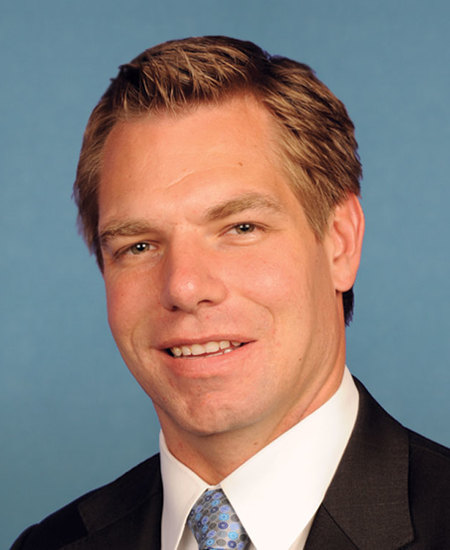
Rep. Eric Swalwell
Sponsored bills
Maddy summaryHR 5483 establishes a Water Infrastructure and Drought Solutions Fund that will provide $750 million annually from 2032-2062 for water storage, reclamation, and reuse projects in Western states. The bill directs 50% of these funds to new water storage projects (with federal funding capped at 50% of project costs), 25% to water reclamation projects, and 25% to WaterSMART grants. It requires the Secretary of the Interior to evaluate groundwater storage opportunities in Western states, particularly in critically overdrafted basins, and creates a pilot program to provide financial assistance for water infrastructure projects in eligible states. The bill also increases funding for water recycling projects from $50 million to $500 million annually through 2027.
Maddy summaryThe Jumpstart on College Act creates federal grant programs to expand early college high schools and dual enrollment programs, aiming to help more students earn postsecondary credentials within the normal timeframe. It authorizes $250 million annually for 6 years, with 40% of funds going directly to college-high school partnerships and 55% to states for statewide support. The grants require matching funds from recipients and mandate specific uses, such as creating college-aligned curricula, providing professional development for teachers, and ensuring students from underrepresented groups can access these programs without paying tuition for college courses. The bill also requires detailed reporting on student outcomes, including graduation rates and credential completion by demographic groups.
Maddy summaryHRES 682 is a symbolic resolution designating the week beginning September 11, 2023, as "National Hispanic-Serving Institutions Week." It does not create new programs or funding but formally recognizes Hispanic-Serving Institutions (HSIs) for their role in educating Hispanic students and underserved communities. The resolution calls for the public to observe the week with ceremonies during Hispanic Heritage Month, highlighting HSIs' contributions to higher education access and economic mobility. This resolution affects no specific entities or policies, as it is purely commemorative.
Maddy summaryHR 3152, the "Fight CRIME Act," aims to maintain international restrictions on Iran's missile-related activities by requiring diplomatic efforts to extend these restrictions before they expire in October 2023. The bill mandates annual reports detailing U.S. diplomatic strategies, potential impacts of expiration, and measures to deter missile technology transfers to Iran. It establishes sanctions against foreign individuals or entities that knowingly support Iran's missile or drone programs, including asset freezes and visa restrictions. These sanctions apply regardless of whether UN restrictions remain in effect after their expiration, directly affecting foreign entities involved in these activities.
Maddy summaryHR 5419, the Direct Seller and Real Estate Agent Harmonization Act, amends the Fair Labor Standards Act to exclude direct sellers (like door-to-door sales representatives) and qualified real estate agents from the federal definition of "employee." This change means these workers would no longer be automatically covered by federal minimum wage and overtime protections under the Fair Labor Standards Act. The bill directly affects individuals working in these specific roles by altering their legal classification under labor law. The key provision is a new definition inserted into existing law, aligning labor classification with existing tax code definitions for these professions.
Maddy summaryHR 5351, the Nationwide Right to Unionize Act, repeals a federal law (Section 14(b) of the National Labor Relations Act) that currently allows states to enact "right-to-work" laws. This would prevent states from banning agreements requiring workers to pay union dues as a condition of employment, directly affecting workers in states with such laws. The bill's key mechanism is overriding state right-to-work statutes with federal law, ensuring union security agreements remain enforceable nationwide.
Maddy summaryThis bill allows the President to declare a "smoke emergency" when wildfire smoke causes a significant drop in air quality across one or more states, following a request from a state governor. If declared, the federal government (via FEMA and other agencies) can provide direct assistance to affected states and communities, including grants for smoke shelters, air purifiers, and air monitoring equipment. It also authorizes the Small Business Administration to offer grants to small businesses that suffer significant revenue loss due to the smoke emergency. The bill includes a budget provision ensuring funds for this assistance won't count toward deficit reduction targets.
Maddy summaryHR 5322, the Time Off to Vote Act, requires most private employers (with 25+ employees) to provide two consecutive hours of paid leave for employees to vote in federal elections. Employers must grant this leave upon request, can schedule it during early voting periods if permitted by state law, and cannot include lunch breaks in the leave period. The bill prohibits retaliation against employees who take this leave and ensures it does not affect accrued employment benefits. Violations could result in civil penalties up to $10,000 per offense, enforced by the Department of Labor.
Maddy summaryThis bill amends two sections of federal law to strengthen penalties for election interference by government officials. It expands the scope of criminal provisions to explicitly include the President, Vice President, and other executive branch employees (previously limited to lower-level staff), and increases the maximum prison sentence for violations from one year to three years. The changes specifically target actions like coercing political activity or interfering with elections through official authority. These amendments directly affect federal employees, particularly high-level officials in the executive branch, by making certain election-related misconduct criminal offenses with steeper penalties. The bill focuses on clarifying and broadening existing legal protections against election interference by government actors.