Protecting Communities from Plastics Act This bill sets forth a variety of requirements and incentives to reduce the production and use of plastics and other petrochemicals, including by directing the Environmental Protection Agency to place a temporary pause on certain new permits for petrochemical facilities under the Clean Air Act and the Clean Water Act.
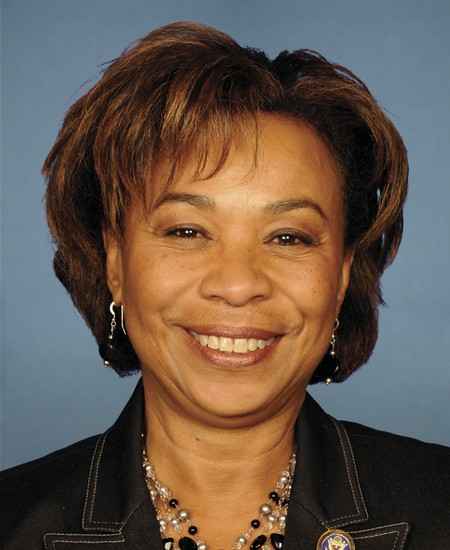
Rep. Barbara Lee
Sponsored bills
Medical Marijuana and Cannabidiol Research Expansion Act This act establishes a new, separate registration process to facilitate research on marijuana. Specifically, the act directs the Drug Enforcement Administration (DEA) to follow procedures specified in the act to register (1) practitioners to conduct marijuana research, and (2) manufacturers to supply marijuana for the research. The act allows certain registered entities (including institutions of higher education, practitioners, and manufacturers) to manufacture, distribute, dispense, or possess marijuana or cannabidiol (CBD) for the purposes of medical research. Additionally, the act directs the DEA to register manufacturers and distributors of CBD or marijuana for the purpose of commercial production of an approved drug that contains marijuana or its derivative. Finally, the act includes various other provisions, including provisions that require the DEA to assess whether there is an adequate and uninterrupted supply of marijuana for research purposes; prohibit the Department of Health and Human Services (HHS) from reinstating the interdisciplinary review process for marijuana research; allow physicians to discuss the potential harms and benefits of marijuana and its derivatives (including CBD) with patients; and require HHS, in coordination with the National Institutes of Health and relevant federal agencies, to report on the therapeutic potential of marijuana for various conditions such as epilepsy, as well as the impact on adolescent brains and on the ability to operate a motor vehicle.

This resolution encourages people around the world to work to achieve the goal of zero new HIV transmissions, zero discrimination, and zero AIDS-related deaths, in order to end the HIV epidemic in the United States and around the world by 2030. The resolution supports continued funding for prevention, care and treatment services, and research programs for communities impacted by HIV and people living with HIV in the United States and globally. The resolution supports continued leadership by the United States in domestic, bilateral, multilateral, and private sector efforts to fight HIV. Finally, the resolution urges other members of the international community to sustain and scale up their support for and financial contributions to efforts around the world to combat HIV.
Maddy summaryHRES 1506 is a symbolic House resolution expressing support for continued government and private investment to develop an HIV vaccine. It does not create new funding or policy but encourages ongoing efforts to complete vaccine development, directly affecting public health advocates, researchers, and organizations working on HIV prevention. The resolution cites statistics on HIV disparities (e.g., Black Americans having 8.1x higher infection rates than White Americans) and current vaccine trials to underscore the need for sustained investment. It references existing U.S. funding for HIV/AIDS programs ($7.4 billion in FY2022) and emphasizes the potential public health benefits of a vaccine. The resolution serves as a statement of congressional encouragement, not a binding policy change.
This resolution condemns Iran's state-sponsored persecution of its Baha'i minority and its continued violation of the international covenants on human rights. Further, it calls on Iran to immediately release all imprisoned or detained Baha'is, and it urges the President and the Department of State to impose sanctions on Iranian officials and others who are responsible for serious human rights abuses, including abuses against Iran's Baha'i community.
Stop Corporate Capture Act This bill modifies the process for federal agency rulemaking. Specifically, it (1) requires interested parties who submit a study or research as part of a comment to a proposed rule to disclose the source of the funding for the study or research, (2) limits the use of the negotiated rulemaking process to government agencies, (3) provides statutory authority for the judicial principle that requires courts to defer to an agency's reasonable or permissible interpretation of a federal law when the law is silent or ambiguous (i.e., the Chevron doctrine), and (4) establishes an Office of the Public Advocate to support public participation in the rulemaking process.
Equity in STD Testing Act This bill provides for coverage, without cost-sharing, of testing for certain sexually transmitted diseases under Medicare Advantage, Medicaid, the Children's Health Insurance Program (CHIP), TRICARE, Department of Veterans Affairs health benefits, and the Indian Health Service.
Food Deserts Act This bill establishes a Department of Agriculture program to provide grants to states for revolving funds to support the establishment and operation of grocery stores in underserved communities. An underserved community is a community that has (1) limited access to affordable, healthy foods, including fresh fruits and vegetables, in grocery retail stores or farmer-to-consumer direct markets; and (2) a high rate of hunger or food insecurity or a high poverty rate. States must use the funds to make loans to support grocery stores in underserved communities, including for opening a store (excluding new construction), or supporting or purchasing an existing store. States may only make loans for grocery stores that meet requirements related to emphasizing unprocessed, healthful foods; providing staple foods and a variety of raw fruits and vegetables; having a plan to keep the foods in stock; charging affordable prices at or below market averages; meeting specified matching requirements using nonfederal funds; and being qualified to operate a store or having partnerships with organizations that provide technical assistance. States must prioritize loan applications from entities that meet criteria related to hiring workers from the underserved community, providing classes or educational information about a healthful diet, sourcing food from local urban farms and gardens, or demonstrating existing supply chain relationships or expertise in the grocery industry.
Designates the facility of the United States Postal Service located at 1663 East Date Place in San Bernardino, California, as the "Dr. Margaret B. Hill Post Office Building."
Designates the facility of the United States Postal Service located at 4770 Eureka Ave in Yorba Linda, California, as the "Cottle Centanni Post Office Building."