

Working for Immigrant Safety and Empowerment Act of 2022 or the WISE Act of 2022 This bill addresses immigration-related issues for victims of domestic violence and other crimes. For example, the bill (1) extends the period of admission into the United States for certain spouses or children who derive their immigration status from an individual who is abusing the spouse or child; and (2) establishes a presumption that an individual with certain pending applications, such as for a visa for a victim of human trafficking or certain other crimes, should be released from immigration detention without conditions.
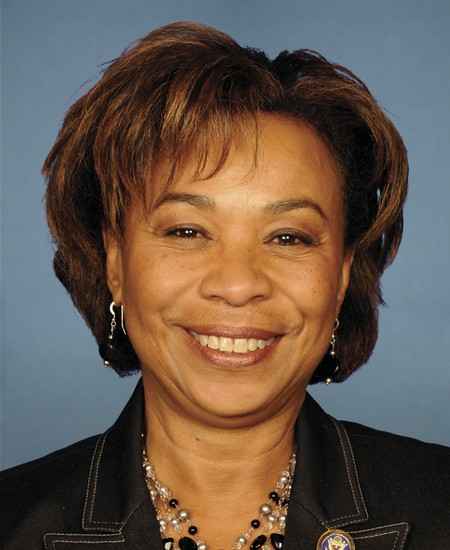
Rep. Barbara Lee
Sponsored bills
This resolution recognizes the anniversaries of the International Day of Peace, Human Solidarity Day, the International Day of Living Together in Peace, and other specified international days. The resolution also expresses that Congress commits to (1) encouraging the people of the United States to continue commemorating international days of peace, coexistence, and cooperation; and (2) supporting activities on such days that promote thoughtful, deliberative, and cooperative actions to achieve peace.
This concurrent resolution commends the bravery, courage, and resolve of the women and men of Iran who are (1) participating in the current protests to defend their fundamental human rights, and (2) risking their safety to speak out against the human rights abuses committed by the Iranian regime. The resolution condemns (1) the brutal beating and death of Mahsa Amini; and (2) the violent suppression by the Iranian regime of women and men participating in the current demonstrations, including children, and calls for transparent accountability for all killings of protesters by Iranian security forces. Finally, the resolution encourages continued efforts by the Biden Administration to respond to the protests, including the recent sanctioning of the Iranian morality police.
Veteran Service Recognition Act of 2022 This bill addresses immigration-related issues pertaining to noncitizen (or non-U.S. national) military veterans, including by authorizing the Department of Homeland Security (DHS) to provide lawful permanent resident status to a veteran subject to removal. If a noncitizen veteran appears to be eligible for lawful permanent resident status under this bill, that veteran must receive a reasonable opportunity to apply for such status and may not be removed until there is a final administrative decision on the veteran's eligibility. For the purposes of providing such status under this bill, DHS may waive any applicable grounds of inadmissibility, except for certain crime- or security-related grounds. The bill also extends certain deadlines relating to obtaining citizenship after serving in the Armed Forces. DHS must create a system for identifying noncitizens who are or may be veterans. Before initiating removal proceedings against a noncitizen, DHS must attempt to determine whether the noncitizen is a veteran. DHS must ensure that veteran status is considered in immigration proceedings. The bill also requires U.S. Citizenship and Immigration Services (USCIS) and the Department of Defense to take certain actions to facilitate opportunities for military recruits and veterans to obtain U.S. citizenship, such as by training Judge Advocate General Corps members to act as liaisons between the Armed Forces and USCIS on servicemember citizenship applications. The bill also establishes the Military Family Immigration Advisory Committee to provide recommendations on cases involving the removal of a servicemember, veteran, or certain family members of a servicemember or veteran. Such an individual may not be removed until the committee has provided a recommendation to DHS about the individual's case, unless the individual is inadmissible due to a conviction for an aggravated felony. The bill also waives certain grounds of inadmissibility (e.g., being unlawfully present in the United States) for certain noncitizens applying for lawful permanent resident status as an immediate relative of a U.S. citizen who has served at least two years in the Armed Forces.
Climate Adaptation Science Centers Act or the CASC Act This bill provides statutory authority for the Department of the Interior's National and Regional Climate Adaptation Science Centers. The centers must provide scientific expertise to managers of natural resources, cultural resources, and ecosystem services to inform decisions that aid adaptation to a changing climate and extreme weather events. The program shall include a National Climate Adaptation Science Center and Regional Climate Adaptation Science Centers. Among its activities, the National Center shall serve as the national office for the regional centers, develop and facilitate coordination among the regional centers, and conduct research on cross-regional and national science priorities. Regional centers shall develop research, education, training, and advisory service priorities regarding the impacts of climate trends and variability on natural and cultural resource management. Interior shall establish an Advisory Committee on Climate and Natural Resource Sciences to advise the National and Regional Climate Adaptation Science Centers on specified matters, including (1) the contents of a national strategy identifying key climate adaptation science priorities to advance the management of natural and cultural resources in the face of climate change; and (2) the integration of equity, particularly for historically underserved communities, in the operation of the National Center and regional centers.
Truth and Healing Commission on Indian Boarding School Policies Act This bill establishes the Truth and Healing Commission on Indian Boarding School Policies in the United States and sets forth its powers, duties, and membership. Among other duties, the commission must investigate the impacts and ongoing effects of the Indian Boarding School Policies (federal policies under which American Indian, Alaska Native, and Native Hawaiian children were forcibly removed from their family homes and placed in boarding schools). Further, the commission must develop recommendations on ways to (1) protect unmarked graves and accompanying land protections; (2) support repatriation and identify the tribal nations from which children were taken; and (3) discontinue the removal of American Indian, Alaska Native, and Native Hawaiian children from their families and tribal communities by state social service departments, foster care agencies, and adoption agencies.
Save Oak Flat Act This bill repeals the requirement for the Department of Agriculture to convey the 2,422 acres of Forest System land located in Tonto National Forest in Pinal County, Arizona, known as Oak Flat, to Resolution Copper Mining, LLC, in exchange for various parcels of land owned by Resolution Copper. Oak Flat is withdrawn from (1) entry, appropriation, or disposal under the public land laws; (2) location, entry, and patent under the mining laws; and (3) disposition under all laws pertaining to mineral and geothermal leasing or mineral materials.
Identifying Mass Shooters Act This bill requires the National Institute of Justice (NIJ) to report to Congress on the content patterns used by mass shooters through online platforms and social media channels. Additionally, the bill directs the NIJ to identify items for further study that are identified in the report. Finally, the bill requires the NIJ to submit findings and federal legislative recommendations to Congress.
Designates the facility of the United States Postal Service located at 6444 San Fernando Road in Glendale, California, as the "Paul Ignatius Post Office."
Pregnant Women in Custody Act This bill establishes requirements to address the health needs of incarcerated women related to pregnancy and childbirth. The bill requires the Bureau of Justice Statistics to collect data on the health needs of incarcerated pregnant women at the federal, state, tribal, and local levels. With respect to incarcerated women at the federal level, the bill requires the Bureau of Prisons (BOP) to provide appropriate services and programs to address the health and safety needs related to pregnancy and childbirth, as well as appropriate health care to a woman with a high-risk pregnancy; limits the use of restrictive housing for prisoners who are pregnant or in postpartum recovery; and requires the BOP to report annually on the number of administrative claims and appeals filed by pregnant inmates. With respect to incarcerated women at the state and local levels, the bill requires the Government Accountability Office to study the services and protections for pregnant incarcerated women in state and local correctional settings.