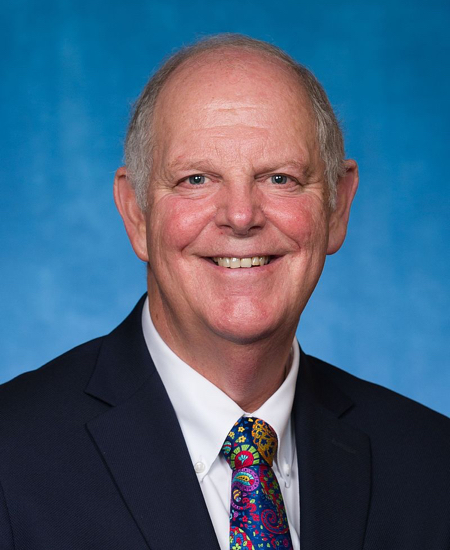
Photo of Tom O’Halleran
D United States House · District 1 · Arizona

Rep. Tom O’Halleran

Compare
Total votes
958
all sessions
Attendance
99%
12 missed
Near the chamber average
With party
97%
of cast votes
Near the chamber average
Bipartisan score
1%
crosses aisle rarely
Near the chamber average
Sponsored
513
bills & resolutions
Near the chamber average
Committees
0
assignments
513 bills and resolutions

Sponsored bills

Total
513
Primary
55
Co-sponsor
458
This page
513
matching current filters
Primary HR 8988
In committee · United States House · Lead sponsor
EPCS 2.0 Act

Electronic Prescribing for Controlled Substances Act or the EPCS 2.0 Act This bill generally requires health insurance plans to establish policies requiring in-network providers to transmit prescriptions for controlled substances to pharmacies electronically.

In committee Sep 27, 2022 0 co-sponsors
Co-sponsor HR 8989
In committee · United States House · Co-sponsor
Buy Low and Sell High Act

Buy Low and Sell High Act This bill revises requirements concerning the Strategic Petroleum Reserve (SPR), establishes an Economic Petroleum Reserve, creates a national network of Strategic Refined Petroleum Product Reserves, increases the size of the Northeast Home Heating Oil Reserve, limits the sale and exportation of petroleum products, and sets forth provisions to reduce the demand for petroleum fuel and increase fuel supply. Specifically, the bill directs the Department of Energy (DOE) to establish within the SPR an Economic Petroleum Reserve of up to 350 million barrels of crude oil. DOE may acquire crude oil from domestic producers at low prices and then sell the oil when the prices are high as specified by the bill. DOE must also establish a national network of Strategic Refined Petroleum Product Reserves to store up to 250 million barrels of gasoline and diesel fuel, which may be sold when there is a severe fuel supply interruption within the district in which the reserve is located. In addition, the bill increases the cap on the amount of barrels of petroleum distillate that may be stored in the Northeast Home Heating Oil Reserve from two million to four million. It also establishes limits on the sale and exportation of petroleum products from such reserves. For example, the bill prohibits the sale or export of fuel from the reserves to (1) China, North Korea, Russia, or Iran; (2) any other country under U.S. sanctions; or (3) any entity owned, controlled, or influenced by one of those countries or the Chinese Communist Party. However, DOE may issue a waiver of the prohibition if it is in the national security interests of the United States to allow such a sale or export. Finally, the bill establishes requirements and incentives to reduce fuel demand and increase fuel supply, including by (1) providing financial assistance for projects to electrify the transportation sector, (2) setting requirements concerning the minimum percentage of federal vehicles that must be zero-emission vehicles, and (3) directing DOE to establish a program to increase the amount of crude oil refined in oil refineries in certain countries in the Western Hemisphere.


In committee Sep 27, 2022 1 co-sponsor
Co-sponsor HR 6434
Passed · United States House · Co-sponsor
Japanese American World War II History Network Act

Japanese American World War II History Network Act This bill directs the Department of the Interior to establish the Japanese American World War II History Network within the National Park Service. In carrying out the network, Interior shall review studies and reports to complement and not duplicate studies of Japanese American World War II history and Japanese American experiences during World War II, including studies related to relocation centers and confinement sites; and produce and disseminate appropriate educational materials, such as handbooks, maps, interpretive guides, or electronic information relating to Japanese American World War II history and Japanese American experiences during that war.

Passed Sep 27, 2022 1 co-sponsor
Co-sponsor HR 6448
Passed · United States House · Co-sponsor
Invest to Protect Act of 2022

Invest to Protect Act of 2022 This bill directs the Office of Community Oriented Policing Services within the Department of Justice to award grants to local and tribal governments that employ fewer than 125 law enforcement officers. Grant funds may be used for various activities, including to provide de-escalation training and improve recruitment and retention.

Passed Sep 27, 2022 1 co-sponsor
Co-sponsor HR 5768
Passed · United States House · Co-sponsor
VICTIM Act of 2022

Violent Incident Clearance and Technological Investigative Methods Act of 2022 or VICTIM Act of 2022 This bill directs the Department of Justice to establish a grant program for state, tribal, or local law enforcement agencies or prosecuting offices (or groups of tribal agencies or offices) to establish, implement, and administer violent incident clearance and technological investigative methods.

Passed Sep 27, 2022 1 co-sponsor
Co-sponsor HR 4118
Passed · United States House · Co-sponsor
Break the Cycle of Violence Act

Break the Cycle of Violence Act This bill establishes federal grant programs and related entities to support violence intervention initiatives. Specifically, the bill directs the Department of Health and Human Services (HHS) to award grants for coordinated community violence intervention initiatives in communities disproportionately impacted by homicides and community violence. HHS must also establish several related entities, including an Office of Community Violence Intervention to administer programs and activities related to violence intervention; the Community Violence Intervention Advisory Committee to advise and assist the office and HHS; and the National Community Violence Response Center to provide training and technical assistance, coordinate research, and develop data collection policies. Additionally, the bill directs the Department of Labor to award grants for job training and workforce programs in communities disproportionately affected by gun violence to connect youth ages 16 to 24 to in-demand occupations.

Passed Sep 27, 2022 1 co-sponsor
Co-sponsor HRES 1386
In committee · United States House · Co-sponsor
Supporting the designation of the week of September 26 through September 30, 2022, as "National Clean Energy Week".

Maddy summaryHRES 1386 is a non-binding resolution designating the week of September 26-30, 2022, as "National Clean Energy Week." It expresses the House’s support for this designation and encourages individuals, organizations, and governments to promote clean energy solutions. The resolution highlights clean energy’s economic benefits (like supporting 7.8 million jobs in 2021) and urges investment in affordable, low-emission energy technologies. It does not create new laws, funding, or obligations - it is purely symbolic recognition of the clean energy sector’s role in the U.S. economy.

In committee Sep 23, 2022 1 co-sponsor
Co-sponsor HRES 1383
In committee · United States House · Co-sponsor
Expressing support for the designation of September 2022 as "National Workforce Development Month".

Maddy summaryHRES 1383 is a symbolic House resolution designating September 2022 as "National Workforce Development Month." It expresses congressional support for workforce development initiatives but does not create new laws or allocate funding. The resolution acknowledges the importance of programs that train workers for jobs requiring postsecondary education (like community college or apprenticeships) and highlights challenges such as high unemployment among Black and Hispanic workers and pandemic job losses. It directly affects no specific group, as it is a non-binding expression of support for existing federal workforce programs like the Workforce Innovation and Opportunity Act.

In committee Sep 22, 2022 1 co-sponsor
Co-sponsor HR 82
In committee · United States House · Co-sponsor
Social Security Fairness Act of 2021

Social Security Fairness Act of 2021 This bill repeals provisions that reduce Social Security benefits for individuals who receive other benefits, such as a pension from a state or local government. The bill eliminates the government pension offset , which in various instances reduces Social Security benefits for spouses, widows, and widowers who also receive government pensions of their own. The bill also eliminates the windfall elimination provision , which in some instances reduces Social Security benefits for individuals who also receive a pension or disability benefit from an employer that did not withhold Social Security taxes. These changes are effective for benefits payable after December 2021.

In committee Sep 21, 2022 1 co-sponsor
Showing 71 to 80 of 513 bills
Previous 1 … 7 8 9 … 52 Next