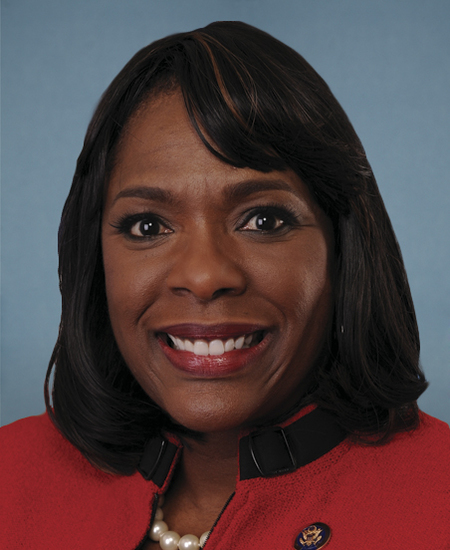
Photo of Terri A. Sewell
D United States House · District 7 · Alabama On the 2026 ballot

Rep. Terri A. Sewell

Compare
Total votes
2,837
all sessions
Attendance
96%
107 missed
Near the chamber average
With party
98%
of cast votes
Near the chamber average
Bipartisan score
1%
crosses aisle rarely
Near the chamber average
Sponsored
1,741
bills & resolutions
Higher than 88% of chamber peers
Committees
7
assignments
1,741 bills and resolutions

Sponsored bills

Total
1,741
Primary
64
Co-sponsor
1,677
This page
1,741
matching current filters
Co-sponsor HR 9842
In committee · United States House · Co-sponsor
RCORP Authorization Act

Maddy summaryThe RCORP Authorization Act (HR 9842) authorizes $165 million annually from 2024 to 2028 to fund the Rural Communities Opioid Response Program. It provides federal grants to states, tribes, rural health offices, and other eligible entities to expand opioid prevention, treatment, and recovery services in rural communities. Funds can be used for planning, evidence-based service delivery, technical assistance, and addressing emerging public health issues, but cannot purchase or improve real property. This program directly supports rural areas facing substance use disorders by strengthening local health services through targeted federal funding.

In committee Sep 25, 2024 1 co-sponsor
Co-sponsor HCONRES 130
In committee · United States House · Co-sponsor
Commending State and local governments for championing reproductive rights as human rights.

Maddy summaryHCONRES 130 is a symbolic concurrent resolution commending state and local governments that treat reproductive rights as human rights following the *Dobbs* decision. It recognizes efforts by cities like Austin, Texas, and Montgomery County, Maryland, to expand abortion access and condemn criminalization of pregnancy outcomes. The resolution affirms that reproductive rights are human rights, urges states to repeal restrictive laws, and references U.S. obligations under international human rights treaties. As a non-binding resolution, it does not create new laws or alter existing policies.

In committee Sep 24, 2024 1 co-sponsor
Co-sponsor HRES 1495
In committee · United States House · Co-sponsor
Expressing support for the designation of September 2024 as "Sickle Cell Disease Awareness Month" in order to educate communities across the United States about sickle cell disease and the need for research, early detection methods, effective treatments, and preventative care programs with respect to complications from sickle cell disease and conditions related to sickle cell disease.

Maddy summaryHRES 1495 designates September 2024 as "Sickle Cell Disease Awareness Month" to raise public education about sickle cell disease (SCD), which affects approximately 100,000 people in the U.S., predominantly in African American communities. The resolution urges the Department of Health and Human Services to address access barriers for SCD treatments in Medicare and Medicaid, calls for increased National Institutes of Health research funding, and proposes forming a federal interagency cabinet to coordinate SCD policy. It also encourages public events during September to highlight early detection, treatments, and preventative care for SCD complications. As a symbolic resolution, it does not create new laws but directs federal agencies to prioritize equitable access and research for SCD.

In committee Sep 24, 2024 1 co-sponsor
Co-sponsor HR 9782
In committee · United States House · Co-sponsor
Uterine Cancer Study Act of 2024

Maddy summaryHR 9782, the Uterine Cancer Study Act of 2024, directs the U.S. Department of Health and Human Services (HHS) to study whether hair straighteners - specifically chemical products - may be linked to uterine cancer, with a focus on higher rates among women of color. The study will review existing research, examine impacts across racial and ethnic groups, and break down results by product type (e.g., dyed, bleached, or permed straighteners). HHS must submit a study methodology within 45 days of the bill’s enactment and complete the study, reporting findings to Congress within two years. The bill does not impose new regulations but may inform future FDA safety requirements for hair straightening products. This affects women of color disproportionately impacted by uterine cancer and the broader population using such products.

In committee Sep 24, 2024 1 co-sponsor
Co-sponsor HR 5526
Passed · United States House · Co-sponsor
Seniors’ Access to Critical Medications Act of 2024

Maddy summaryThis bill clarifies Medicare rules to allow doctors to provide certain critical medications directly in their offices without extra administrative hurdles. It specifically amends a Medicare provision (Section 1877(b)(2) of the Social Security Act) to remove a requirement that drugs furnished in-office must follow specific administrative rules, effective May 11, 2023. The bill also directs the removal of conflicting Medicare guidance published in 2021 and 2023, which had previously restricted this practice. This change directly affects Medicare beneficiaries (seniors) and doctors' offices that supply covered medications during patient visits. It streamlines access to necessary drugs by eliminating an unnecessary barrier to in-office medication administration under Medicare.

Passed Sep 24, 2024 1 co-sponsor
Co-sponsor HR 3433
Passed · United States House · Co-sponsor
Give Kids a Chance Act of 2024

Maddy summaryHR 3433, the "Give Kids a Chance Act of 2024," requires pharmaceutical companies developing certain cancer drugs to conduct pediatric studies if the drugs target molecular pathways relevant to childhood cancers. It directly affects drug manufacturers submitting new applications for cancer treatments, particularly those combining previously approved adult cancer drugs or containing a single new active ingredient. The bill amends FDA regulations to mandate these pediatric investigations only when specific conditions are met, such as when a drug's molecular target is relevant to pediatric cancer growth. The FDA must issue implementing guidance within 12 months, and reports to Congress will track implementation and effectiveness starting 2 years after enactment.

Passed Sep 24, 2024 1 co-sponsor
Co-sponsor HR 9161
In committee · United States House · Co-sponsor
Health Equity and Accountability Act of 2024

Maddy summary# Summary of Health Equity and Accountability Act of 2024 This comprehensive legislation addresses multiple aspects of health care access, workforce development, and immigration policy with a strong focus on health equity. ## Key Themes 1. **Workforce Diversity**: Significant emphasis on increasing racial, ethnic, and socioeconomic diversity in the health care workforce 2. **Language Access**: Mandates for language access services for individuals with limited English proficiency 3. **Underserved Communities**: Targeted investments in medically underserved areas and communities 4. **Immigration Policy**: Modifications to programs that bring health care professionals to the U.S. ## Major Provisions ### Workforce Development - **$1 billion** for nursing education enhancement and modernization grants in underserved areas - **$552 million** for health professions workforce development in 2032 (increasing annually) - **$392 million** for health professions education programs in 2025 - New grants for schools of medicine and osteopathic medicine in underserved areas - Expansion of the Conrad State 30 program for foreign physicians to address physician shortages ### Language Access - Requires health care providers to provide language access services to individuals with limited English proficiency - Mandates translation services and interpretation services for all health care settings ### Diversity Initiatives - **David Satcher Public Health and Health Services Corps** to increase awareness of health career opportunities - **Louis Stokes Public Health Scholars Program** for underrepresented students - **Patsy Mink Health and Gender Research Fellowship Program** - **Paul David Wellstone International Health Fellowship Program** - **Edward R. Roybal Health Scholar Program** ### Immigration Policy - **Conrad State 30 program extension** through 2027 - **Physician retention** provisions to help foreign physicians stay in medically underserved areas - **Dual intent for physicians** seeking graduate medical training - **Clarifications to national interest waiver** requirements - **Automatic extension** of physician nonimmigrant status during residency transitions ### Funding - **Health Professions Workforce Fund** established with multi-year funding increasing from $392 million in 2025 to $552 million in 2032 - Specific allocations for nursing workforce development and health professions education This legislation represents a comprehensive approach to addressing health care disparities through workforce development, improved access, and policy changes to support a more diverse and equitable health care system.

In committee Sep 23, 2024 1 co-sponsor
Co-sponsor HR 9727
In committee · United States House · Co-sponsor
Voter Empowerment Act of 2024

Maddy summary# Summary of Voter Empowerment Act Legislation This comprehensive legislation, titled the "Voter Empowerment Act," aims to significantly reform election administration across the United States to increase voter access, improve election security, and ensure equitable treatment of all voters. Key provisions include: 1. **Voter Access Enhancements**: - Requires states to provide voter-verified paper ballots for all voters - Mandates secure drop boxes for absentee ballots with specific accessibility requirements - Prohibits restrictions on curbside voting - Requires states to notify voters of polling place changes at least 7 days before elections - Allows use of sworn written statements or student ID cards to meet voter ID requirements 2. **Special Populations Accommodations**: - Requires accommodations for voters residing on Indian lands, including designated ballot pickup locations - Mandates bilingual voting materials for covered jurisdictions - Provides special provisions for military and overseas voters - Requires institutions of higher education to serve as voter registration agencies 3. **Election Administration Improvements**: - Requires states to establish contingency plans for natural disasters and public health emergencies - Establishes minimum standards for polling place operations to prevent unreasonable waiting times - Mandates states to provide sufficient poll workers and voting systems - Requires states to participate in post-election surveys 4. **Enforcement Mechanisms**: - Creates private rights of action for individuals to challenge violations - Authorizes the Attorney General to bring civil actions for enforcement - Establishes clear timelines for addressing violations - Prohibits campaign activities by chief state election officials 5. **Implementation Timeline**: - Most provisions apply to the 2026 election cycle or later - Some provisions apply immediately upon enactment The legislation is designed to modernize election administration while ensuring accessibility and security, with specific provisions addressing the needs of historically marginalized voting populations and creating new enforcement mechanisms to hold states accountable for compliance.


In committee Sep 20, 2024 1 co-sponsor
Co-sponsor HR 9743
In committee · United States House · Co-sponsor
DEPLOY Tax Relief Act

Maddy summaryHR 9743, the DEPLOY Tax Relief Act, creates a new tax deduction for federal disaster relief workers. It directly affects workers certified by FEMA as traveling on temporary duty for federally declared disasters who are away from home for more than one year. The bill amends the tax code to allow these workers to deduct travel expenses incurred during such extended assignments. This provides a concrete tax benefit for their out-of-pocket costs while serving in long-term disaster response roles.

In committee Sep 20, 2024 1 co-sponsor
Co-sponsor HRES 1473
In committee · United States House · Co-sponsor
To condemn racism and bigotry towards Haitian people, to celebrate the vast contributions of people of Haitian descent to the United States, to condemn the spread of misinformation, and to call on Americans to affirm our shared humanity.

Maddy summaryHRES 1473 is a non-binding resolution passed by the U.S. House of Representatives that condemns racism, bigotry, and misinformation targeting Haitian people and their descendants. It celebrates the historical contributions of Haitian Americans to U.S. society, including founding cities (like Chicago via Jean Baptiste Point du Sable), advancing civil rights (W.E.B. Du Bois), and enriching healthcare, education, and culture. The resolution specifically calls on all Americans to reject racist tropes and misinformation, and urges elected officials to promote inclusivity and responsible communication. It was introduced in response to recent false claims that fueled threats against Haitian communities, such as the bomb threats in Springfield, Ohio.

In committee Sep 19, 2024 1 co-sponsor
Showing 721 to 730 of 1,741 bills
Previous 1 … 72 73 74 … 175 Next