

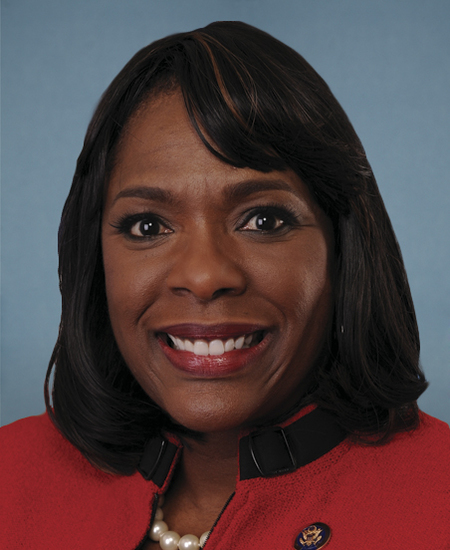
Photo of Terri A. Sewell
D United States House · District 7 · Alabama On the 2026 ballot

Rep. Terri A. Sewell

Compare
Total votes
2,837
all sessions
Attendance
96%
107 missed
Near the chamber average
With party
98%
of cast votes
Near the chamber average
Bipartisan score
1%
crosses aisle rarely
Near the chamber average
Sponsored
1,741
bills & resolutions
Higher than 88% of chamber peers
Committees
7
assignments
1,741 bills and resolutions

Sponsored bills

Total
1,741
Primary
64
Co-sponsor
1,677
This page
1,741
matching current filters
Co-sponsor HR 4534
Passed · United States House · Co-sponsor
Women and Lung Cancer Research and Preventive Services Act of 2024

Maddy summaryThis bill mandates an interagency review by the Department of Health and Human Services (with Defense and Veterans Affairs) to address lung cancer disparities affecting women. It requires a report evaluating research gaps, improving access to lung cancer screening (especially for underserved groups), and developing public awareness campaigns about early detection. The review will focus on factors like environmental exposures, genomic differences, and treatment responses specific to women, particularly those who never smoked. The report must be submitted to Congress within one year of enactment. This directly affects women at risk of lung cancer, including those with non-smoking-related cases.

Passed Dec 17, 2024 1 co-sponsor
Co-sponsor HR 4475
In committee · United States House · Co-sponsor
Period PROUD (Providing Resources for Our Underserved and Disadvantaged) Act of 2023

Maddy summaryHR 4475, the Period PROUD Act of 2023, allocates $1.9 billion over four years (2025-2028) through the Social Services Block Grant Program to provide free menstrual products to low-income menstruating individuals. It requires states to distribute funds to qualified nonprofits for direct product distribution, community outreach, and improving access, while limiting administrative costs to 9% of funds. The bill mandates an evaluation by 2030 to assess health impacts and requires annual reports on program effectiveness. It also establishes best practices for schools on discussing menstruation and exempts funding from automatic budget cuts.

In committee Dec 17, 2024 1 co-sponsor
Co-sponsor HR 4392
In committee · United States House · Co-sponsor
PrEP Access and Coverage Act of 2023

Maddy summaryThe PrEP Access and Coverage Act of 2023 requires private health insurance plans, Medicare, Medicaid, and other public health programs to cover pre-exposure prophylaxis (PrEP) for HIV prevention without cost-sharing, including the medication, related lab tests, and follow-up care. The bill also prohibits life, disability, and long-term care insurance companies from denying coverage or charging higher premiums to people taking PrEP. It establishes public education campaigns to increase awareness of PrEP and PEP (post-exposure prophylaxis) and creates funding for state and community programs to expand access to HIV prevention services, particularly for populations disproportionately affected by HIV including Black, Hispanic/Latinx, and transgender individuals. The legislation specifically addresses current disparities in PrEP access, as data shows only 11% of Black/African American and 21% of Hispanic/Latinx individuals eligible for PrEP received prescriptions in 2022 compared to 82% of White individuals. Coverage requirements for most plans will take effect on January 1, 2025.

In committee Dec 17, 2024 1 co-sponsor
Co-sponsor HR 4375
In committee · United States House · Co-sponsor
Survival Aid For Emergencies through Medicare Act

Maddy summaryThis bill adds Medicare coverage for "home resiliency services" to help vulnerable beneficiaries prepare for disasters. It covers medically necessary items like heat pumps for temperature-sensitive patients, solar batteries for medical equipment users (e.g., home ventilators), and energy-efficient cold storage for heat-sensitive medicines. Medicare will pay 100% of the cost for these services if the Secretary determines an individual is medically vulnerable during climate or manmade disasters, based on factors like chronic conditions, medical equipment reliance, and regional climate risks. It directly affects Medicare beneficiaries with chronic health needs who face heightened risks during extreme weather or infrastructure failures.

In committee Dec 17, 2024 1 co-sponsor
Co-sponsor HR 4315
In committee · United States House · Co-sponsor
Medicare Orthotics and Prosthetics Patient-Centered Care Act

Maddy summaryThis bill prohibits Medicare from paying for certain custom-fitted or custom-fabricated orthotic and prosthetic devices delivered via "drop shipment" (direct shipping without in-person training from a qualified provider). It directly affects Medicare beneficiaries who need these devices, ensuring they receive necessary in-person fitting and training. The bill also expands which healthcare professionals (including physical therapists, occupational therapists, orthotists, and prosthetists) can prescribe these devices and updates definitions to clarify terms like "orthoses" and "prostheses." Final regulations implementing these changes must be issued within one year of the bill's enactment.

In committee Dec 17, 2024 1 co-sponsor
Co-sponsor HR 4363
In committee · United States House · Co-sponsor
Comprehensive Cancer Survivorship Act

Maddy summaryThe Comprehensive Cancer Survivorship Act (HR 4363) establishes new Medicare and Medicaid coverage for cancer care planning and coordination services, requiring personalized survivorship care plans for cancer survivors from diagnosis through the end of life. The bill creates a demonstration program to test different models of survivorship care, including navigation services to help survivors transition from cancer treatment to ongoing care, and mandates Medicaid coverage for cancer fertility services. It also establishes a comprehensive cancer survivorship program with resource centers for survivors and health care providers, and includes provisions to help cancer survivors overcome employment barriers and improve their quality of life through physical activity and mental health support. The legislation specifically addresses disparities in care for racial/ethnic minorities, lower socioeconomic groups, and rural populations who face unique challenges as cancer survivors.

In committee Dec 17, 2024 1 co-sponsor
Co-sponsor HR 4276
In committee · United States House · Co-sponsor
American Worker and Trade Competitiveness Act

Maddy summary# Summary of Trade Legislation Document This is a comprehensive trade bill containing multiple sections that: 1. **Extends and modifies the Trade Adjustment Assistance (TAA) program** through 2030, with increased funding and expanded benefits for: - Workers (including child care, transportation, and mental health services) - Firms (with new eligibility criteria) - Communities (with strategic planning requirements) - Farmers (with new qualifying requirements) 2. **Increases health coverage tax credits** from 72.5% to 80% of premium costs for eligible individuals. 3. **Modifies and extends the Generalized System of Preferences (GSP)** through December 31, 2026, with new eligibility criteria including: - Human rights compliance - Environmental protection - Enforcement of labor rights - Review of laws relating to worker rights and equal protection 4. **Reauthorizes the American Manufacturing Competitiveness Act** through 2026, with new requirements for petitions including: - Certification that articles are not "finished goods" - Additional reporting requirements 5. **Provides new duty suspensions and reductions** for over 50 specific chemical and material products (sections 4101-4155), including: - Various chemicals (e.g., lithium hexafluorophosphate, potassium fluoride) - Specialty materials (e.g., scandium crystals, silica gel cat litter) - Food products (e.g., Irish dairy chocolate crumb, coconut water) - Industrial materials (e.g., tungsten concentrate, neodymium metal) The legislation includes detailed provisions for implementation, reporting requirements, and compliance reviews, with most provisions effective upon enactment and extending through 2030 for program funding.

In committee Dec 17, 2024 1 co-sponsor
Co-sponsor HR 4261
In committee · United States House · Co-sponsor
ARC Act of 2023

Maddy summaryThe ARC Act of 2023 establishes a national program to address peripheral artery disease (PAD), which disproportionately affects minority populations and leads to avoidable amputations. The bill requires Medicare and Medicaid to cover PAD screening tests (such as ankle-brachial index testing) for at-risk beneficiaries without cost-sharing, including people 65+ or those with diabetes, smoking history, or other risk factors. It authorizes $6 million annually for a CDC-led education program to inform healthcare providers and the public about PAD prevention and treatment. The bill also creates quality measures to encourage alternative treatments to amputation and establishes a pilot program to test amputation prevention services at healthcare facilities. These provisions aim to reduce amputation rates and improve outcomes for millions of Americans with PAD.

In committee Dec 17, 2024 1 co-sponsor
Co-sponsor HR 4260
In committee · United States House · Co-sponsor
Public Servants Protection and Fairness Act of 2023

Maddy summaryThis bill, the Public Servants Protection and Fairness Act of 2023, amends Social Security to better protect public servants who work in jobs not covered by Social Security (such as certain government positions). It creates a new formula for calculating retirement benefits that combines both covered and noncovered earnings, ensuring public servants receive the higher of two benefit calculations. The bill also provides an additional $150 monthly payment for certain public servants whose benefits were previously reduced by the windfall elimination provision. It improves Social Security account statements to clearly show noncovered earnings and requires a study of how state retirement plans handle these benefits. These changes will apply to benefits starting in 2025.

In committee Dec 17, 2024 1 co-sponsor
Co-sponsor HR 4170
In committee · United States House · Co-sponsor
LIFT the BAR Act

Maddy summaryThe LIFT the BAR Act removes barriers preventing lawfully present noncitizens from accessing federal benefits like food assistance, Medicaid, and school meals. It repeals specific 1996 welfare law provisions that excluded noncitizens and updates terminology to replace "alien" with "noncitizen" throughout federal law. The bill expands eligibility to include noncitizens in categories such as Deferred Action for Childhood Arrivals (DACA) recipients, individuals with special immigrant juvenile status, and those with pending U-visa applications. This change ensures more noncitizens lawfully present in the U.S. can access essential services without being denied based on immigration status.

In committee Dec 17, 2024 1 co-sponsor
Showing 641 to 650 of 1,741 bills
Previous 1 … 64 65 66 … 175 Next