

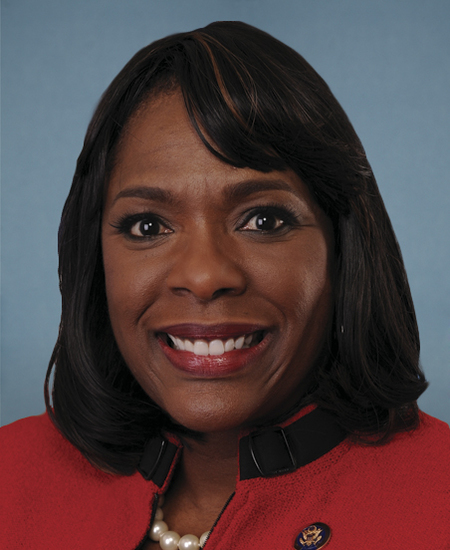
Photo of Terri A. Sewell
D United States House · District 7 · Alabama On the 2026 ballot

Rep. Terri A. Sewell

Compare
Total votes
2,837
all sessions
Attendance
96%
107 missed
Near the chamber average
With party
98%
of cast votes
Near the chamber average
Bipartisan score
1%
crosses aisle rarely
Near the chamber average
Sponsored
1,741
bills & resolutions
Higher than 88% of chamber peers
Committees
7
assignments
1,741 bills and resolutions

Sponsored bills

Total
1,741
Primary
64
Co-sponsor
1,677
This page
1,741
matching current filters
Primary HR 5128
In committee · United States House · Lead sponsor
Preserving Access to Home Health Act of 2023

Maddy summaryHR 5128, the Preserving Access to Home Health Act of 2023, repeals temporary Medicare payment adjustments for home health agencies that were added by the 2018 Bipartisan Budget Act, restoring pre-2018 payment rates effective for 2024. This directly affects home health agencies that rely on Medicare reimbursement by stabilizing their payment structure. The bill also requires the Medicare Payment Advisory Commission to analyze how different payers (Medicare, Medicaid, others) impact home health agency finances and beneficiary access, including collecting detailed data on payments by payer source starting in 2025. These changes aim to ensure consistent funding and transparency in home health care financing.

In committee Dec 17, 2024 0 co-sponsors
Co-sponsor HR 5013
In committee · United States House · Co-sponsor
Value in Health Care Act of 2023

Maddy summaryThis bill simplifies participation in Medicare's Accountable Care Organization (ACO) program by removing distinctions between small and large ACOs and eliminating the requirement for new ACOs to assume financial risk for three years before joining shared savings models. It creates a new "100% shared savings" option where ACOs keep all savings from cost reductions but bear full financial responsibility for losses. The bill also mandates clearer, transparent benchmark calculations for ACO performance, establishes appeal processes for disputed benchmarks, and requires technical assistance for rural and underserved providers. These changes directly affect Medicare ACOs, particularly smaller or newer organizations in rural or safety-net settings, aiming to make value-based care participation more accessible.

In committee Dec 17, 2024 1 co-sponsor
Co-sponsor HR 5027
In committee · United States House · Co-sponsor
Chronic Kidney Disease Improvement in Research and Treatment Act of 2023

Maddy summaryThis bill expands Medicare benefits for chronic kidney disease patients by adding kidney disease screening to annual wellness visits and broadening education options to include more healthcare professionals like nurse practitioners. It updates payment systems to better cover innovative kidney treatments, including new drugs and devices, and requires a study on increasing kidney transplant rates. The bill also aims to improve the kidney care workforce by expanding training opportunities in underserved areas and ensures Medicare Advantage plans properly cover new kidney therapies. These changes directly affect Medicare beneficiaries with kidney disease, dialysis centers, and nephrology providers, with key provisions taking effect in 2022-2024.

In committee Dec 17, 2024 1 co-sponsor
Co-sponsor HR 5035
In committee · United States House · Co-sponsor
HOPE for Haitian Prosperity Act of 2023

Maddy summaryThe HOPE for Haitian Prosperity Act extends duty-free access for Haitian goods to the U.S. market until 2035, with specific extensions for apparel and other exports. It requires Haitian producers to meet labor standards on minimum wages, working hours, and safe conditions to maintain this trade benefit. The bill also creates a new U.S. technical assistance program to help Haiti diversify exports, focusing on agriculture, apparel, and services, while requiring collaboration with Haitian government, businesses, and labor groups. Annual reports to Congress will track progress on these efforts.

In committee Dec 17, 2024 1 co-sponsor
Co-sponsor HR 5008
In committee · United States House · Co-sponsor
HEAL for Immigrant Families Act of 2023

Maddy summaryHR 5008, the HEAL for Immigrant Families Act of 2023, would remove immigration status as a barrier to health insurance coverage for immigrants in the United States. The bill would make all lawfully present immigrants, including those with Deferred Action for Childhood Arrivals (DACA) status, eligible for Medicaid, CHIP, and Affordable Care Act health insurance subsidies. It would eliminate state-level restrictions on Medicaid eligibility for immigrants and allow individuals with federally authorized presence to access premium tax credits and cost-sharing reductions. This legislation aims to address health coverage disparities that disproportionately affect immigrant communities, particularly Black, Indigenous, Latinx, and other communities of color.

In committee Dec 17, 2024 1 co-sponsor
Primary HR 4813
In committee · United States House · Lead sponsor
Rural Health Training Opportunities Act

Maddy summaryThis bill changes how federal grants support rural health training programs. It requires grant applications to prioritize projects in rural areas (where participants live, projects are run, or employer partners are located) and mandates that all funded programs include transportation assistance plans - like helping participants access subsidized transit or paying for gas when public transit isn't available. The program must also report annually to Congress on how effectively it addresses healthcare worker shortages in rural communities. These changes apply to grant-funded training initiatives starting October 1, 2023.

In committee Dec 17, 2024 0 co-sponsors
Co-sponsor HR 4783
In committee · United States House · Co-sponsor
To provide low-income individuals with opportunities to enter and follow a career pathway in the health professions, and for other purposes.

Maddy summaryThe Pathways to Health Careers Act creates a federal grant program to help low-income individuals (those with family income at or below 200% of the Federal poverty level) enter health professions. It provides $425 million annually for fiscal years 2024-2028 to fund training programs that must include support services like adult basic education, child care, transportation, and career coaching. The bill requires grant recipients to serve at least 10% of participants who qualify for Temporary Assistance for Needy Families (TANF) and sets aside funding for demonstration projects focused on people with arrest/conviction records and maternal health career pathways. Recipients must track outcomes including credential attainment, employment in health professions, and earnings. This program directly affects low-income individuals seeking health careers and the organizations that will administer these training programs.

In committee Dec 17, 2024 1 co-sponsor
Co-sponsor HR 4779
In committee · United States House · Co-sponsor
Breast Cancer Patient Equity Act

Maddy summaryThe Breast Cancer Patient Equity Act would require Medicare to cover custom-made breast prostheses for women who have undergone mastectomies, directly affecting Medicare beneficiaries and influencing private insurance coverage practices. Currently, Medicare denies coverage for these prostheses as "not medically necessary" while covering surgical breast reconstruction, creating a gap that disproportionately impacts older and minority women. The bill amends Medicare’s coverage rules to explicitly include custom breast prostheses under the same category as other body part prostheses. This change would address the lack of access to a common, less invasive alternative to surgery for over 100,000 women undergoing mastectomies annually.

In committee Dec 17, 2024 1 co-sponsor
Co-sponsor HR 4752
In committee · United States House · Co-sponsor
Concentrating on High-value Alzheimer's Needs to Get to an End Act of 2023

Maddy summaryHR 4752 (the CHANGE Act of 2023) requires Medicare to include standardized cognitive impairment screening during annual wellness visits and initial preventive physical exams for beneficiaries starting in 2024. It mandates doctors use National Institute on Aging-approved tools to detect memory issues and document results in medical records. This directly affects Medicare patients aged 65+ and their healthcare providers, aiming to enable earlier Alzheimer’s diagnosis and care planning. The bill focuses on making routine screenings a standard part of Medicare-covered checkups, not on funding or new programs. It does not alter existing Medicare benefits but adds a specific screening requirement to two existing service categories.

In committee Dec 17, 2024 1 co-sponsor
Co-sponsor HR 4583
In committee · United States House · Co-sponsor
Social Security 2100 Act

Maddy summaryThe Social Security 2100 Act would significantly enhance Social Security benefits for millions of Americans by increasing monthly payments for retirees, disabled workers, widows/widowers, and children. Key provisions include raising the minimum benefit for long-term low earners, improving cost-of-living adjustments using a more accurate index, eliminating the 5-month waiting period for disability benefits, and extending child benefits to age 26. The bill also changes how Social Security taxes are calculated by applying them to income above $400,000 and establishes a unified Social Security Trust Fund to manage program finances. Most provisions would apply to benefits payable from 2025 through 2034, affecting all current and future Social Security beneficiaries.

In committee Dec 17, 2024 1 co-sponsor
Showing 631 to 640 of 1,741 bills
Previous 1 … 63 64 65 … 175 Next