

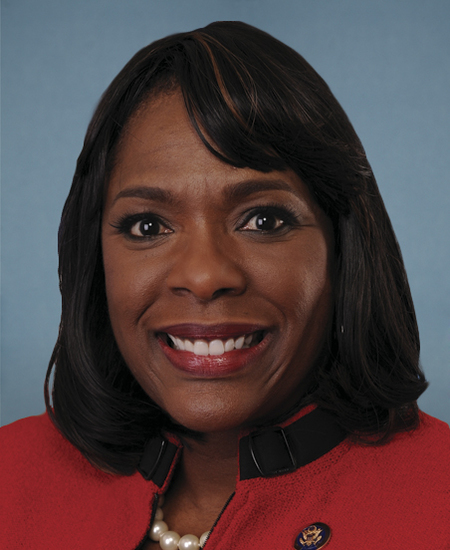
Photo of Terri A. Sewell
D United States House · District 7 · Alabama On the 2026 ballot

Rep. Terri A. Sewell

Compare
Total votes
2,837
all sessions
Attendance
96%
107 missed
Near the chamber average
With party
98%
of cast votes
Near the chamber average
Bipartisan score
1%
crosses aisle rarely
Near the chamber average
Sponsored
1,741
bills & resolutions
Higher than 88% of chamber peers
Committees
7
assignments
1,741 bills and resolutions

Sponsored bills

Total
1,741
Primary
64
Co-sponsor
1,677
This page
1,741
matching current filters
Primary HR 9708
In committee · United States House · Lead sponsor
Bridge to Medicaid Act of 2024

Maddy summaryThe Bridge to Medicaid Act of 2024 (HR 9708) would provide healthcare affordability assistance to low-income individuals with household incomes at or below 138% of the federal poverty level. It would reduce out-of-pocket costs for these individuals in health insurance plans, create special enrollment periods for them, and provide additional benefits like non-emergency medical transportation in silver-level plans for 2026-2027. The bill also temporarily expands premium tax credits for these individuals and allocates $105 million for outreach and education about health insurance options. These changes would apply to plan years 2026 through 2028, with some provisions extending through 2029.

In committee Dec 17, 2024 0 co-sponsors
Co-sponsor HR 9152
In committee · United States House · Co-sponsor
SCHOOL Professionals Act of 2024

Maddy summaryHR 9152, the "SCHOOL Professionals Act of 2024," clarifies that contractors primarily providing operations or logistics services to educational organizations must be treated like direct employees for health coverage purposes under federal tax law. This means educational institutions using such contractors must determine if these workers qualify as "full-time" for health insurance requirements, similar to their own employees. The bill directly affects schools and colleges that rely on external contractors for facility or support services, requiring them to apply the same full-time employee rules to these contractors when assessing health coverage obligations. The rule change applies to months beginning after the bill's enactment date.

In committee Dec 17, 2024 1 co-sponsor
Co-sponsor HR 8977
In committee · United States House · Co-sponsor
Improving Access to Emergency Medical Services Act of 2024

Maddy summaryThis bill creates a new Medicare payment model for emergency medical services (EMS) that allows coverage when ambulance providers deliver critical care on-site without transporting patients to a hospital. It directly affects Medicare beneficiaries receiving such on-site emergency care and ambulance providers who would previously not be reimbursed for non-transport services. The key provision requires Medicare to pay for these services at rates matching what would have been paid for transport, based on state protocols and emergency call responses, for a 5-year trial period. A report due 4 years after implementation will evaluate impacts on patient outcomes, system efficiency, and regional access.

In committee Dec 17, 2024 1 co-sponsor
Co-sponsor HR 8796
In committee · United States House · Co-sponsor
Stop Comstock Act.

Maddy summaryHR 8796, the "Stop Comstock Act," removes outdated restrictions from federal law that previously banned the distribution of materials related to contraception and abortion as "obscene" or "indecent." The bill amends Title 18 and the Tariff Act by deleting references to "indecent," "immoral," "unlawful abortion," and "procuring abortion" from provisions governing obscene materials. It clarifies that the law only prohibits "obscene materials" in commerce, eliminating broad restrictions on reproductive health information. This directly affects internet platforms, healthcare providers, and individuals sharing reproductive health resources by removing legal barriers to their distribution.

In committee Dec 17, 2024 1 co-sponsor
Co-sponsor HR 8702
In committee · United States House · Co-sponsor
Improving Seniors’ Timely Access to Care Act of 2024

Maddy summaryThis bill requires Medicare Advantage plans to implement electronic prior authorization systems by 2027 and publish detailed data on their approval and denial rates for medical services by 2026. It directly affects Medicare Advantage plans (private insurers offering Medicare coverage) and their enrollees (seniors 65+), mandating transparency about prior authorization decisions, processing times, and appeal outcomes. Key provisions include requiring plans to report annual statistics on request approvals/denials, average processing times, and use of technology, with this data published publicly by the Centers for Medicare & Medicaid Services. The bill also sets timelines for plan responses to prior authorization requests and mandates reports to Congress on implementation and impacts.

In committee Dec 17, 2024 1 co-sponsor
Co-sponsor HR 8411
In committee · United States House · Co-sponsor
Defending American Property Abroad Act

Maddy summaryHR 8411, the Defending American Property Abroad Act, blocks U.S. government funding for activities involving foreign ports or terminals where a U.S. entity owns the land needed for access, and a foreign government has taken actions like nationalizing that land or nullifying a related contract. It requires the Homeland Security Secretary to designate such "prohibited property" within 60 days, then prohibits funding for vessels using these locations to import goods, dock, or receive maintenance. The bill mandates annual reports to Congress tracking designated properties, affected vessels, and the foreign actions triggering designations, along with assessments of economic and national security impacts. This directly affects U.S. businesses with foreign port access and U.S. agencies managing maritime activities.

In committee Dec 17, 2024 1 co-sponsor
Co-sponsor HR 8390
In committee · United States House · Co-sponsor
Mental Health and MAMA Act of 2024

Maddy summaryHR 8390, the Mental Health and MAMA Act of 2024, eliminates cost-sharing (like copays or deductibles) for mental health and substance use disorder services during pregnancy and for one year after birth. It applies to people enrolled in group health plans, individual insurance, or federal employee health plans, covering services provided by in-network providers. The bill requires insurers to waive these costs starting two years after enactment, explicitly including telehealth services. It specifically targets care for pregnant and postpartum individuals, ensuring coverage from pregnancy diagnosis through the 12 months following birth.

In committee Dec 17, 2024 1 co-sponsor
Co-sponsor HR 8331
In committee · United States House · Co-sponsor
Essential Caregivers Act of 2024

Maddy summaryThe Essential Caregivers Act of 2024 requires nursing homes and similar facilities to allow residents to designate essential caregivers who provide emotional support or assistance with daily activities. During emergencies when regular visitation is restricted, facilities must permit at least one essential caregiver access to residents daily and cannot deny access without following specific procedures. Facilities may deny access for a maximum of 7 days during emergencies (or 14 days with state approval), and must provide a written explanation and appeal process if access is denied. The bill establishes a 48-hour appeal process for residents and caregivers to challenge denials, with facilities required to prove violations during appeals. This law applies to Medicare skilled nursing facilities, Medicaid nursing facilities, intermediate care facilities, and certain inpatient rehabilitation facilities.

In committee Dec 17, 2024 1 co-sponsor
Co-sponsor HR 8225
In committee · United States House · Co-sponsor
Apprenticeship Opportunity Act

Maddy summaryHR 8225, the Apprenticeship Opportunity Act, requires states to ignore income earned during the first year of a registered apprenticeship when determining eligibility for Temporary Assistance for Needy Families (TANF) benefits. This directly affects low-income individuals entering apprenticeships, as their initial earnings would no longer count against TANF eligibility. The bill mandates states to disregard this income under Section 408(a)(13) of the Social Security Act, with a penalty of a 1% reduction in the state’s next year’s TANF grant for noncompliance. It aims to remove a financial barrier for apprentices while maintaining existing TANF program rules. The provision takes effect in the first federal fiscal year after enactment.

In committee Dec 17, 2024 1 co-sponsor
Co-sponsor HR 8203
In committee · United States House · Co-sponsor
TANF State Expenditure Integrity Act of 2024

Maddy summaryThis bill creates a new TANF Program Integrity Unit at the Administration for Children & Families to monitor state use of Temporary Assistance for Needy Families (TANF) funds, with $10 million in annual funding added to support its operations. If a state intentionally misuses TANF funds, the unit would require the state to repay the misused amount by providing direct cash assistance to families earning below 100% of the federal poverty line. The law applies directly to states administering TANF programs, mandating stricter oversight of fund usage and repayment of misused funds. It also requires the unit to submit annual reports to Congress on its activities.

In committee Dec 17, 2024 1 co-sponsor
Showing 601 to 610 of 1,741 bills
Previous 1 … 60 61 62 … 175 Next