

Maddy summaryHRES 1423 expresses the U.S. House of Representatives' support for designating the week of September 21-28, 2024, as "National Estuaries Week." The resolution highlights estuaries' economic and ecological importance, noting they support over 3.5 million jobs, contribute $476 billion to the U.S. GDP, and provide critical services like flood control and water filtration. It does not create new laws or funding but aims to raise public awareness about protecting estuaries, which face threats like pollution and habitat loss. The resolution acknowledges ongoing restoration efforts by federal, state, tribal, and community partners.
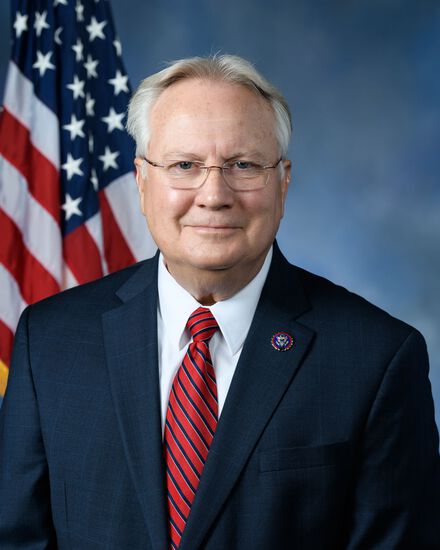
Rep. Jerry L. Carl
Sponsored bills
This resolution supports the designation of National FFA Week. It also (1) recognizes the important role of the National FFA Organization (Future Farmers of America) in developing the next generation of globally conscious leaders who will change the world; and (2) celebrates the 10th anniversary of the Give the Gift of Blue program, which has donated more than 17,000 FFA blue jackets to FFA members in need.
Maddy summaryHR 9376, "Lulu’s Law," requires the Federal Communications Commission (FCC) to update wireless emergency alert regulations within 60 days of enactment. It specifically adds "shark attack" as an event eligible for emergency Alert Messages under FCC rules. This change directly affects how emergency alerts are categorized and transmitted to the public via wireless devices. The bill modifies existing FCC regulations (Title 47, Part 10) to include shark attacks as a triggering event for emergency alerts, without altering other alert types or requirements.
Maddy summaryThis bill increases funding for replacing potentially insecure telecommunications equipment from $1.9 billion to $4.98 billion under the Secure and Trusted Communications Networks Act. It appropriates $3.08 billion specifically for the Federal Communications Commission (FCC) to implement this program in fiscal year 2024. The bill mandates the FCC to conduct a spectrum auction for certain frequencies within one year of enactment, regardless of prior expiration deadlines for such auctions. This directly affects the FCC, telecom companies bidding on spectrum licenses, and national security networks requiring secure communications infrastructure.
Maddy summaryHR 9274, the SHAWL Act, establishes two new Smithsonian museums: the National Museum of the American Latino and the American Women’s History Museum. It authorizes both museums to be located within the National Mall’s "Reserve" area, overriding prior restrictions, and requires federal agencies managing potential sites to transfer jurisdiction to the Smithsonian after notifying congressional committees. The bill mandates that both museums accurately represent diverse cultures, histories, and viewpoints within Latino and women’s communities through exhibits and programs, requiring input from a broad range of community experts. It also requires the Smithsonian to submit biennial reports to Congress detailing compliance with these representation requirements.
Maddy summaryHRES 1394 is a non-binding resolution celebrating the U.S.-India partnership based on shared democratic values, religious pluralism, and human rights, while highlighting the contributions of the Indian diaspora in the United States. It specifically recognizes the 50th anniversary of BAPS Swaminarayan Sanstha's community work, including its spiritual centers (mandirs) and volunteer efforts across the country. The resolution does not create legal obligations but formally acknowledges these ties and achievements.
Maddy summaryHCONRES 122 is a non-binding resolution expressing Congress's view that Operation Legend - a 2020 federal-local initiative - successfully reduced violent crime in major cities like Chicago, Kansas City, and Memphis. It recommends that future presidential administrations consider deploying federal law enforcement agents to partner with local agencies in high-crime areas, similar to Operation Legend’s 2020 approach. The resolution also proposes providing grant funding to states and cities to hire more officers (including bonuses), impose stricter sentences for repeat offenders, and use bail/pretrial detention to keep dangerous individuals from reentering communities. It does not create new law but urges future administrations to prioritize these strategies to address ongoing violent crime surges.
Maddy summaryThis bill allows non-VA doctors (contract physicians) to conduct disability exams for veterans, expanding access for rural veterans who face travel barriers to VA facilities. It requires these doctors to hold current state licenses, not be barred from practice, and perform exams under VA contracts. The VA would cover costs through existing benefit funding, and the bill terminates a 1996 pilot program on this approach. The law directly affects veterans seeking disability benefits and the VA’s examination process, making it more flexible for rural communities.
Maddy summaryHRES 1365 is a non-binding House resolution calling for the immediate termination of Kimberly Cheatle as U.S. Secret Service Director. It directly addresses the Secret Service Director and the executive branch, though it has no legal force to remove her from office. The resolution’s sole provision is a formal request for her termination, reflecting the sponsors' position on her leadership. As a symbolic gesture, it does not change her employment status or require any action from the President or Secret Service.
Maddy summaryThis is a commemorative resolution (HRES 1369) honoring Corey Comperatore, a volunteer firefighter, U.S. Army Reserves veteran, and community leader from Sarver, Pennsylvania, who died on July 13, 2024. The resolution formally mourns his passing and celebrates his life, noting he left behind his wife, Helen, and two daughters, Allyson and Kaylee. It recognizes his service to the Buffalo Township Volunteer Fire Department, his military service, and his role as a devoted member of Cabot Methodist Church. As a ceremonial resolution, it has no policy impact or direct effect on legislation or constituents beyond this formal acknowledgment.