

Maddy summaryThe Central Valley Water Solution Act (HR 6641) authorizes over $830 million in federal funding for water infrastructure projects across California's Central Valley. It directly supports agricultural water districts and communities by financing groundwater banking systems, canal repairs, water treatment plants, and reservoir construction to improve water storage, quality, and conveyance. Key provisions include $830 million for fixing subsidence in the Delta-Mendota Canal, $850 million for the San Luis Canal/Aqueduct, and $300 million for groundwater banking programs across multiple districts. These projects aim to enhance drought resilience, restore water delivery capacity, and support conjunctive use of surface and groundwater resources.
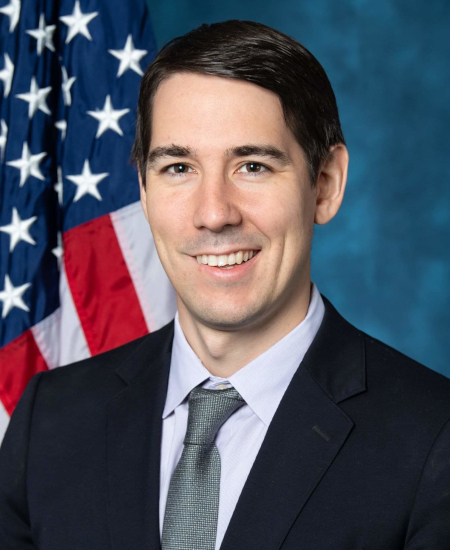
Rep. Josh Harder
Sponsored bills
Maddy summaryHR 5360, the AWARE Act, requires the Federal Trade Commission (FTC) to create and publish public educational resources about AI chatbot safety within 180 days of the bill becoming law. These resources will specifically help parents, educators, and minors (under age 18) understand safe AI chatbot use, including how to identify risks, privacy practices, and supervision strategies. The FTC must model these materials after its existing Youville program. The bill defines "AI chatbot" as consumer-facing interactive AI systems but does not regulate or restrict chatbot development or use.
Maddy summaryHR 6572 establishes the X-Labs Initiative at the National Institutes of Health (NIH), providing long-term funding to eligible research institutions for breakthrough biomedical research. It creates four funding categories: XL01 for foundational science ($5M-$50M/year for 7 years), XL02 for developing research tools ($5M-$50M/year), XL03 for regranting to high-potential projects ($5M-$50M/year), and XL04 for new institution planning ($1M-$5M for 1-3 years). The bill directly affects nonprofits, universities, and for-profit entities with research subsidiaries, requiring them to use funds exclusively for NIH-supported research without competing for other federal research grants during the award period. Key provisions include strict requirements for XL03 regrants to support projects unlikely to secure traditional NIH funding, and annual reporting to Congress on program progress and impact.
Maddy summaryThis bill authorizes the placement of a memorial honoring women who supported the U.S. war effort during World War II (including those working as pilots, engineers, and in factories) on federal land in Washington, D.C. It specifies two locations: Area I on the National Mall map or the National Mall Reserve, as defined in existing law. The memorial was previously authorized by Section 702 of the 2023 Consolidated Appropriations Act (Public Law 117-328), and this bill clarifies its permitted locations.
Maddy summaryHR 6523 directs the United States Postal Service to open a new post office in Mountain House, California, within one year of the bill becoming law. This bill specifically requires the USPS to establish a physical location for postal services in that community. It directly affects residents of Mountain House who would gain access to a local post office, replacing potential reliance on nearby facilities. The bill contains no additional funding mechanisms or complex provisions beyond this directive.
Maddy summaryThis bill establishes a new interagency Task Force to dismantle foreign scam operations targeting Americans, particularly through "pig butchering" scams in Southeast Asia. The Task Force, chaired by the Secretary of State, will coordinate efforts across multiple agencies to shut down scam centers, impose sanctions on perpetrators, and support victims of trafficking. It requires a detailed strategy within 180 days and annual reports to Congress on progress, including sanctions imposed and funds recovered. The bill authorizes $30 million for these efforts in fiscal years 2026-2027, focusing on countries like Cambodia, Laos, and Burma where scam centers operate with forced labor.
Maddy summaryHR 5731, the School Food Modernization Act, provides funding to help schools upgrade facilities and equipment for healthier meal programs. It authorizes $300 million in loan guarantees (covering up to 80% of costs) and $35 million annually for grants to support kitchen renovations, equipment purchases, and food safety improvements for local schools and tribal organizations. The bill also allocates $10 million yearly to fund training programs for school food service staff, developed by third-party organizations, to meet nutrition standards. These provisions directly affect public school districts, tribal schools, and their food service operations by enabling infrastructure upgrades and staff training.
Give Kids a Chance Act of 2025 This bill expands the Food and Drug Administration’s (FDA’s) authority with respect to research on rare pediatric diseases, including by permitting the FDA to take enforcement action against drug sponsors that fail to satisfy pediatric study requirements and by reauthorizing programs that support pediatric research. Specifically, the bill modifies requirements relating to molecularly targeted pediatric cancer investigations to permit research on new drugs in combination with active ingredients that have already been approved, provided certain conditions are met; permits the FDA to take enforcement action against drug sponsors that fail to comply with pediatric study requirements, if such sponsors demonstrated a lack of due diligence in satisfying the requirement; renews the FDA’s authority to award priority review vouchers to sponsors of new products intended to treat rare pediatric diseases through September 30, 2029; and reauthorizes through FY2027 certain funding for the National Institutes of Health to support priority pediatric research. The bill also provides statutory authority for the FDA’s interpretation of the orphan drug exclusivity period. The bill specifies, consistent with FDA regulations, that the seven-year market exclusivity period for drugs for rare diseases or conditions (i.e., orphan drugs) prohibits the approval of the same drug for the same approved use or indication with respect to the disease or condition. (In Catalyst Pharmaceuticals, Inc. v. Becerra , a court rejected the FDA’s interpretation and held that orphan drug exclusivity extends to all uses or indications for the disease or condition.)
Maddy summaryHR 5652, the Wildfire Recovery Act, increases federal reimbursement for wildfire response by setting a minimum 75% federal cost share under Section 420 of the Stafford Act, directly benefiting states, local governments, and Tribal governments that deploy firefighting resources. It requires FEMA to develop rules within three years to determine when the federal share could exceed 75% based on a state's financial impact from wildfires. The bill also updates FEMA policy to allow reimbursement for predeployment of fire assets (like crews or equipment) before a fire occurs. These changes aim to provide more predictable and timely federal support for wildfire recovery efforts.
Maddy summaryHR 4802, the Securing Infrastructure from Adversaries Act of 2025, bans the use of federal funds for certain foreign-made LiDAR technology in transportation projects. It prohibits the Secretary of Transportation from procuring, obtaining, or contracting for LiDAR technology from specified "covered foreign countries," "covered LiDAR companies," or "covered LiDAR technology" starting June 30, 2026. Contractors must certify they will not use banned technology, and the Secretary may grant limited waivers for national security reasons, requiring congressional notification. This directly affects transportation infrastructure projects funded by the Department of Transportation, including grants and contracts.