

Maddy summaryHJRES 144 is a congressional disapproval resolution targeting a specific rule issued by the Bureau of Alcohol, Tobacco, Firearms, and Explosives (ATF) on April 19, 2024. The resolution seeks to block the ATF's rule that redefined the term "engaged in the business" for firearm dealers, which would have affected how federal licensing requirements apply to certain sellers. If enacted, this resolution would nullify the rule, preventing it from taking effect under procedures in Title 5 of the U.S. Code. The bill directly impacts firearm dealers operating under the current regulatory framework and the ATF's enforcement authority.
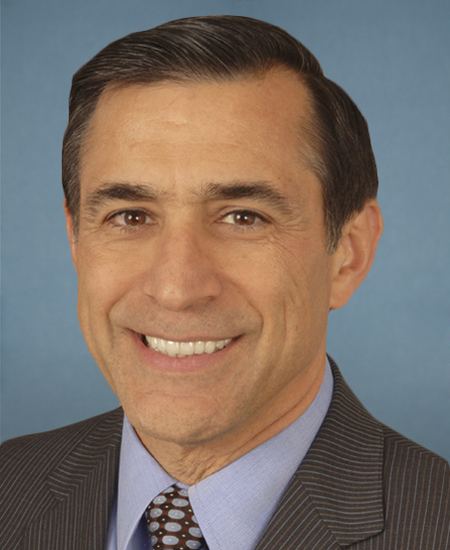
Rep. Darrell Issa
Sponsored bills
Maddy summaryHR 9677, the Modernize the Au Pair Program Act of 2024, ensures only federal law - not state laws - regulates the au pair program. It requires the State Department to revise a proposed rule within 90 days to adjust the weekly payment formula for host families, balancing affordability with program costs like room, board, and childcare hours. This update aims to maintain the program’s accessibility for American families, including military households, shift workers, and single parents who rely on au pairs for childcare. The bill preserves the program’s cultural exchange purpose and economic benefits without expanding its scope or creating new requirements.
Maddy summaryHR 9605, the "No Censors on our Shores Act," amends U.S. immigration law to bar entry and allow deportation of foreign government officials who censor U.S. citizens within the United States. Specifically, it adds new grounds for inadmissibility and deportability if a foreign official, while in office, directly suppressed a U.S. citizen's speech in the U.S. in a manner that would violate the First Amendment if done by a U.S. official. The bill targets foreign officials' actions against U.S. citizens' free speech rights within U.S. territory, not general censorship or actions abroad. It does not affect U.S. citizens, organizations, or non-governmental actors. This is a policy change to immigration enforcement, not a new free speech law.
Maddy summaryThis bill (HJRES 163) is a congressional disapproval resolution targeting an Environmental Protection Agency (EPA) rule finalized on May 9, 2024. The EPA rule established new emissions standards for greenhouse gases from fossil fuel power plants (both new and existing) and repealed a previous rule called the Affordable Clean Energy Rule. The resolution would block this EPA rule from taking effect by invoking the Congressional Review Act (Chapter 8 of Title 5, U.S. Code). If passed, it would prevent the EPA rule from being enforced, directly affecting fossil fuel power plant operators and the EPA’s regulatory authority over emissions.
Maddy summaryThe Fairness for Servicemembers and their Families Act of 2024 requires the Department of Veterans Affairs to review the automatic maximum coverage amount for Servicemembers’ Group Life Insurance (SGLI) and Veterans’ Group Life Insurance (VGLI) every three years, starting January 1, 2024. The review compares the current coverage amount to a new inflation-adjusted figure calculated as $400,000 multiplied by the cumulative increase in the Consumer Price Index (CPI) since 2005. The results of each review must be submitted to Congress. This provision directly affects active-duty service members and veterans enrolled in SGLI or VGLI by establishing a process to potentially increase their automatic coverage to keep pace with inflation.
Maddy summaryThe JUDGES Act of 2024 authorizes new federal district court judgeships across multiple states to address rising case backlogs in the federal judiciary. It specifies new permanent judgeships for districts including California (multiple districts), Florida, Texas, Delaware, Indiana, Iowa, New Jersey, and New York, with implementation phased through 2035, and creates temporary judgeships for Oklahoma districts with specific vacancy rules. The bill authorizes funding for these positions and requires reports on judicial caseloads and detention space needs, while mandating public access to the Judicial Conference's judgeship recommendations. The bill directly affects federal district courts in the specified locations by increasing judicial staffing to handle growing case volumes.
Maddy summaryHR 5245 requires the Secretary of State to provide detailed notifications to Congress before entering, renewing, or extending any science and technology agreement with China. The notification must include the full agreement text, national security justification, risk assessments (including technology transfer concerns), human rights considerations, and monitoring plans, and must be submitted 30 days before any agreement takes effect. Existing agreements with China must be revoked unless the Secretary submits the required notification within 60 days of the bill's enactment. This bill directly affects the Department of State's ability to negotiate such agreements and gives Congress enhanced oversight authority. It applies to all future agreements and existing ones in effect when the law takes effect.
Maddy summaryHR 9473, the Sanctuary City Accountability Act, allows U.S. citizens to sue local governments (called "sanctuary jurisdictions") in federal court if an immigrant who was in that jurisdiction commits a crime against them or their immediate family. A "sanctuary jurisdiction" is defined as any state or local government that obstructs immigration enforcement - such as refusing to honor ICE detainers, imposing unreasonable conditions on ICE cooperation, or denying ICE access to incarcerated individuals. The bill creates a private right of action for victims seeking court orders or compensation, but it explicitly states that local governments cannot be held liable for following state laws that require cooperation with immigration enforcement. This bill directly affects cities or states with specific immigration policies and establishes a new legal pathway for individuals impacted by crimes committed by immigrants in those jurisdictions.
Maddy summaryHRES 1028 is a non-binding House resolution commending southern California wineries and vineyards for their economic and cultural contributions. It recognizes the industry's role in supporting over 600,000 U.S. jobs (including 422,000 in California), generating billions in annual economic activity, and driving tourism across counties like Riverside, San Diego, and Orange. The resolution highlights specific achievements, such as wine-related tourism spending exceeding $900 million in San Diego County in 2022. As a symbolic gesture, it does not create new laws, allocate funds, or alter regulations - only formally acknowledging the industry's significance.
This resolution supports the designation of National FFA Week. It also (1) recognizes the important role of the National FFA Organization (Future Farmers of America) in developing the next generation of globally conscious leaders who will change the world; and (2) celebrates the 10th anniversary of the Give the Gift of Blue program, which has donated more than 17,000 FFA blue jackets to FFA members in need.