

Maddy summaryThis Senate resolution (SR 115) designates June 2025 as "Dairy Month" in Pennsylvania. It symbolically recognizes the dairy industry's economic significance - supporting over 47,000 jobs and contributing $11.8 billion annually - to raise awareness of the industry's value and hardships while encouraging the purchase of Pennsylvania-produced dairy products. The resolution has no binding policy impact and serves purely as a ceremonial acknowledgment.
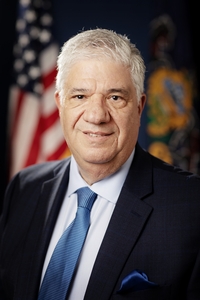
Sen. Wayne Fontana
Sponsored bills
Maddy summarySB 150 amends Pennsylvania's Human Relations Act to expand anti-discrimination protections by adding "sexual orientation," "gender identity or expression," and "use of guide or support animals" (due to blindness, deafness, or disability) to the list of protected categories. It updates the law to prohibit discrimination in employment, housing, and public accommodations by employers, housing providers, and public spaces based on these newly covered characteristics. The bill also clarifies that religious organizations are generally exempt from certain provisions but must comply when discrimination relates to "race, color, age, sex, sexual orientation, gender identity or expression, national origin or non-job related handicap or disability." This amendment broadens the 1955 law's scope to align with evolving anti-discrimination standards.
Maddy summarySB 175 makes it a crime to knowingly report false emergencies (like crimes or medical crises) to police, fire departments, 911 operators, or emergency medical services. It directly affects individuals who make such false reports, requiring them to pay the full costs of the emergency response - including officer/firefighter overtime, equipment, and supplies - through court-ordered restitution. For juveniles, parents or guardians may be ordered to pay a portion of these costs if the juvenile cannot afford it, with payment plans or hardship adjustments available. The law applies to false reports originating in Pennsylvania or targeting Pennsylvania agencies, and it expands the Attorney General’s authority to prosecute cross-county or multi-state violations.
Maddy summarySB 797 exempts certain veterans from Pennsylvania vehicle registration fees. It specifically applies to veterans receiving disability benefits tied to service-connected injuries or disabilities, with total annual income under $19,200. Instead of the standard registration fee, the state will charge a $10 processing fee for these vehicles. The veteran must be the principal driver unless physically or mentally incapable, but may authorize others to drive the vehicle. The bill takes effect 90 days after enactment.
Maddy summarySB 805 prohibits releasing untethered sky lanterns (paper balloons with small fires) outdoors in Pennsylvania unless secured to the ground. It also bans tethering lanterns and leaving them unattended. The law imposes fines of $500 for improper release and $1,500 if lanterns are left unattended and drift out of control. It directly affects anyone using these devices, including individuals, businesses, or event organizers, but excludes the Commonwealth government. The bill aims to prevent fire hazards by requiring physical tethering during use.
Maddy summaryThis resolution designates June 2025 as "Migraine and Headache Awareness Month" in Pennsylvania. It symbolically recognizes the impact of headache disorders - such as migraine, cluster headache, and related conditions - on millions of people, including disproportionate effects on women, veterans, and underserved communities. The resolution encourages Pennsylvanians, healthcare professionals, and policymakers to support awareness, research, and improved access to care for those living with these conditions. It does not create new laws or funding but serves as a formal acknowledgment of the issue.
Maddy summarySB 813 establishes Pennsylvania's HUB Zone Business Procurement Program to increase state contracting with businesses in designated underutilized areas. It requires state agencies to set contract-specific goals ensuring 20% HUB zone business participation on contracts between $100,000-$750,000 and 25% on larger contracts, with waivers available if agencies demonstrate "good faith efforts" to find qualified businesses. The program mandates agencies to compile verified business lists, monitor compliance monthly, and review utilization schedules. This directly affects Pennsylvania state purchasing agencies and for-profit businesses headquartered in designated HUB zones meeting federal certification criteria.
Maddy summarySB 809 amends Pennsylvania's law to clarify that disabled veterans must have been honorably discharged "for service in any war or armed conflict" to qualify for the real estate tax exemption on their principal residence. This change directly affects veterans seeking the existing tax exemption for their primary home, including the land it sits on. The key provision updates the eligibility requirement in Section 8902(a)(1) of Title 51 to specify the discharge reason tied to military service in conflict. The bill does not create new benefits but refines the existing exemption's criteria. It takes effect 60 days after enactment.
Maddy summaryThis resolution designates May 29, 2025, as "College and Career Savings Day" in Pennsylvania to raise public awareness about the state's existing 529 College and Career Savings Program. It directly affects Pennsylvania residents who use the program, which currently serves over 314,000 families by offering tax-advantaged savings for education expenses. The resolution does not create new policy or change program rules - it simply recognizes the program's purpose of helping families save for college, vocational training, or other qualified educational costs through tax benefits and fee reductions.
Maddy summarySB 799 modifies Pennsylvania's Public School Code to clarify how charter schools receive state funding. It requires school districts to fund charter schools at a rate equal to the district's per-student spending (minus specific district expenses like transportation and facilities) for regular students, and adds a special education funding component based on district spending ratios. For cyber charter schools, the bill limits payments to nonaffiliated cyber charters to the maximum amount the district's own affiliated cyber school would receive. This directly affects charter schools (especially cyber charters) and school districts responsible for funding student placements. The changes aim to standardize funding calculations but do not alter overall funding levels.