

Maddy summarySB 928 creates the Pennsylvania Film Producer Grant Program to provide financial support to eligible film producers. It directly affects film producers who maintain their principal business in Pennsylvania and film projects entirely within the state, excluding news, sports, political content, or productions for private/institutional use. The program establishes a restricted account in the state General Fund for grants covering site preparation, crew costs, and other qualifying production expenses. Administered by the Pennsylvania Council on the Arts, grants require producers to meet specific location and project criteria outlined in the bill.
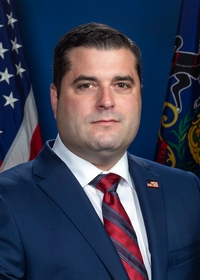
Sen. Devlin Robinson
Sponsored bills
Maddy summarySB 947 amends Pennsylvania's 1987 law designating a specific area at the Harrisburg State Capitol as "Soldiers' Grove" to honor veterans. It prohibits all festivals, celebrations, or gatherings in this area except for events specifically for veterans, their families, first responders, or their families. Government entities cannot issue permits for such events, and violations carry a penalty of up to $2,500 or one year in jail. The bill focuses on protecting the memorial site's solemn character, not creating new programs or funding.
Maddy summarySB 950 requires pet cremation providers in Pennsylvania to clearly explain service options to pet owners and intermediaries (like veterinarians or pet shops). It mandates written disclosures detailing three cremation types: private (single pet, ashes returned), individual-partitioned (multiple pets separated, ashes returned), and communal (multiple pets, no ashes returned). Providers must also certify returned ashes and maintain records for five years. The law directly affects pet owners, cremation providers, and businesses handling pet remains, aiming to prevent confusion and ensure transparency in pet cremation services.
Maddy summarySB 811 establishes Pennsylvania's SBIR/STTR Matching Funds Program to support small businesses with federal research grants. It provides state matching funds (up to $50,000) to Pennsylvania-based businesses that receive Phase I awards under the federal Small Business Innovation Research (SBIR) or Small Business Technology Transfer (STTR) programs. To qualify, businesses must conduct at least 51% of their Phase II research in Pennsylvania, submit a Phase I report, and avoid duplicate state funding. The program aims to foster economic growth by helping small businesses advance federal-funded research projects.
Maddy summarySB 416 allows licensed organizations in Pennsylvania (like charities or community groups) to accept electronic payments - such as credit cards, debit cards, or mobile payments - for raffle tickets. It requires these organizations to verify buyers are at least 18 years old and comply with federal gambling laws. The bill specifically prohibits mobile payment services for certain gaming licensees under Chapter 9. It also removes an outdated regulation (61 Pa. Code § 901.506) that conflicted with these new payment rules.
Maddy summaryThis Pennsylvania Senate resolution (SR 116) urges Congress to support H.R. 2102, the Major Richard Star Act, which would eliminate a rule reducing retirement pay for medically retired service members. Currently, veterans with less than 20 years of service and a disability rating under 50% lose $1 in retirement pay for every $1 in disability benefits they receive. The resolution highlights that an estimated 50,000 veterans are affected by this offset, with average monthly reductions of about $1,900. It specifically calls for removing this restriction to allow medically retired service members to receive full retirement pay and VA disability benefits simultaneously.
Maddy summarySB 930 amends Pennsylvania's Public School Code to strengthen school safety and security systems. It establishes a School Safety and Security Committee, requires schools to appoint coordinators for safety planning, and mandates annual training for staff on topics like cyber safety, active shooter drills, and mental health awareness. The bill creates a grant program funding mental health services and cyber security measures (e.g., preventing data breaches), with funds restricted to these purposes. Schools must report safety meeting attendance and security personnel details annually, starting in 2026, to their boards of directors. These changes directly affect public school districts, charter schools, and their administrators.
Maddy summarySR 133 is a symbolic resolution designating July 21-25, 2025, as "Construction Opioid Awareness Week" in Pennsylvania. It directly encourages Pennsylvania's construction industry - including contractors, unions, and organizations like the Keystone Contractors Association - to promote awareness of opioid dangers and facilitate discussions during that week. The resolution references high overdose rates in construction (130.9 deaths per 100,000 workers in 2020) and urges existing efforts like educational toolkits, naloxone access, and "Drug Take Back" events. As a non-binding resolution, it does not create new laws or funding but formally recognizes the industry’s ongoing awareness initiatives.
Maddy summarySB 95 amends Pennsylvania's Pharmacy Act to create a 180-day provisional license for pharmacists moving from other states, allowing them to practice without demonstrating competency under Pennsylvania's requirements. It also permits emergency medical services providers to distribute naloxone dose packages for opioid overdose reversal under specific conditions, including a Department of Health standing order and voluntary distribution without liability. Additionally, the bill requires pharmacies to disclose prescription drug prices (brand vs. generic), cost-sharing amounts, and health insurance options upon customer request. These changes aim to improve pharmacist mobility, expand naloxone access, and increase price transparency for consumers.
Maddy summaryPennsylvania's SB 649 (now Act No. 35 of 2025) creates a new criminal offense for "digital forgery," targeting individuals who create and distribute fake digital images or audio recordings of real people without consent, intending to defraud or cause harm. It defines a "forged digital likeness" as a computer-generated representation that materially changes a person's appearance, speech, or behavior to deceive others, with penalties ranging from a misdemeanor to a felony for fraud schemes. The law explicitly excludes satire, political commentary, law enforcement activities, and technology providers from prosecution, and allows a defense if the creator clearly disclosed the content as fake. This law directly affects creators of deceptive digital content and aims to protect individuals from identity-based fraud or harm.