

Maddy summarySB 72 strengthens Pennsylvania's Construction Workplace Misclassification Act by increasing penalties for employers who wrongly classify workers as independent contractors. It adds criminal penalties (misdemeanors to felonies based on prior offenses), creates a private right for misclassified employees to sue for triple back pay plus attorney fees, and expands debarment authority to exclude violators from public construction projects for up to five years. The bill directly affects construction employers, workers on public projects, and contractors doing state work, while prohibiting retaliation against those reporting violations. These changes aim to enforce proper worker classification and compensation under the existing 2010 law.
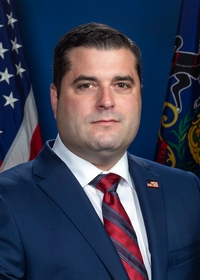
Sen. Devlin Robinson
Sponsored bills
Maddy summaryThis bill amends Pennsylvania's sentencing guidelines to increase penalties for specific offenses committed during riots. It requires the Pennsylvania Commission on Sentencing to create enhanced penalties for crimes like simple assault, aggravated assault, burglary, and criminal trespass when these occur while violating riot laws (18 Pa.C.S. § 5501). The key mechanism is adding a sentencing enhancement factor for such circumstances, modifying the standard penalty ranges for these offenses. The bill directly affects individuals convicted of these specific crimes during riot-related incidents.
Maddy summarySB 916 modifies Pennsylvania's burglary laws and juvenile definitions. It elevates burglary involving intent to steal a firearm or ammunition to a first-degree felony (the most serious category) and adds sentencing enhancements when domestic animals are harmed during burglary or stolen firearms are used in subsequent crimes. For juveniles, it revises the definition of "child" to extend court jurisdiction beyond age 18 for those pursuing education, employment, or training, and updates "delinquent act" to exclude certain serious crimes committed by 15+ year olds involving deadly weapons. The bill directly affects burglary defendants (especially firearm-related cases), courts (with new sentencing options), and juveniles aged 15-21 facing specific charges.
Maddy summarySR 135 is a Senate resolution honoring Pennsylvania veterans on Veterans Day, November 11, 2025. It formally recognizes all Pennsylvania veterans who served during wartime and peacetime, acknowledging their contributions to national security. The resolution encourages communities across Pennsylvania to hold ceremonies on that date to honor approximately 700,000 current Pennsylvania residents who have served in the armed forces. As a commemorative resolution, it does not create new laws or policies but serves as a symbolic gesture of appreciation.
Maddy summarySB 918 sets mandatory minimum prison terms for Pennsylvania residents convicted of illegal firearm possession. First-time offenders face at least 11 months in prison, repeat offenders get a minimum of 5 years for a second conviction, and those with two prior violations face a 15-year minimum. The law requires courts to verify prior convictions before applying these sentences and bars parole until the minimum term is served. It directly affects individuals convicted under Pennsylvania's firearm possession law (18 Pa.C.S. § 6105), particularly those with prior offenses.
Maddy summaryThis Pennsylvania bill amends the state's riot law by defining when group actions become a third-degree felony. It targets participants who act with intent to commit crimes, block government actions, or use weapons (including firearms), and organizers who coordinate, control, or fund riots involving two or more people. Organizers causing death face first-degree felony charges instead of third-degree. The law directly affects individuals involved in organized group disturbances meeting these criteria. It takes effect 60 days after enactment.
Maddy summarySB 917 requires Pennsylvania courts to impose higher sentences for drivers convicted of causing fatal accidents while driving under the influence of multiple drugs or a combination of alcohol and one or more drugs. The bill directs the Pennsylvania Commission on Sentencing to create a specific sentencing enhancement when a driver's blood or breath test shows multiple controlled substances (as defined by law) or alcohol plus at least one controlled substance. This change directly affects drivers found responsible for vehicular homicides involving these substance combinations, increasing their penalties. The law takes effect 60 days after enactment.
Maddy summaryThis resolution designates the week of August 17-23, 2025, as "Social Media Safety and Parental Awareness Week" in Pennsylvania. It aims to raise awareness about online child exploitation, citing statistics such as a 192% increase in online enticement cases (546,000 in 2024) and 1 in 5 teens experiencing sextortion. The resolution encourages educational programming and public awareness efforts to protect minors from social media risks as students return to school, without creating new laws or enforcement mechanisms. It is a non-binding symbolic gesture focused on community education, not a policy change.
Maddy summarySB 699 amends Pennsylvania's Alternative Energy Portfolio Standards Act to add "linear generators" to the definitions of "alternative energy sources" and "tier I alternative energy source." The bill specifically defines linear generators as systems that convert linear motion directly into electricity without flames or sparks, are dispatchable across all power loads, and can operate on multiple fuels including renewable options like hydrogen and biogas. This change directly affects renewable energy producers and distributors who use this technology, expanding the eligible sources under the state's renewable energy requirements. The amendment takes effect 60 days after enactment.
Maddy summaryThis resolution (SR 119) is a non-binding request from the Pennsylvania Senate urging Congress to support the Whole Milk for Healthy Kids Act of 2025 and amend federal law. It specifically seeks to change current requirements under the Healthy, Hunger-Free Kids Act of 2010, which currently restricts school milk options to fat-free or low-fat varieties. The resolution asks Congress to allow whole milk and 2% reduced-fat milk (flavored or unflavored) in Pennsylvania's elementary and secondary schools, and directs federal agencies to update dietary guidelines accordingly. This would permit schools to offer these milk types without risking federal funding, but the resolution itself does not alter any existing law or standards.