

Maddy summaryHB 912 standardizes Pennsylvania's process for issuing concealed firearm carry licenses. It requires a uniform application form (created by the State Police) where applicants must state a valid reason (like self-defense or hunting) and certify they meet legal eligibility. The bill mandates sheriffs to conduct specific background checks within 45 days and adds new requirements for the Attorney General to seek reciprocity agreements with all states for mutual recognition of firearm licenses, reporting progress annually. This directly affects firearm license applicants, local law enforcement, and the Attorney General's office. The bill does not change eligibility criteria but streamlines application procedures and expands interstate recognition efforts.
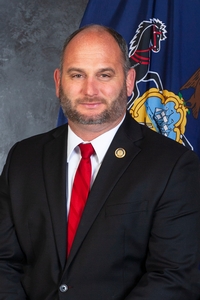
Rep. Eric Davanzo
Sponsored bills
Maddy summaryHB 897 requires Pennsylvania state agencies to prioritize purchasing "American-made" supplies, defined as goods assembled within the United States. The bill adds this definition to procurement rules and mandates agencies to incorporate prioritization into their buying policies. If an agency determines a supply isn’t American-made or unavailable in sufficient quantities, it must publish the decision in the Pennsylvania Bulletin, allowing 30 days for objections with evidence. Affirmed determinations exempt specific supplies from the prioritization requirement.
Maddy summaryHB 766 designates a specific segment of State Route 3037 in Sewickley Township, Westmoreland County - from Waltz Mill Flats Road to Segment 0170/Offset 0950 - as the "PFC Earl 'Butch' Long Memorial Highway." This procedural bill honors PFC Earl "Butch" Long, a Vietnam War infantryman killed in action in 1967, by naming the highway in his memory. The Pennsylvania Department of Transportation will install and maintain signs displaying the highway's new name. The bill does not create new policy or affect any regulations; it solely commemorates the veteran's service and sacrifice.
Maddy summaryHB 548 strengthens Pennsylvania's state preemption of local firearm regulations by declaring that all aspects of firearm regulation - including purchase, sale, possession, and transportation - must follow state law, invalidating any conflicting local ordinances. It directly affects counties, municipalities, and townships that previously enacted stricter gun rules, as well as residents, gun dealers, or organizations challenging such local laws. Key provisions include creating legal remedies for those harmed by illegal local regulations (allowing lawsuits for damages, attorney fees, and injunctions) and explicitly stating that state law supersedes all local efforts. The bill takes effect in 90 days for its core preemption rules, requiring local governments to align with state firearm laws immediately.
Maddy summaryHB 454 repeals Pennsylvania's requirement for a license to carry a firearm (openly or concealed) for most individuals, making it legal to carry without a license statewide, including in Philadelphia where previous restrictions on public streets and property are removed. The bill also repeals provisions about proof of license and related exceptions, while maintaining existing prohibitions for convicted felons and other restricted locations like schools. Additionally, it includes a new provision for a sportsman's firearm permit and specific regulations for antique firearms. The changes directly affect law-abiding Pennsylvanians who previously needed a license for general firearm carry.
Maddy summaryThis bill amends Pennsylvania vehicle laws to establish a new road user charge specifically for electric vehicles. The new fee, set to begin on April 1, 2025, is designed to generate revenue for state roads and bridges, while also updating motorcycle inspection requirements. The legislation takes effect immediately upon approval, with most other provisions becoming active within 60 days.
Maddy summaryHB 1409 updates the Pennsylvania Fish and Boat Commission's authority to set fees for fishing licenses, permits, and issuing agents. The bill allows the commission to adjust specific amounts for various licenses, such as resident annual and senior resident lifetime licenses, as well as different tourist and replacement options, by referencing existing administrative rules. It also establishes fixed fees for special permits, including those for trout fishing and charter boat guides, while capping transaction costs for the automated licensing system at one dollar. This legislation directly impacts anglers and fishing businesses by defining the current fee structure and providing the legal framework for the commission to manage these costs.
Maddy summaryThis bill amends the Pennsylvania Prevailing Wage Act to update definitions regarding construction work. Specifically, it adds "rebar system assembly" to the list of covered activities while removing the phrase "or smaller prefabricated components" from the definition of prefabricated components. These changes clarify which specific tasks and materials are subject to prevailing wage requirements for public projects. The bill also outlines updated duties for the Secretary of Labor and Industry in enforcing these provisions.
Maddy summaryThis bill designates a specific stretch of State Route 3037 in Sewickley Township as the PFC Earl "Butch" Long Memorial Highway to honor a local soldier who died during the Vietnam War. The legislation requires the Department of Transportation to install and maintain signs displaying this new name for traffic traveling in both directions. The act also includes a section detailing the life and military service of Private First Class Long, who was killed in action in 1967 and is buried in Westmoreland County. This measure is a commemorative resolution that does not alter traffic laws or funding but serves to recognize the individual's sacrifice through official naming.
Maddy summaryThis bill requires private health insurers and state-managed health plans to cover biomarker testing when it is used to diagnose, treat, or monitor a specific disease or condition. The legislation defines biomarker testing as the analysis of tissue, blood, or other biological samples to identify indicators of biological processes, while explicitly excluding coverage for general screening purposes. Coverage for these tests must follow the same rules as other medical services, including standard cost-sharing and medical necessity reviews, and the changes will take effect 180 days after the bill is signed.