

Maddy summaryHB 32 amends Pennsylvania's Taxpayer Relief Act to clarify income definitions for senior citizens' property tax and rent rebate programs. It specifically adds a temporary exception: seniors who were already eligible for rebates as of December 31, 2012, may retain eligibility if their household income limit is exceeded solely due to Social Security cost-of-living adjustments (COLAs). This exception applies only to income increases from Social Security COLAs, not other income sources, and expires on December 31, 2016. The change directly affects seniors whose rebate eligibility was previously jeopardized by automatic Social Security payment increases.
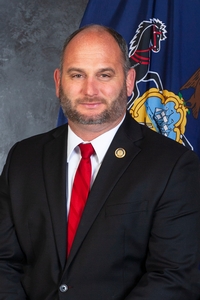
Rep. Eric Davanzo
Sponsored bills
Maddy summaryHB 1152 requires insurance companies to directly reimburse non-network emergency medical services (EMS) agencies for 911 emergency calls within 45 days at 350% of the Medicare ambulance rate for the same service in the same area. EMS agencies must register with the state annually to qualify for direct payments, and insurers cannot demand contracts to facilitate this reimbursement. The insurer's payment covers the full service cost (excluding the patient's copay, coinsurance, or deductible), so EMS agencies cannot bill patients for the remaining amount. This law applies only to non-network EMS providers offering 911 emergency medical services, unless preempted by federal law.
Maddy summaryHB 1112 allows Pennsylvania electric utility customers to request traditional electromechanical analog meters instead of smart meters. Customers can elect this option by notifying their utility company, and if the utility has already installed smart meters, they may charge the customer for the switch - amortized over 12 months - but cannot impose additional fees. The bill directly affects residential and commercial electricity customers who prefer analog meters for privacy or cost reasons. It defines "electromechanical analog meters" as devices with no wireless capabilities, no power line transmission/reception, and specific safety features, while ensuring costs are recovered through approved utility rates.
Maddy summaryThis bill proposes a constitutional amendment to Pennsylvania that would ban all taxes on real property, including land and buildings owned by individuals or businesses. The change would take effect on July 1, 2030, and would apply to taxes imposed by the state government, local municipalities, school districts, or any other political subdivision within the Commonwealth. To become law, the amendment must pass both houses of the General Assembly and then be approved by voters in a statewide election. The bill argues that taxing property violates the inherent right to own and protect property, a principle recognized since Pennsylvania's founding in 1776.
Maddy summaryHB 1035 amends Pennsylvania's Solid Waste Management Act by adding specific definitions for "advanced recycling" and related terms. It clarifies that plastic waste and waste tires processed through advanced recycling (using methods like pyrolysis) are no longer classified as "municipal waste" or "residual waste" under the law. This change directly affects facilities using advanced recycling technology, reducing their regulatory burden under existing waste management rules. The bill takes effect 60 days after enactment.
Maddy summaryHB 861 amends Pennsylvania's Fiscal Code to change how funds from the Pennsylvania Race Horse Development Fund are distributed. It requires annual transfers to the State Racing Fund specifically for medication testing costs at horse racing facilities, including personnel, equipment, and supplies (excluding stables). These funds must be transferred in 52 equal weekly installments before other distributions, with the provision expiring June 30, 2028. This directly affects horse racing facilities, the commission overseeing medication testing, and the fund's allocation process.
Maddy summaryHB 685 requires Pennsylvania schools to accept U.S. currency as payment for admission to school-sponsored activities, such as athletic events, assemblies, or field trips. It applies to all school entities, including public school districts, charter schools, and private schools participating in school activities. The bill mandates that cash must be accepted when fees are charged, while allowing schools to also accept other payment methods like credit cards. It defines "cash" as U.S. coins and paper money recognized as legal tender and clarifies that schools may refuse payments in large denominations that exceed the fee amount.
Maddy summaryHB 942 amends Pennsylvania's Game Commission law to change how full-time enforcement officers are paid. It requires that all full-time officers whose duty is to enforce game laws be classified for compensation "in the same manner as members of the Pennsylvania State Police." This change directly affects Game Commission enforcement officers by aligning their pay structure with State Police standards. The bill applies to compensation earned on or after its effective date, 60 days after enactment. (1-2 sentences as it's a procedural pay classification change.)
Maddy summaryHB 896 requires Pennsylvania courts to impose the death penalty on defendants convicted of first-degree murder who are documented as undocumented migrants under U.S. immigration law (defined as violating 8 U.S.C. Ch. 12). The bill amends sentencing procedures to mandate this specific penalty after the court records the defendant's undocumented status, replacing standard sentencing considerations. It directly affects individuals facing first-degree murder charges who lack legal immigration status in the U.S.
Maddy summaryThis bill designates English as the official language of Pennsylvania and requires state and local government official documents and actions to be in English. It prohibits government policies that favor non-English languages or diminish English's role, while explicitly exempting public safety, health, and justice situations where other languages are necessary. The legislation also restricts the use of state funds to promote or demonstrate preference for languages other than English, with exceptions for foreign language instruction, Native American language preservation, and international commerce. Private businesses and individuals retain the right to use any language they choose, and the law does not apply when federal law requires otherwise.