

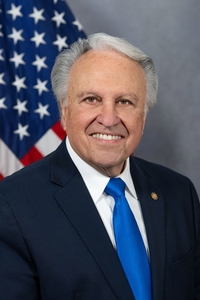
Photo of Eddie Pashinski
D Pennsylvania House · District 121

Rep. Eddie Pashinski

Compare
Total votes
8,241
all sessions
Attendance
100%
18 missed
Near the chamber average
With party
98%
of cast votes
Near the chamber average
Bipartisan score
1%
crosses aisle rarely
Near the chamber average
Sponsored
2,057
bills & resolutions
Near the chamber average
Committees
1
assignment
2,057 bills and resolutions

Sponsored bills

Total
2,057
Primary
89
Co-sponsor
1,968
This page
2,057
matching current filters
Primary HB 404
Passed · Pennsylvania House · Lead sponsor
An Act amending the act of May 17, 1921 (P.L.682, No.284), known as The Insurance Company Law of 1921, in casualty insurance, further providing for conditions subject to which policies are to be issued and for health insurance coverage for certain children of insured parents.

Maddy summaryHB 404 amends Pennsylvania's Insurance Company Law to extend health insurance coverage for children under family policies. It requires policies to cover dependent children up to age 26 (previously 19) and prohibits insurers from denying or restricting coverage based on a child's financial dependency, residency, marital status, school enrollment, or employment. The bill also allows group health plans to extend coverage for adult children up to age 29 if they meet specific conditions, such as not being married, having no dependents, and residing in Pennsylvania or attending school full-time. This affects all health insurance policies sold in Pennsylvania that provide dependent child coverage.

Passed Mar 25, 2025 0 co-sponsors
Co-sponsor HR 141
In committee · Pennsylvania House · Co-sponsor
A Resolution recognizing the week of April 13 through 19, 2025, as "National Public Safety Telecommunicators Week" in Pennsylvania in honor of those whose diligence and professionalism keep our communities and residents safe.

Maddy summaryThis resolution designates April 13-19, 2025, as "National Public Safety Telecommunicators Week" in Pennsylvania. It honors 911 dispatchers (also called public safety telecommunicators) who serve as the first point of contact during emergencies and support emergency responders. The resolution recognizes their critical role in ensuring community safety through their professionalism and dedication during high-pressure situations. As a ceremonial resolution, it does not create new laws or policies.

In committee Mar 24, 2025 1 co-sponsor
Co-sponsor HB 1029
In committee · Pennsylvania House · Co-sponsor
An Act amending the act of June 1, 1937 (P.L.1168, No.294), known as the Pennsylvania Labor Relations Act, further providing for definitions; providing for notice and regulations; further providing for unfair labor practices and for representatives and elections; providing for initial collective bargaining agreement; further providing for prevention of unfair labor practices and for penalties; and imposing penalties.

Maddy summaryHB 1029 amends Pennsylvania's 1937 Labor Relations Act to clarify worker protections and union election processes. It defines "employe" more broadly (excluding independent contractors) and bans agreements that prevent workers from joining class or collective lawsuits. Employers must post notices about labor rights and provide detailed voter lists for union elections within two business days of a board order. The bill also adds new unfair labor practices, including coercing workers to sign agreements that limit their right to pursue collective claims. These changes directly affect Pennsylvania workers, employers, and labor organizations involved in union representation efforts.

In committee Mar 24, 2025 1 co-sponsor
Primary HB 861
In committee · Pennsylvania House · Lead sponsor
An Act amending the act of April 9, 1929 (P.L.343, No.176), known as The Fiscal Code, in additional special funds and restricted accounts, further providing for distributions from Pennsylvania Race Horse Development Fund.

Maddy summaryHB 861 amends Pennsylvania's Fiscal Code to change how funds from the Pennsylvania Race Horse Development Fund are distributed. It requires annual transfers to the State Racing Fund specifically for medication testing costs at horse racing facilities, including personnel, equipment, and supplies (excluding stables). These funds must be transferred in 52 equal weekly installments before other distributions, with the provision expiring June 30, 2028. This directly affects horse racing facilities, the commission overseeing medication testing, and the fund's allocation process.

In committee Mar 19, 2025 0 co-sponsors
Co-sponsor HB 831
In committee · Pennsylvania House · Co-sponsor
An Act establishing a moratorium on for-profit hospital ownership; and directing the Joint State Government Commission to study and issue a report on for-profit hospitals.

Maddy summaryHB 831 establishes a 24-month moratorium on transferring hospital ownership to for-profit entities in Pennsylvania. It directly affects hospitals and health systems seeking to change ownership structures, pausing approvals for such transactions. The bill also requires the Joint State Government Commission to study for-profit hospital ownership patterns, including causes for their rise, cost/benefit comparisons with non-profits, and policy recommendations. The Commission must issue a report to state leaders within 18 months of the law's effective date. The moratorium and study requirements expire 24 months after the bill takes effect.

In committee Mar 10, 2025 1 co-sponsor
Co-sponsor HB 826
In committee · Pennsylvania House · Co-sponsor
An Act amending the act of October 27, 1955 (P.L.744, No.222), known as the Pennsylvania Human Relations Act, further providing for definitions and for unlawful discriminatory practices.

Maddy summaryHB 826 amends Pennsylvania's Human Relations Act to require public venues (like theaters, sports arenas, and events charging admission) to provide free admission for personal care attendants accompanying eligible individuals with disabilities. It defines "attendant care services" to include daily living support such as bathing, mobility assistance, and managing transportation, and specifies that "eligible individuals" are those needing such services due to a disability. The bill prohibits venues from charging personal care attendants for entry when their presence is necessary for the eligible individual to access the event. This directly affects people with disabilities who rely on attendants to participate in public activities and the venues hosting those events.

In committee Mar 6, 2025 1 co-sponsor
Co-sponsor HB 824
In committee · Pennsylvania House · Co-sponsor
An Act amending the act of June 28, 1995 (P.L.89, No.18), known as the Conservation and Natural Resources Act, in Department of Conservation and Natural Resources, further providing for community recreation and heritage conservation.

Maddy summaryHB 824 amends Pennsylvania's Conservation and Natural Resources Act to require the Department of Conservation and Natural Resources to prioritize grant applications for playgrounds, playground equipment, and recreation areas that address accessibility for people with disabilities. The bill specifies that projects must include features like ramped play areas, accessible swings, wheelchair-friendly tables, and adaptations for blind or visually impaired individuals to receive priority. It mandates that the department favor universally designed recreation areas - where all equipment and the space itself are fully accessible - over projects with only partial accessibility. This change directly affects communities applying for state grants to build or improve local playgrounds, ensuring new facilities meet inclusive design standards from the start.

In committee Mar 6, 2025 1 co-sponsor
Co-sponsor HB 776
In committee · Pennsylvania House · Co-sponsor
An Act amending the act of March 10, 1949 (P.L.30, No.14), known as the Public School Code of 1949, in high schools, further providing for assessment of civic knowledge.

Maddy summaryHB 776 requires Pennsylvania high school students to score at least 60% on a civic knowledge assessment to graduate or earn a general equivalency diploma, starting in the 2028-2029 school year. The bill amends the Public School Code to add this graduation requirement, which applies to all students except those with an individualized education program (IEP) if their IEP specifies an exemption. The assessment measures knowledge of civic topics like government structure and citizenship. This policy directly affects all Pennsylvania public high school students seeking graduation or a general equivalency diploma.

In committee Mar 3, 2025 1 co-sponsor
Co-sponsor HB 739
In committee · Pennsylvania House · Co-sponsor
An Act amending the act of May 22, 1951 (P.L.317, No.69), known as The Professional Nursing Law, further providing for title, for definitions, for State Board of Nursing, for dietitian-nutritionist license required, for unauthorized practices and acts not prohibited, for temporary practice permit, for graduates of schools of other states, territories or Dominion of Canada, for persons entitled to practice, for certified registered nurse practitioners and qualifications, for scope of practice for certified registered nurse practitioners, for prescriptive authority for certified registered nurse practitioners, for Drug Review Committee, for professional liability, for reporting of multiple licensure, for continuing nursing education, for punishment for violations, for refusal, suspension or revocation of licenses, for reinstatement of license and for injunction or other process; and providing for the expiration of the State Board of Nursing's power to license certified registered nurse practitioners.

Maddy summaryHB 739 amends Pennsylvania's 1951 Professional Nursing Law to modernize terminology and clarify roles for advanced practice nurses. It replaces "certified registered nurse practitioner" with "APRN-CNP" throughout the law, defines "collaboration" requirements for new APRN-CNPs (requiring 3,600 practice hours before independent work), and updates definitions for "medical nutrition therapy" and "population focus areas." The bill explicitly removes the State Board of Nursing's authority to license APRN-CNPs, shifting that responsibility elsewhere. These changes directly affect registered nurses seeking advanced practice certification and the Board's regulatory role in nursing licensure.

In committee Feb 26, 2025 1 co-sponsor
Co-sponsor HB 77
Passed · Pennsylvania House · Co-sponsor
An Act amending Title 3 (Agriculture) of the Pennsylvania Consolidated Statutes, in food protection, further providing for definitions, providing for food allergy awareness and further providing for powers of department.

Maddy summaryHB 77 updates Pennsylvania's food protection laws to align with the 2022 FDA Food Code. It requires retail food facilities (like restaurants and grocery stores) to prominently display employee allergy awareness posters detailing major allergens and symptoms, and to include allergen information on menus or written materials for customers. The bill also revises definitions of "potentially hazardous food" and mandates that the Pennsylvania Department of Agriculture adopt the FDA Food Code standards, with updates published in the Pennsylvania Bulletin. The law takes effect 60 days after enactment.

Passed Feb 20, 2025 1 co-sponsor
Showing 271 to 280 of 2,057 bills
Previous 1 … 27 28 29 … 206 Next