

Maddy summaryThis bill changes U.S. immigration law to make certain fraud convictions deportable without requiring a minimum fraud loss amount. It targets immigrants (aliens) convicted of fraud against any private individual, fund, corporation, or government entity, removing the previous threshold for deportation. It also adds provisions to revoke citizenship for naturalized citizens convicted of such fraud crimes, requiring courts to cancel their naturalization certificates. The changes apply to fraud committed on or after September 30, 1996, if not previously charged before the bill's enactment.
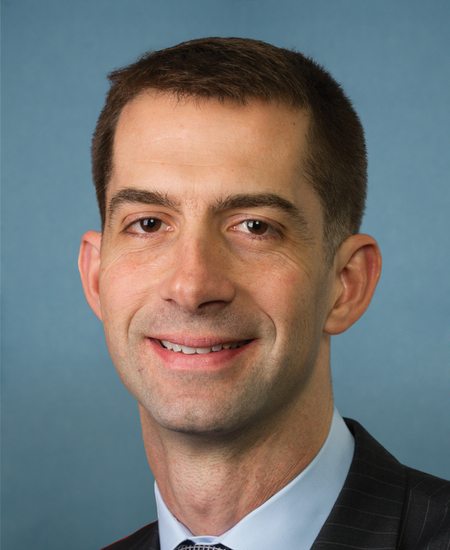
Sen. Tom Cotton
Sponsored bills
Maddy summaryThis bill creates a new category of independent electricity provider called a "consumer-regulated electric utility" (CREU) for systems serving previously unserved electric loads. CREUs operate entirely separate from the main electricity grid (physically "islanded") and are exempt from federal regulations covering rates, reliability standards, interconnection rules, and other oversight by FERC and the Department of Energy. To maintain this exemption, CREUs must never connect to the bulk-power system; if they do, they lose the exemption and become subject to full federal regulation. The bill directly affects new CREUs and their customers who receive service exclusively through these independent systems.
Maddy summaryThis bill creates a legal "protective zone" around National Guard members during deployments under federal law. It defines a 15-foot area marked by signs, warnings, or barriers as a zone where entering or staying is prohibited if done to interfere with their duties. Violating this zone carries fines, up to one year in prison, or up to five years if physical contact occurs. The law explicitly states it does not restrict peaceful protests or protected speech happening outside the marked zone.
Maddy summaryS 3519, the Remote Access Security Act, amends the Export Control Reform Act of 2018 to regulate remote access to U.S.-controlled items (like dual-use technology) via cloud services from outside the U.S. by "foreign persons of concern" (including governments of specified countries and their entities). It defines prohibited remote access as activities posing national security risks, such as enabling weapons development, offensive cyber operations, or human rights violations through spyware. The bill requires new licensing for remote access, imposes penalties for violations, and mandates annual reports to Congress on implementation, with controls set to expire after 10 years. It directly affects U.S. cloud service providers and foreign entities seeking remote access to controlled items.
Maddy summaryThis bill exempts certain non-lethal projectile devices (like pepper ball guns or rubber bullets) from federal firearms and ammunition taxes. It directly affects manufacturers, producers, and importers of these devices by removing tax obligations under IRS Code sections 4181 and 5845. Key provisions define "less-than-lethal" devices as those not expelling standard firearm ammunition, operating below 500 feet per second, and not convertible to lethal weapons. The Secretary of the Treasury must annually update a public list of qualifying devices and report to Congress on non-qualifying devices that exceed the velocity limit.
Maddy summaryThis bill amends key provisions of U.S. immigration law to tighten asylum eligibility requirements. It requires asylum seekers to have attempted to seek protection in transit countries (unless denied protection there), raises the standard for credible fear claims from "significant possibility" to "more likely than not," and adds new grounds for permanent ineligibility (including unlawful entry and visa fraud). It also specifies that families may be detained together for up to 180 days during expedited removal or asylum proceedings. The changes directly affect individuals seeking asylum who entered the U.S. after transiting through other countries or who have immigration violations.
Maddy summaryThis bill enforces a federal law prohibiting states from offering in-state tuition rates to undocumented immigrants at public colleges. It requires colleges to verify students' immigration status using the DHS SAVE system annually and charge undocumented students the higher out-of-state rate instead. States that continue providing in-state tuition to undocumented students could lose federal education funding. The bill directly affects undocumented immigrant students in public colleges across 22 states and D.C., as well as the states and institutions currently offering these subsidies.
Maddy summaryThis bill requires U.S. exporters to obtain a license before sending digital sequences of human- or AI-designed synthetic DNA or RNA to "foreign entities of concern" (such as entities tied to specific countries like China). It directly affects biotechnology companies, researchers, and academic institutions that export these digital genetic blueprints. The key mechanism is a new license requirement for exporting the digital files representing synthetic biological sequences, which are defined as binary files or digital representations of DNA/RNA molecules. This policy change aims to prevent foreign adversaries from accessing U.S. biotechnology research and intellectual property through export channels.
Maddy summaryThis bill modifies federal regulations to allow surplus broiler hatching eggs (eggs intended for hatching chicks) to be sold directly to facilities that break eggs for liquid products ("egg breakers"), rather than requiring them to be used solely for hatching. It exempts these surplus eggs from current FDA rules (21 CFR §118.4(e)) governing their storage and handling, effective upon enactment. The Secretary of Health and Human Services must issue a new rule within 180 days to establish appropriate storage conditions for these eggs during transport to egg breakers. This change primarily affects egg processors and hatcheries by creating a new pathway for surplus eggs to enter the liquid egg supply chain.
Maddy summaryThe PATRIOT Parks Act (S 2308) would allow national parks to charge international tourists an additional surcharge on entrance fees and recreation passes, in addition to standard fees. Park managers would set the entrance fee surcharge amount to maximize revenue without deterring visitors, with those funds staying at the specific park for local maintenance and services. For recreation passes, the surcharge would be sent to a central restoration fund, not the park itself. This policy applies only to international visitors (nonimmigrant tourists), leaving U.S. citizen fees unchanged.