

Maddy summaryThe SAFE Chips Act of 2025 requires U.S. exporters to obtain government licenses before sending advanced computer chips to "foreign adversary countries" (including China, Hong Kong, and Macau) or to entities owned by such countries. It defines "advanced integrated circuits" using specific technical standards, such as high processing power (e.g., 4,800+ performance points) or bandwidth (e.g., 4,100+ gigabytes per second), excluding chips designed for data centers. The bill mandates license denials for these exports and allows the Commerce Secretary to update technical definitions after 30 months, with required Congressional briefings on national security impacts. This directly affects chip manufacturers and companies exporting to specified regions, imposing strict controls on advanced semiconductor trade.
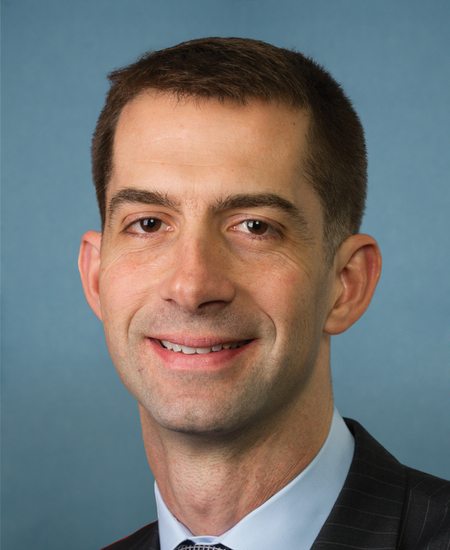
Sen. Tom Cotton
Sponsored bills
Maddy summaryThe American Citizens First Act restricts federal benefits for noncitizens and strengthens immigration enforcement. It bars noncitizens from receiving most federal benefits, including welfare, food assistance, Medicaid (except emergency services), housing aid, and student loans. The bill also allows revoking citizenship for naturalized citizens convicted of violent protests or acts against the government, expands expedited removal for certain immigrants, and requires security reviews for Afghans admitted since 2021. Additionally, it automatically terminates temporary protected status for nationals from countries where the crime rate among them exceeds the national average by 20%, with semiannual crime rate reports to Congress.
Maddy summaryThis bill increases the tax exclusion for capital gains when selling a primary residence. It doubles the exclusion amount from $250,000 (for single filers) to $500,000 and from $500,000 (for married couples) to $1,000,000. The bill also adds an inflation adjustment for amounts after 2025, tying future increases to the cost-of-living adjustment. It directly affects homeowners who sell their primary residence and would otherwise owe tax on profits exceeding the previous limits. The changes apply to sales after the bill's enactment date.
Maddy summaryThe CLEAR Act of 2025 limits legal challenges to energy projects by blocking repeated lawsuits about the same project's authorization. It establishes that once a court rules on any legal action concerning an energy project's authorization (like permits for electricity, fossil fuels, or critical minerals), no further lawsuits about that project can be filed - regardless of the parties or type of relief sought. The bill requires courts to remand procedural errors to agencies within 180 days and sets a 150-day deadline for filing challenges after authorization is public. Exceptions include post-completion violations or enforcement actions by government agencies. This primarily affects energy developers, federal/state agencies, and legal challengers by reducing litigation delays for projects already approved.
Maddy summaryS 3287, the Fair Allocation of Interstate Rates Act, prevents transmission providers serving customers across multiple states from charging out-of-state consumers for electric transmission facilities built to implement a specific state's energy policy (like renewable mandates). It prohibits cost allocation to consumers not residing in the state whose policy led to the facility's construction, unless that consumer's state explicitly consents. The bill establishes that benefits of such facilities are presumed to accrue only to residents of the implementing state, making them the default "cost causers." This directly affects interstate electricity providers and consumers in states with differing energy policies, requiring new cost-allocation rules within 180 days of enactment.
Maddy summaryThis bill (S 3179, the "Halo Act") makes it a federal crime to approach within 25 feet of a Federal immigration enforcement officer after being verbally warned not to, if the person intends to impede the officer's work, threaten them with physical harm, or harass them. The law defines "harass" as causing substantial emotional distress with no legitimate purpose and specifies that the warning must be given by the officer. Violators face fines, up to 5 years in prison, or both. It directly affects individuals who interfere with immigration enforcement activities, not the officers themselves.
Maddy summaryThe Shutdown Fairness Act guarantees standard pay for covered government workers and contractors during federal funding gaps. It directly affects federal employees, military personnel on active duty, and contractor staff who must work during a shutdown, ensuring they receive their regular compensation without regard to prior furloughs. The bill requires agencies to use emergency funds to pay covered employees within 7 days of enactment for the 2025-2026 shutdown period, and on regular pay schedules for future shutdowns. This applies retroactively from September 30, 2025, and limits funds strictly to pay, prohibiting reprogramming for other purposes.
Shutdown Fairness Act This bill provides appropriations to pay federal employees who work during a government shutdown. Specifically, the bill provides appropriations for federal agencies to provide standard rates of pay, allowances, pay differentials, benefits, and other payments to excepted employees for work performed during any period in which interim continuing appropriations or full-year appropriations are not in effect for a fiscal year (i.e., a government shutdown). An excepted employee is an employee who is required to work during a government shutdown. Under current law, excepted employees are not paid until the government shutdown is over. This bill provides appropriations to pay excepted employees during a government shutdown. The bill also specifies that the term excepted employee includes certain contractors who support federal employees during a government shutdown and members of the Armed Forces who are on active duty. A federal agency may not use the funds provided by this bill during any period in which continuing appropriations are in effect for the purpose of paying excepted employees of the agency. The bill must take effect as if it had been enacted on September 30, 2025.
Maddy summarySRES 490 is a Senate resolution (not a bill) that affirms the U.S. Senate's position on maintaining American leadership in artificial intelligence. It states that preserving U.S. AI dominance is critical for national security, economic competitiveness, and global influence, particularly in countering China's AI investments and reliance on U.S. chips. The resolution supports existing policies like export controls on advanced chips and emphasizes prioritizing U.S. companies' access to AI resources while restricting adversaries' access. It does not create new laws or alter current policy but expresses the Senate's endorsement of the White House AI Action Plan and ongoing efforts to secure U.S. technological advantages.
Maddy summaryThis bill defines "copy-cat ingredients" as substances mimicking approved drugs but made via different processes or with lower quality, and clarifies "counterfeit drugs" under existing law. It updates the Fentanyl Sanctions Act to replace all references to "opioid" with "illicit drug," expanding the law's scope to cover all counterfeit pharmaceuticals - not just opioid-related products. The bill also adds a waiver allowing access to medications on the HHS drug shortage list. These changes help regulators and law enforcement better identify and address counterfeit drugs affecting patients and the healthcare system.