

Life at Conception Act This bill declares that the right to life guaranteed by the Constitution is vested in each human being at all stages of life, including the moment of fertilization, cloning, or other moment at which an individual comes into being. Nothing in this bill shall be construed to authorize the prosecution of any woman for the death of her unborn child.
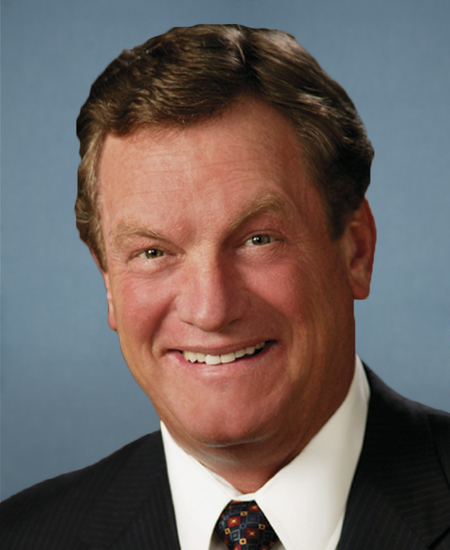
Rep. Michael K. Simpson
Sponsored bills
Standardizing Thresholds Of Penalties for Fentanyl Act or the STOP Fentanyl Act This bill reduces the drug quantity thresholds that trigger a mandatory minimum prison term for a defendant who manufactures, distributes, imports, exports, or possesses with intent to distribute fentanyl. The bill also creates enhanced criminal penalties for certain violations involving fentanyl that was imported along the U.S.-Mexico border. Specifically, the bill reduces from 400 to 5 grams the fentanyl quantity and from 100 to 0.05 grams the fentanyl analogue quantity that trigger a mandatory minimum prison term for high-level first-time or repeat offenders. It also reduces from 40 to 0.5 grams the fentanyl quantity and from 10 to 0.005 grams the fentanyl analogue quantity that trigger a mandatory minimum prison term for low-level first-time or repeat offenders. Additionally, the bill creates enhanced mandatory minimum prison terms for importing or exporting fentanyl that was imported along the U.S.-Mexico border.
Ninth Circuit Court of Appeals Judgeship and Reorganization Act of 2023 This bill divides the U.S. Court of Appeals for the Ninth Circuit into two judicial circuits: (1) the Ninth Circuit, and (2) a new Twelfth Circuit. The Ninth Circuit is composed of California, Guam, Hawaii, and Northern Mariana Islands. The new Twelfth Circuit is composed of Alaska, Arizona, Idaho, Montana, Nevada, Oregon, and Washington.
Maddy summaryHR 269 would add one federal district judge position for the U.S. District Court in Idaho, increasing its authorized judgeship count from two to three. The bill requires the President to appoint the new judge, subject to Senate confirmation, to handle the court's caseload. It also updates the official table in federal law (Title 28, U.S. Code) to reflect this change in Idaho's authorized judgeships. This is a procedural adjustment to court staffing, not a policy change affecting the public.
Maddy summaryH.J.Res. 12 proposes a constitutional amendment requiring the federal government to balance its budget annually, meaning spending cannot exceed revenue except under specific circumstances. It would directly affect Congress and the President by mandating that annual budgets must not exceed revenue, with exceptions requiring a 3/5 vote in both chambers of Congress or a military conflict waiver approved by a joint resolution. Key provisions include prohibiting increases to the national debt without a 3/5 congressional vote, requiring the President to submit a balanced budget proposal each year, and defining "receipts" to exclude borrowing. The amendment would take effect five years after ratification by 38 states (three-fourths of states) and includes limited waivers for declared wars or imminent national security threats. This is a procedural constitutional change, not a spending bill, and would fundamentally alter federal budgeting processes.
Maddy summaryThis bill establishes nationwide recognition for valid concealed carry permits. It allows permit holders from any state to carry concealed handguns in states that either issue such permits or don't ban concealed carry, provided they carry a photo ID and their valid permit. Key provisions include making presentation of a valid permit and ID prima facie evidence of compliance, shifting the burden of proof to prosecutors if challenged, and requiring courts to award attorney fees to successful defendants. It does not override state laws prohibiting concealed carry on private property or government lands, nor does it affect restrictions on federal lands like national parks.
Maddy summaryHR 53 (FIND Act) requires federal contractors to certify they do not refuse to work with firearm manufacturers, dealers, ammunition sellers, or related safety device companies based on bias. It prohibits main contractors from awarding subcontracts exceeding 10% of a contract’s value to entities that fail to make this certification, and bans efforts to circumvent the rule through complex subcontract tiers. The law applies to all federal procurement contracts, directly affecting businesses bidding on government work. Violations risk contract termination and suspension from future government contracts.
Maddy summaryHRES 641 is a ceremonial resolution recognizing the 75th anniversary of the National Association of Conservation Districts (NACD). It celebrates NACD's history as a locally led conservation organization with 3,000 districts across all 50 states and territories, which works with landowners and governments to manage natural resources. The resolution describes NACD's mission of promoting voluntary, incentive-driven conservation programs at the local level. As a non-binding resolution, it does not create new laws or funding, but formally honors NACD's role in conservation efforts.
Cardiovascular Advances in Research and Opportunities Legacy Act This act addresses research, education, and awareness concerning valvular heart disease and its treatment. This disease is caused by damage to or disease affecting any valve that controls blood flow in the heart. The National Institutes of Health may conduct or support research on the disease in consultation with the National Heart, Lung, and Blood Institute (NHLBI). The NHLBI must also conduct a workshop on mitral valve prolapse, which occurs when the valve between the chambers of the left side of the heart seals improperly. The Department of Health and Human Services (HHS) must develop best practices to treat valvular heart disease. HHS may also carry out other projects to increase education and awareness of the disease.
This bill extends through FY2021 the inapplicability of the requirement for counties to elect to receive certain payments under the Secure Rural Schools and Community Self-Determination Act of 2000. That act provides compensation to counties for the presence of untaxable federal land within their borders.