

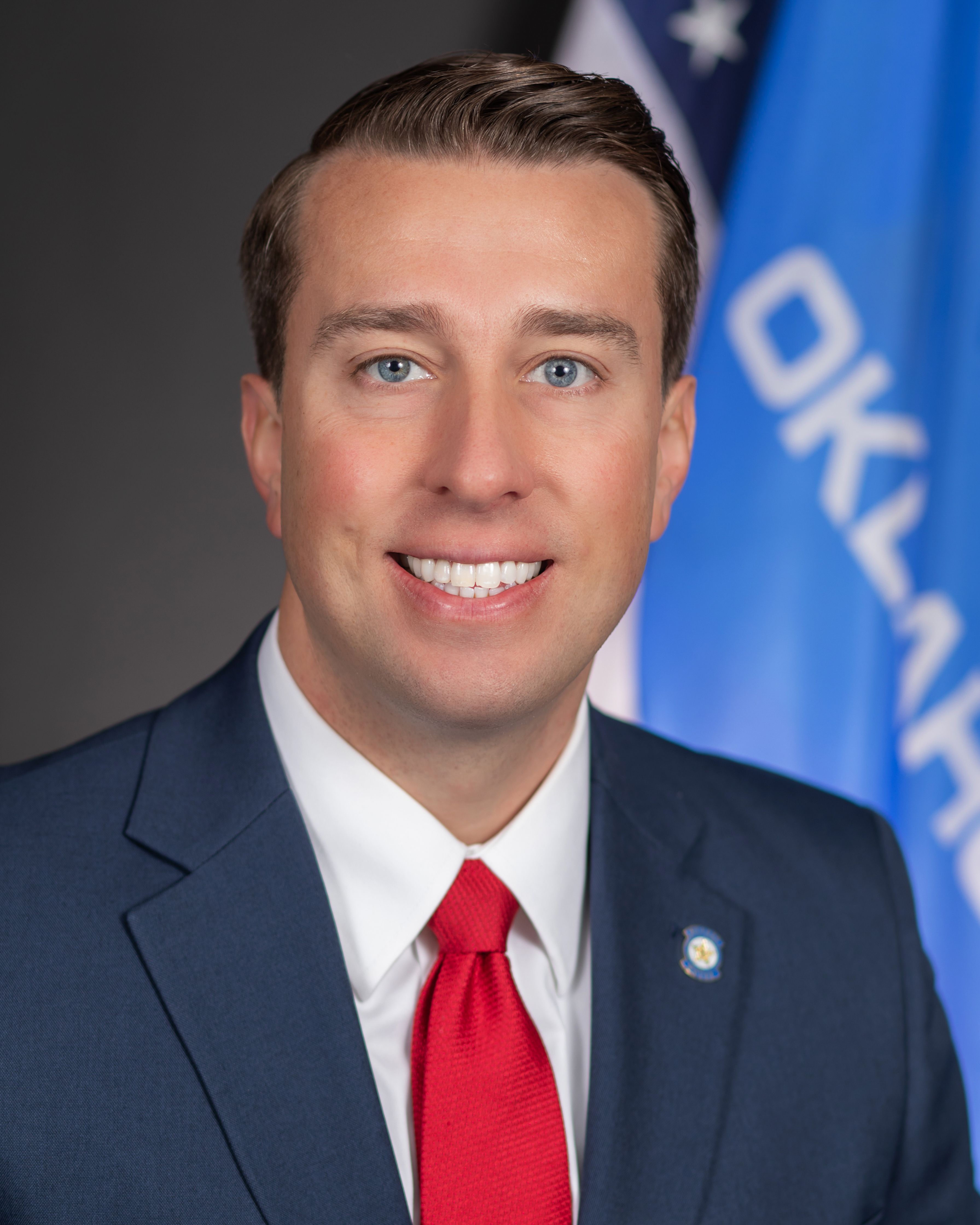
Photo of Collin Duel
R Oklahoma House · District 31 On the 2026 ballot

Rep. Collin Duel

Compare
Total votes
4,515
all sessions
Attendance
97%
103 missed
Near the chamber average
With party
96%
of cast votes
Near the chamber average
Bipartisan score
3%
crosses aisle rarely
Near the chamber average
Sponsored
110
bills & resolutions
Near the chamber average
Committees
3
assignments
110 bills and resolutions

Sponsored bills

Total
110
Primary
110
Co-sponsor
0
This page
110
matching current filters
Primary SB 1118
Failed · Oklahoma Senate · Lead sponsor
Judicial retirement; mandating retirement of certain judicial officers upon certain age; authorizing completion of certain term. Effective date.

Maddy summarySenate Bill 1118 requires Oklahoma judges (including Supreme Court justices, appellate judges, and district court judges) to retire upon reaching age 75, though they may finish their current term if they choose. The bill mandates that current judges must retire on the bill’s effective date but allows them to complete their existing term. It references existing retirement benefits and prohibits re-election, retention, or appointment of judges who have reached 75. The bill failed in committee on March 27, 2025, with 18 votes in favor and 26 against.

Failed Mar 27, 2025 0 co-sponsors
Primary SB 1118
Failed · Oklahoma Senate · Lead sponsor
Judicial retirement; mandating retirement of certain judicial officers upon certain age; authorizing completion of certain term. Effective date.

Maddy summarySB 1118 mandates that Oklahoma judges serving on the Supreme Court, Court of Criminal Appeals, Court of Civil Appeals, or district courts must retire upon reaching age 75, though they may complete their current term if they turn 75 during it. The bill applies directly to these judicial officers and specifies that retired judges will receive retirement benefits as currently provided by law. It requires judges already at age 75 to retire on the bill’s effective date, unless they choose to finish their current term. The legislation also prohibits the election, retention, or appointment of individuals who have reached age 75. (Note: The bill failed to pass with a 18-26 vote on March 27, 2025.)

Failed Mar 27, 2025 0 co-sponsors
Primary SB 729
In committee · Oklahoma Senate · Lead sponsor
Oklahoma Consumer Protection Act; adding actions prohibited as unlawful practices. Effective date.

Maddy summarySB 729 amends Oklahoma's Consumer Protection Act to add 34 new prohibited deceptive practices. It bans false claims about product origins, bait-and-switch advertising, misleading price promotions, and other deceptive sales tactics that mislead consumers. The law directly affects businesses selling goods or services to Oklahoma consumers by expanding existing protections against false advertising and fraud. These changes strengthen consumer safeguards under the current legal framework without creating new regulatory requirements.

In committee Mar 11, 2025 0 co-sponsors
Primary SB 729
In committee · Oklahoma Senate · Lead sponsor
Oklahoma Consumer Protection Act; adding actions prohibited as unlawful practices. Effective date.

Maddy summarySB 729 amends Oklahoma's Consumer Protection Act to add 34 new prohibited business practices that directly affect consumers and businesses operating in Oklahoma. It bans deceptive tactics like falsely claiming a product is "new" when it's used, misleading advertising about origins or prices, "bait-and-switch" schemes, and deceptive debt collection methods (such as threatening lawsuits for expired debts). The bill expands consumer protections by making these specific actions unlawful under state law, with penalties for violations. Currently pending in the legislature (reported out of committee but not yet passed), it would take effect upon enactment.

In committee Mar 11, 2025 0 co-sponsors
Primary SB 937
In committee · Oklahoma Senate · Lead sponsor
Health care; creating the Uniform Health-Care Decisions Act of 2025. Effective date.

Maddy summaryOklahoma's SB 937 establishes the "Uniform Health-Care Decisions Act of 2025," creating a legal framework for advance health care planning. It defines when an individual has the capacity to make health care decisions (including understanding risks/benefits), presumes capacity unless rebutted by a qualified health professional, and allows individuals to create health care instructions or appoint agents. The bill requires health care providers to document these instructions in medical records, prohibits certain family members from serving as agents, and specifies that conflicting instructions revoke prior ones. This directly affects Oklahomans planning future health care, their providers, and those acting as surrogates when capacity is disputed.

In committee Mar 3, 2025 0 co-sponsors
Primary SB 937
In committee · Oklahoma Senate · Lead sponsor
Health care; creating the Uniform Health-Care Decisions Act of 2025. Effective date.

Maddy summarySB 937 creates Oklahoma's "Uniform Health-Care Decisions Act of 2025," establishing clear rules for when adults can make their own health care decisions. It presumes capacity unless rebutted by a qualified professional's finding (e.g., a physician or psychologist), and requires documentation for advance directives like living wills or health care powers of attorney. The bill disqualifies facility employees (unless family) from serving as health care agents and specifies how conflicting directives are resolved. This directly affects all Oklahomans planning for future medical decisions, standardizing the process for advance care planning.

In committee Mar 3, 2025 0 co-sponsors
Primary SB 196
In committee · Oklahoma Senate · Lead sponsor
Oklahoma Water Resources Board; making an appropriation. Emergency.

Maddy summarySB 196 appropriates $1.2 million from the state's General Revenue Fund to the Oklahoma Water Resources Board for infrastructure grants to rural water districts. The funds are intended to support water infrastructure projects in rural communities across Oklahoma. The bill declares an emergency to allow it to take effect immediately upon approval. This is a funding measure focused on direct financial support for rural water systems, with no other policy changes or provisions.

In committee Feb 13, 2025 0 co-sponsors
Primary SB 196
In committee · Oklahoma Senate · Lead sponsor
Oklahoma Water Resources Board; making an appropriation. Emergency.

Maddy summarySB 196 appropriates $1.2 million from the General Revenue Fund to the Oklahoma Water Resources Board for infrastructure grants to rural water districts in the 2023 fiscal year. This funding directly supports rural communities by helping them upgrade or maintain water systems. The bill declares an emergency to allow immediate implementation upon approval, though it does not change existing water regulations or create new requirements for water districts.

In committee Feb 13, 2025 0 co-sponsors
Primary SB 334
In committee · Oklahoma Senate · Lead sponsor
Public buildings and public works; modifying price threshold for certain construction contract negotiations with qualified contractors. Effective date. Emergency.

Maddy summaryThis Oklahoma bill increases the threshold for direct negotiation of public construction contracts from $10,000 to $25,000. It allows local governments and public agencies to negotiate contracts under $25,000 with qualified contractors without requiring competitive bids, affecting routine maintenance and small-scale public projects. The change modifies existing rules to streamline procurement for smaller contracts while maintaining bidding requirements for projects over $25,000. This amendment applies to most state and local government construction work, excluding federal-funded projects and school district maintenance.

In committee Feb 10, 2025 0 co-sponsors
Primary SB 334
In committee · Oklahoma Senate · Lead sponsor
Public buildings and public works; modifying price threshold for certain construction contract negotiations with qualified contractors. Effective date. Emergency.

Maddy summarySB 334 increases the price threshold for public construction contracts that can be negotiated without competitive bidding from $10,000 to $25,000. This change affects public agencies like counties, cities, and school districts when awarding contracts for infrastructure, buildings, or repairs under $25,000. Previously, only contracts under $10,000 could be negotiated, but now agencies can use simplified processes for larger projects. The bill also specifies that school district maintenance contracts under $25,000 may be negotiated, while those between $50,000 and $100,000 must still use competitive bidding.

In committee Feb 10, 2025 0 co-sponsors
Showing 51 to 60 of 110 bills
Previous 1 5 6 7 11 Next