

Maddy summarySB 63 establishes a nine-member Board of Motor Vehicles to oversee North Carolina's Division of Motor Vehicles, replacing the current structure where the Commissioner is appointed by the Transportation Secretary. The Board will appoint the Motor Vehicles Commissioner and include members from the Transportation Secretary, Information Technology Secretary, Highway Patrol, and appointments by the Governor and General Assembly. The bill also mandates a study by the Department of Transportation to evaluate creating a separate Motor Vehicle Authority (replacing the current Division), including feasibility, required legal changes, a timeline, and implementation steps. The study must be completed and reported to the General Assembly by January 1, 2026, but does not create the Authority itself.
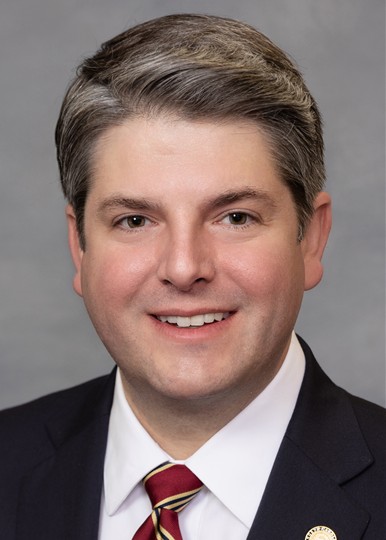
Sen. Brad Overcash
Sponsored bills
Maddy summarySB 506 increases funding for North Carolina's Advanced Teaching Roles (ATR) program, which provides salary supplements to teachers in specialized roles. It allocates an additional $16.2 million for 2025-2026 and $20.1 million for 2026-2027 (totaling $27.1M and $31M annually) to fund these supplements, plus $1 million more for program expansion. The bill directs the Department of Public Instruction to distribute these funds to public school districts participating in the ATR program, as outlined in state law (G.S. 115C-310.13). This funding increase directly affects eligible teachers in participating schools by boosting their salary supplements. The bill becomes effective July 1, 2025, pending legislative approval.
Maddy summarySB 97 adds stomach cancer (gastric cancer) to the list of cancers presumed to be work-related for firefighters under North Carolina's Public Safety Employees' Death Benefits Act. This means firefighters who die from stomach cancer will automatically qualify for line-of-duty death benefits without needing to prove occupational connection. The bill appropriates $500,000 annually from 2025-2027 to cover these new benefits. It takes effect July 1, 2025, applying to qualifying deaths occurring on or after that date.
Maddy summarySB 490 allows individuals who disagree with certain agency decisions - such as funding denials related to eminent domain proceedings - to appeal those determinations to a superior court. It requires agencies to notify people of their right to appeal within 30 days of a final decision and sets clear procedures for filing a petition, including serving the agency and requesting a de novo court review. The law specifies courts can overturn agency decisions only if they violate the constitution, fail to follow state/federal law, or contain legal errors. This directly affects property owners or applicants challenging agency actions under North Carolina's eminent domain and funding laws.
Maddy summarySB 491 requires debt settlement companies in North Carolina to obtain a state license before offering services to consumers. It sets application requirements including a $2,000 nonrefundable fee, criminal background checks, financial disclosures, and proof of compliance with specific operational standards. The law exempts banks, lawyers, credit unions, and nonprofit organizations meeting federal tax-exempt criteria from licensing. It also clarifies that assisting consumers in enrolling in free federal student loan programs does not count as debt settlement under this law.
Maddy summarySB 504, the North Carolina Farmland and Military Protection Act, prohibits foreign governments designated as "adversarial" by the U.S. Department of State from purchasing, leasing, or holding interests in agricultural land or land within 75 miles of military installations in North Carolina. The bill defines agricultural land broadly (excluding small research leases under 250 acres) and specifically lists military sites like Fort Bragg, Camp Lejeune, and Seymour Johnson Air Force Base. Any violation would void the transfer, and the law takes effect on December 1, 2025. This directly affects adversarial foreign governments seeking to acquire such land, aiming to protect food production and military security.
Maddy summarySB 619 establishes North Carolina's AI Academic Support Grant Program, providing $10,060,560 in recurring funds for public school districts to contract with Khan Academy for its Khanmigo AI tool. The program directly affects public schools serving grades 6-12, requiring districts to use funds exclusively for Khanmigo licenses, associated teacher training, and secure class rostering systems approved by the state. Schools must annually evaluate Khanmigo's use and report metrics like student interactions, teacher usage, and impacts on learning outcomes to the legislature. A separate study by the Office of Learning Research will measure Khanmigo's effectiveness on student performance, with results due by April 2028.
Maddy summarySB 701 allows North Carolina state and local law enforcement officers with at least 30 years of service to continue receiving retirement benefits while remaining actively employed. Specifically, officers aged 59.5 or older can elect to receive their retirement allowance without separating from their current law enforcement position. The bill requires employers to cover both employee and employer retirement contributions during this period, while prohibiting additional service credit accrual or eligibility for disability/supplemental retirement benefits. This policy directly affects qualifying officers who wish to stay on duty while maintaining their retirement income.
Maddy summarySB 724 prohibits unauthorized camping in public parks, sidewalks, and other public spaces (like non-designated areas), except for temporary sites specifically approved for homeless encampments. It defines "public camping" as using tents, bedding, or personal items on public property without authorization, making violations a misdemeanor punishable by fines or short jail time (with first offenses directed to shelters instead of charges). Local governments must enforce this ban and cannot allow regular camping on non-designated public areas, while citizens can sue municipalities that fail to comply. The bill also withholds state homelessness funding from counties or cities that violate these provisions and fail to correct violations after notice.
Maddy summarySB 689 requires North Carolina's Charter Schools Review Board to approve all state rules affecting charter schools, shifting this authority from the State Board of Education. The bill exempts charter schools from reporting class rank on student transcripts and permits them to use alternative teacher evaluations aligned with state teaching standards. Low-performing charter schools must now submit improvement plans directly to the Review Board (instead of the State Board of Education), and the Board gains authority to review federal funding decisions for charter schools. Additionally, the Review Board may hire legal counsel without needing prior approval.