

Maddy summarySB 435 restores education-based salary supplements for North Carolina teachers and instructional support personnel (ISP) that were previously eliminated. It directs the State Board of Education to use the 2013 policy (TCP-A-006) to determine eligibility for the "M" salary schedule and degree-based pay increases (e.g., for master's or doctoral degrees). The bill appropriates $8 million from the General Fund for the 2025-2026 fiscal year to fund these reinstated supplements. The law takes effect on July 1, 2025, directly affecting eligible educators' pay through revised salary calculations.
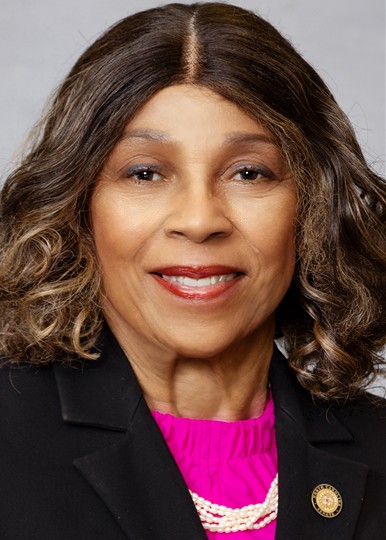
Sen. Joyce Waddell
Sponsored bills
Maddy summarySB 454, the Community Safety Act, allocates $5.5 million in state funds for North Carolina law enforcement agencies over the 2025-2026 fiscal year. It provides grants for community policing programs ($1 million), officer incentives for exemplary service or diversity efforts ($1.5 million), and additional detective funding for severe crimes ($2 million). The bill also revises use-of-force policies to ban strangleholds and neck restraints as acceptable tactics, requiring officers to use minimum force and prioritize de-escalation. Additionally, it sets a minimum hiring age of 21 for officers and allows denial of certification based on certain felony or misdemeanor convictions, regardless of expungement. These provisions directly affect all law enforcement agencies and officers in North Carolina.
Maddy summarySB 457 requires automatic voter registration for eligible North Carolina residents at driver's license offices, public agencies, community colleges, and UNC system institutions starting January 2026. Individuals applying for or renewing a driver's license, ID card, or college enrollment would be automatically registered to vote unless they explicitly decline during the process. The bill mandates clear disclosures about voter qualifications, penalties for false information, and an outreach campaign by the State Board of Elections. Registration applications submitted at these locations must meet standard deadlines (e.g., received by 5:00 PM, 25 days before an election) to be valid for upcoming votes.
Maddy summarySB 386 establishes same-day voter registration on election day in North Carolina, allowing eligible individuals to register and vote immediately at their county's election office or early voting site. It also permits 16- and 17-year-olds to preregister to vote for upcoming elections they will qualify for upon turning 18. To register under this bill, voters must provide proof of residence (e.g., utility bill, bank statement) and photo ID, and submit a completed registration form. The bill modifies existing deadlines and primary election rules to align with these new registration provisions. This changes how voters can register and participate, focusing on expanding access while maintaining verification requirements.
Maddy summarySB 356 requires the North Carolina Secretary of Revenue to refund local sales and use taxes paid indirectly by the North Carolina Global Transpark Authority (GTA) directly back to the GTA itself. This administrative change ensures the GTA receives tax refunds it has already paid, rather than having them processed through other channels. The bill applies to refunds for the first full quarter occurring after it becomes law. This is a procedural adjustment to tax refund handling for the GTA, a state agency focused on economic development.
Maddy summarySB 365 creates a new Class F felony for entering someone's property without legal justification during a declared state of emergency in an affected county and damaging or taking another person's temporary housing. It specifically targets acts against temporary shelters like tents, mobile homes, or vehicles used as emergency housing, excluding permanent structures. The law imposes felony penalties for these actions and allows victims to seek triple damages plus legal costs. It applies only to counties within an emergency area during an active state of emergency, as defined by existing state law, and takes effect December 1, 2025.
Maddy summarySB 367 allocates $8 million from the Education Lottery Fund to four North Carolina Historically Black Colleges and Universities (HBCUs) - Bennett College, Johnson C. Smith University, Livingstone College, and Shaw University - for campus capital improvement projects like building repairs or new facilities. Funding is distributed proportionally based on each HBCU’s number of North Carolina resident undergraduate students receiving federal Pell Grants. The bill, effective July 1, 2025, provides nonrecurring funds specifically for physical campus upgrades at these institutions. It directly affects the listed HBCUs and their enrolled students who qualify for Pell Grants.
Maddy summarySB 379, the Senior Care Assurance Act, expands healthcare access for North Carolina seniors (65+) by enhancing Medicaid coverage for preventive screenings and chronic care services. It creates two new programs: a $2.5 million annual grant program to fund free health screenings and geriatric care for low-income seniors (at or below the federal poverty level), prioritizing rural and underserved areas, and a $2 million annual program to help seniors purchase telehealth equipment and internet access, with priority for rural seniors. The bill also updates telehealth infrastructure funding to support rural healthcare providers in establishing telehealth services. These provisions directly benefit seniors facing financial or geographic barriers to care, focusing on preventive health and independent aging.
Maddy summarySB 381 expands North Carolina's anti-discrimination protections to cover housing and employment. It adds sexual orientation, gender identity, military/veteran status, and genetic information to the list of protected characteristics in housing (e.g., rentals, sales, loans) and employment (for employers with 15+ staff). The bill prohibits specific discriminatory actions like refusing housing based on protected status, denying employment opportunities, or making biased land-use decisions. It directly affects residents, renters, job seekers, and businesses operating in these sectors across the state.
Maddy summarySB 366 increases Medicaid payment rates for personal care services to $7.50 per 15-minute increment and private duty nursing to $16.25 per 15-minute increment. It directly affects healthcare providers who deliver these services to Medicaid beneficiaries through programs like personal care services and private duty nursing. The bill allocates $119.2 million annually in state funds (with matching federal funds) to cover the rate increases for the 2025-2027 fiscal biennium. The changes take effect July 1, 2025.