

Maddy summaryHB 571 appropriates $500,000 from the state General Fund to the Department of Public Safety for a grant program treating police officers diagnosed with PTSD. It directly affects North Carolina police officers who have received a clinical PTSD diagnosis. The key provision establishes a state-funded grant program to cover treatment costs, with funds allocated for the 2025-2026 fiscal year. The program becomes effective July 1, 2025, and focuses solely on providing financial support for treatment, not on expanding eligibility or altering diagnosis standards.
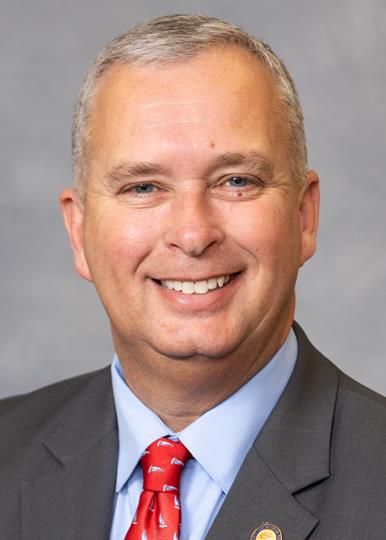
Rep. Todd Carver
Sponsored bills
Maddy summaryHB 275 increases penalties for drivers who fail to yield the right-of-way to blind or partially blind pedestrians using a white cane (white or red-tipped) or a guide dog. It requires drivers to come to a full stop, leave a clear path, and remain stopped until the pedestrian has crossed at both uncontrolled intersections and signal-controlled crossings where the pedestrian is already moving when lights change. This bill directly affects drivers operating vehicles in North Carolina and blind/partially blind pedestrians using visible signals. The penalty for violating this law becomes a Class 2 misdemeanor, effective December 1, 2026.
Maddy summaryHB 534 appropriates $700,000 from North Carolina's General Fund for the 2025-2026 fiscal year to establish sexual assault nurse examiner (SANE) training programs at Rowan-Cabarrus Community College and Wake Technical Community College. Each college receives $350,000 to hire a full-time faculty member ($105,000), a clinical coordinator ($105,000), purchase equipment/supplies ($45,000), and cover program development and accreditation costs ($95,000). The bill directly affects these two community colleges and future healthcare professionals seeking SANE certification. It creates a concrete funding mechanism to expand training capacity for nurses specializing in sexual assault victim care.
Maddy summaryHB 511 establishes new salary levels for full-time magistrates in North Carolina, directly affecting these court officers who handle minor cases like traffic violations and small claims. The bill appropriates $11.5 million annually from the General Fund for 2025-2027 to fund these increases, with specific salary steps outlined in the law. Magistrates will receive raises every two years for the first three experience levels and every four years for higher levels, starting at $47,228 for new hires and reaching $90,498 for the highest step. The changes take effect July 1, 2025, and apply to magistrates working at least 40 hours weekly.
Maddy summaryHB 498 creates a retirement credit for North Carolina teachers who served in the military. It allows veterans to count up to four years of active duty service toward their state retirement system, provided they weren’t dishonorably discharged, served before becoming a teacher, and meet licensure requirements. The bill modifies the retirement system to include this credit, requiring employers to pay a lump sum covering the retirement system’s increased liability for the credited service. This directly affects military veterans transitioning to teaching careers in North Carolina, making their prior service count toward retirement benefits.
Maddy summaryHB 186, the "Stars and Stripes Commitment Act," requires all North Carolina public schools (including charter, regional, and laboratory schools) to schedule the daily recitation of the Pledge of Allegiance within one hour of the start of the instructional day. It also mandates that schools display U.S. and North Carolina flags in classrooms when available and provide age-appropriate instruction about the flag and pledge’s meaning. The bill applies to all school governing bodies and state education board meetings, requiring the pledge to open each meeting. Crucially, it explicitly states the policy does not compel anyone to stand, salute, or recite the pledge. The law takes effect for the 2025-2026 school year.
Maddy summaryHB 223 authorizes the Town of Mooresville to transfer its owned land to developers or nonprofits for building housing specifically for low- and moderate-income residents, veterans, and emergency responders. The bill requires that any transferred property include deed restrictions ensuring it remains housing for these groups, with the land reverting to the town if misused before the agreed period. Conveyances must be approved via a public board resolution posted online 10 days in advance. This policy change directly enables the town to expand targeted housing options without requiring payment for the land.
Maddy summaryHB 28, the "Gun Violence Prevention Act," creates a new criminal offense for individuals convicted of a felony who possess a firearm or "weapon of mass death and destruction" (as defined in state law) during the commission or attempt of another felony. It imposes stricter penalties: a Class C felony if the weapon is discharged, Class D for brandishing (displaying the weapon), and Class F for other violations. This law applies specifically to convicted felons who already face restrictions on firearm possession, treating this additional offense as separate from the underlying felony. The bill takes effect December 1, 2025, for offenses committed on or after that date.
Maddy summaryHB 400, "Bentley's Law," requires defendants convicted of certain felony death-by-vehicle offenses (specifically violations of G.S. 20-141.4 subsections (a1), (a5), or (a6)) to pay child support as restitution to the minor children of the deceased victim. The court must order payments until each child turns 18 and graduates high school, considering the child’s needs, living standards, and custody arrangements. Payments are made to the clerk of court for distribution to the surviving parent or guardian within 10 days, with enforcement treated as a civil judgment. This law directly affects children of victims in these specific vehicular homicide cases and mandates financial support through the criminal sentencing process.
Maddy summaryHB 35 designates November of each year as Military Appreciation Month in North Carolina. The bill creates a symbolic recognition within state law, honoring military service members and veterans during this month. It does not establish new programs, funding, or requirements - it simply formally names November for this purpose. The bill affects the state government's official calendar and public recognition efforts, with no direct impact on individuals or organizations.