

Maddy summaryHB 791, the Women's Safety and Protection Act, defines "biological sex" (based on physical characteristics at birth) and "gender" in North Carolina law and mandates that single/multiple occupancy restrooms, changing facilities, and sleeping quarters in state-funded facilities (including public schools, prisons, domestic violence centers, and juvenile facilities) be designated for use by one biological sex at a time. The bill requires facilities to have policies ensuring only one biological sex uses these spaces simultaneously, with exceptions for family use, maintenance, medical emergencies, or safety threats. It specifically prohibits students from sharing sleeping quarters with individuals of another biological sex in public schools unless family members or with parental permission. The law applies to all covered facilities receiving state funds, including public schools and domestic violence centers, and subjects its provisions to "intermediate scrutiny" under constitutional review.
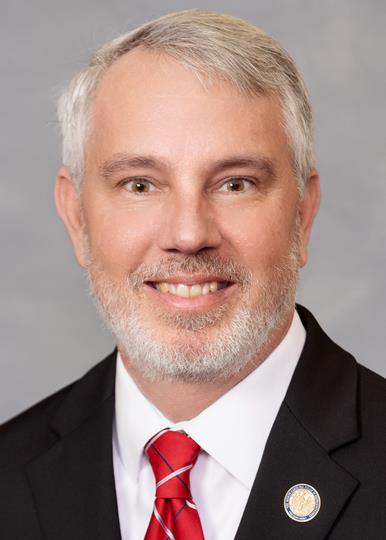
Rep. Blair Eddins
Sponsored bills
Maddy summaryHB 776, the North Carolina Religious Freedom Restoration Act, requires state and local governments to apply strict scrutiny before restricting religious practices. It protects religious gatherings in places of worship, homes, and neighborhoods from neutral laws or regulations that incidentally burden faith, such as housing rules or emergency orders. The law defines a "burden" as any government action limiting religious exercise (including withholding benefits or imposing penalties) and mandates that such restrictions must serve a compelling government interest through the least restrictive means. It explicitly does not affect constitutional protections against government establishment of religion or alter existing housing nondiscrimination laws.
Maddy summaryHB 295 requires the North Carolina Department of Transportation (DOT) to install permanent property corner markers after acquiring land for transportation projects. It directly affects property owners whose land is used for DOT projects, ensuring clear boundary identification. The bill mandates DOT to survey and place durable markers (like metal stakes) along acquired property lines after project completion, using coordinates tied to North Carolina's State Plane Coordinate system. This ensures accurate, long-term documentation of property boundaries for future reference.
Maddy summaryHB 692 requires all North Carolina public schools to install at least two automatic external defibrillators (AEDs) per school building - one in a state-identified location and one in athletic facilities - and provide annual training for school staff in AED use and CPR. The bill directly affects public school personnel, students, and school districts by mandating specific installation, maintenance, and training protocols through new rules from the State Board of Education. Key provisions include requiring schools to coordinate with emergency medical systems, maintain AEDs properly, and develop policies aligned with state guidelines. The law takes effect for the 2025-2026 school year, using existing school funding for implementation.
Maddy summaryHB 751 requires large electric utilities (serving at least 150,000 North Carolina customers by 2025) that already offer seasonal or intermittent energy rates in part of their service area to file a rate case by September 2025. This would extend those same seasonal rates to all eligible customers statewide, rather than offering different rates in different regions. The bill applies specifically to utilities with existing seasonal rate schedules, mandating a uniform statewide approach for those services. It does not change the rates themselves, only requires the utility to expand an existing rate structure to all customers it serves.
Maddy summaryHB 647 expands North Carolina’s agricultural tax program to include land owned by qualified conservation organizations. It allows conservation holders (nonprofits dedicated to preserving farmland/forestland) to have land taxed at its current agricultural or forest use value, rather than its full market value, when they acquire it. To qualify, land must be appraised at present-use value upon transfer to the conservation holder, and the holder must continue using it for conservation purposes while assuming tax liability for any deferred taxes. This bill directly affects conservation groups and landowners transferring property to them, aiming to support long-term land preservation through tax incentives. The law takes effect for taxes due in 2026.
Maddy summaryHR 563 adopts the permanent rules for the North Carolina House of Representatives during the 2025 Regular Session. These rules establish procedural guidelines including session hours (e.g., no Friday sessions in January and February, adjournment by 10:00 PM on Mondays and 9:00 PM on other days), quorum requirements, and the order of business for legislative proceedings.
Maddy summaryHB 134 requires manufacturers of cell-cultured, insect-based, or plant-based food products to clearly label items that use meat-related terms (like "beef" or "chicken") with specific qualifying terms (such as "cell-cultured," "plant-based," or "insect-based") in prominent, close proximity on packaging. This directly affects food companies producing alternative meat products that might otherwise confuse consumers by mimicking traditional meat names. The bill defines key terms like "identifying meat term" and "qualifying term" to ensure labels are clear and prevent misleading representations. It mandates that products using terms like "beef" or "chicken" must include these qualifiers to avoid being deemed "misbranded" under North Carolina law. The law aims to ensure transparency for consumers about the origin of these food products.
Maddy summaryHB 16 requires the North Carolina General Assembly to display the national motto "In God We Trust" directly above and behind the dais for the Speaker of the House and President of the Senate, aligning with the U.S. House of Representatives' display. The bill mandates the Legislative Services Officer to implement this, first using private gifts or donations for costs, and if none are provided within 90 days, using state funds. It becomes effective July 1, 2025. This is a procedural bill affecting legislative chamber decor, not a substantive policy change.
Maddy summaryHB 511 establishes new salary levels for full-time magistrates in North Carolina, directly affecting these court officers who handle minor cases like traffic violations and small claims. The bill appropriates $11.5 million annually from the General Fund for 2025-2027 to fund these increases, with specific salary steps outlined in the law. Magistrates will receive raises every two years for the first three experience levels and every four years for higher levels, starting at $47,228 for new hires and reaching $90,498 for the highest step. The changes take effect July 1, 2025, and apply to magistrates working at least 40 hours weekly.