

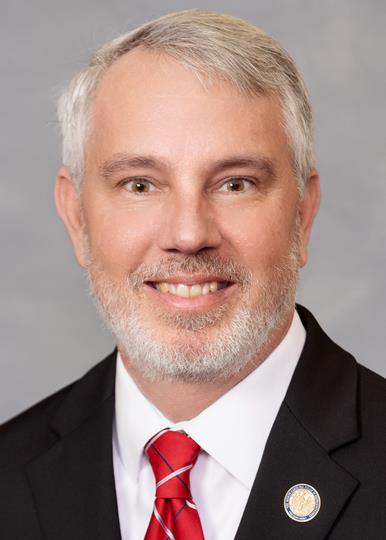
Photo of Blair Eddins
R North Carolina House · District 94 On the 2026 ballot

Rep. Blair Eddins

Compare
Total votes
497
all sessions
Attendance
100%
of floor votes
Higher than 91% of chamber peers
With party
99%
of cast votes
Near the chamber average
Bipartisan score
0%
crosses aisle rarely
Near the chamber average
Sponsored
109
bills & resolutions
Near the chamber average
Committees
8
assignments
109 bills and resolutions

Sponsored bills

Total
109
Primary
6
Co-sponsor
103
This page
109
matching current filters
Co-sponsor HB 87
Signed into law · North Carolina House · Co-sponsor
Educational Choice for Children Act (ECCA).

Maddy summaryHB 87 (Educational Choice for Children Act) allows North Carolina to participate in a federal tax credit program that encourages donations to private scholarship organizations. The bill requires the State Education Assistance Authority to maintain and publish an annual list of qualifying scholarship groups operating in North Carolina, enabling donors to claim federal tax credits for contributions. These scholarships can cover elementary and secondary school costs, including homeschooling expenses, as permitted under federal law. The law becomes effective after 2026, with the Authority needing to establish necessary rules by July 2026 to comply with federal requirements.

Signed into law Jun 3, 2026 1 co-sponsor
Co-sponsor HJR 1030
In committee · North Carolina House · Co-sponsor
US Department of Education.

Maddy summaryThis North Carolina joint resolution urges the U.S. Congress to eliminate the United States Department of Education by returning control of education to the states. The bill argues that federal involvement has led to excessive regulations and mandates without improving student reading scores, asserting that states are better equipped to handle education based on local needs. It also states that removing the department would not stop federal funding programs from reaching states but would instead allow taxpayer dollars to be used more efficiently. As a non-binding resolution, it does not directly change laws or allocate funds but serves as a formal statement of support for federal efforts to abolish the department.

In committee Jun 2, 2026 1 co-sponsor
Co-sponsor HB 1026
In committee · North Carolina House · Co-sponsor
Remote Instruction for Excess Emergencies.

Maddy summaryThis bill allows North Carolina public schools to use an extra three days or 15 hours of remote instruction when they face ongoing emergencies after already using their standard emergency allowance. Schools that have exhausted their initial five-day limit for weather, power outages, or other crises can now count this additional time toward their required school calendar. To ensure accountability, school districts must report details about these extra days and the specific emergencies that caused them to the state by July 1 each year. The legislation also allocates $5,000 in state funds to help cover administrative costs and provide technical support for enforcing these new rules starting in the 2026-2027 school year.

In committee Jun 2, 2026 1 co-sponsor
Co-sponsor HB 1089
Signed into law · North Carolina House · Co-sponsor
Constitutional Amendment Property Tax Levy Limit.

Maddy summaryThis bill proposes a constitutional amendment that would require the North Carolina legislature to establish a statewide limit on how much local property tax levies can increase each year. The measure also mandates that any local government wanting to raise property taxes beyond this limit must first obtain approval from a majority of voters in that specific area. Because this change alters the state constitution, it will not take effect immediately but will instead be placed on the November 3, 2026, ballot for voters to decide whether to adopt. If approved by the public, the amendment would legally bind the General Assembly to create the specific tax increase caps mentioned in the text.

Signed into law May 21, 2026 1 co-sponsor
Co-sponsor HB 1110
In committee · North Carolina House · Co-sponsor
Early Intervention School Attendance Pilot.

Maddy summaryThis bill establishes a two-year pilot program in North Carolina to test data-driven systems aimed at reducing chronic absenteeism, which currently affects one in four public school students. The Department of Public Instruction will select a single public school unit serving up to 15,000 diverse students to implement a vendor-provided platform that offers real-time monitoring, automated family communication, and targeted intervention strategies. Appropriated funds totaling $75,000 will cover technology costs, staff training, and program evaluation, with the pilot running from the 2026-2027 fiscal year through the 2027-2028 fiscal year. By the end of the program, the department must report findings on attendance improvements and operational efficiencies to determine if the initiative should be expanded statewide.

In committee May 19, 2026 1 co-sponsor
Co-sponsor HB 1019
Passed · North Carolina House · Co-sponsor
Mike Clampitt 1st Responder Tax Fairness Act.

Maddy summaryThis bill, known as the Mike Clampitt 1st Responder Tax Fairness Act, aims to expand tax exemptions for volunteer fire departments and rescue squads in North Carolina. Specifically, it allows these independent groups, which have two or fewer paid employees and are already exempt from state income tax, to avoid paying a highway use tax on specific emergency vehicles like fire trucks, forest firefighting units, and other emergency service vehicles. The change applies to vehicles when a certificate of title is issued on or after July 1, 2026, ensuring these organizations can acquire necessary equipment without incurring this particular tax. By broadening the existing exemption, the legislation directly benefits volunteer responders who operate outside of local government units.

Passed May 18, 2026 1 co-sponsor
Co-sponsor HB 1154
In committee · North Carolina House · Co-sponsor
Expand the FarmSHARE Food Hub Program.

Maddy summaryThis bill allocates $6 million in state funds to expand two food assistance programs in North Carolina for the 2026-2027 fiscal year. The first $4 million supports FarmSHARE, which provides grants to buy locally grown food and distribute it for free to food-insecure individuals and households. The second $2 million funds the Double Up Food Bucks Program, allowing people receiving nutrition assistance to use their benefits to purchase fresh fruits and vegetables at farmers markets and other local retailers. Both programs require the state department to submit annual reports detailing participation numbers, distribution metrics, and financial data to legislative oversight committees. The legislation takes effect on July 1, 2026.

In committee May 13, 2026 1 co-sponsor
Co-sponsor HB 1086
In committee · North Carolina House · Co-sponsor
Child Care Initiative Funds/Reform/Study.

Maddy summaryThis bill creates a pilot program to train new individuals with no prior experience as lead teachers in North Carolina's licensed child care centers. Funded by state money and requiring a local match, the program offers free, intensive training courses through community colleges in selected counties, with graduates receiving a state credential and potential stipends for completing the course and working for a year. The initiative aims to expand the child care workforce by establishing academies across the state, starting in Johnston and Wayne counties, and includes requirements for local partnerships to select additional sites. Additionally, the bill directs the North Carolina Partnership for Children to study the feasibility of liability insurance for providers and update bidding rules for child care grants.

In committee May 12, 2026 1 co-sponsor
Co-sponsor HB 1163
In committee · North Carolina House · Co-sponsor
Workforce Act of 2026.

Maddy summaryThis bill, titled the Workforce Act of 2026, provides funding and policy changes to expand workforce development programs in North Carolina. It allocates $3.1 million to the Community Colleges System Office to support the ApprenticeshipNC program, which helps connect employers with learners through work-based training. The legislation also directs the Department of Commerce to maintain a list of industry-valued credentials and collect data on wages and job outcomes to better align education with labor market needs. Additionally, it increases financial aid for short-term workforce development grants to help students pursue credentials that are not eligible for federal funding.

In committee May 4, 2026 1 co-sponsor
Co-sponsor HB 1108
In committee · North Carolina House · Co-sponsor
Constitutional Amendment/Permitless Carry.

Maddy summaryThis bill proposes a constitutional amendment in North Carolina to allow law-abiding citizens to carry firearms openly or concealed without needing a permit. The change would apply to any U.S. citizen who has not been convicted of a violent crime or drug offense and has not been declared mentally incompetent, unless they are on property that is legally posted against carrying weapons. While the amendment removes the requirement for a permit, it states that a permit system will still be maintained to help with reciprocity with other states and to facilitate purchasing weapons. The bill does not take effect immediately but must be approved by voters in a referendum scheduled for the November 3, 2026, general election.

In committee Apr 30, 2026 1 co-sponsor
Showing 11 to 20 of 109 bills