

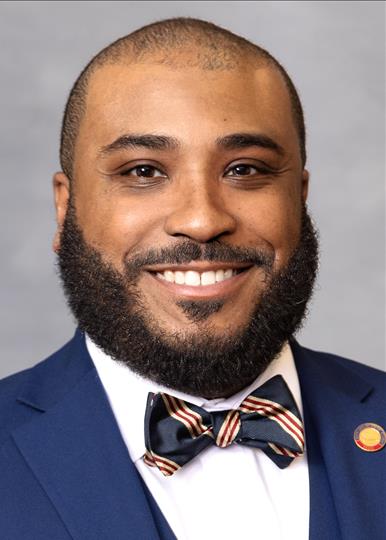
Photo of Terry Brown
D North Carolina House · District 92 On the 2026 ballot

Rep. Terry Brown

Compare
Total votes
1,795
all sessions
Attendance
97%
58 missed
Higher than 78% of chamber peers
With party
95%
of cast votes
Near the chamber average
Bipartisan score
3%
crosses aisle rarely
Near the chamber average
Sponsored
669
bills & resolutions
Higher than 76% of chamber peers
Committees
7
assignments
669 bills and resolutions

Sponsored bills

Total
669
Primary
74
Co-sponsor
595
This page
669
matching current filters
Co-sponsor HB 639
In committee · North Carolina House · Co-sponsor
Prioritize In-State Applicants/UNC Educator Schools.

Maddy summaryHB 639 requires all University of North Carolina (UNC) educator preparation programs to give first priority in admissions to applicants who qualify as North Carolina residents for tuition purposes under state law. This directly affects UNC schools offering teacher training programs and prospective in-state students applying to those programs starting in the 2025-2026 academic year. The bill mandates that programs follow the state's standardized residency determination process to verify applicant status. It does not change tuition rates but alters admission priority based solely on residency eligibility.

In committee Apr 2, 2025 1 co-sponsor
Co-sponsor HB 651
In committee · North Carolina House · Co-sponsor
Reduce Parent Copays/Child Care Subsidy/Funds.

Maddy summaryHB 651 reduces parent cost-sharing for subsidized child care in North Carolina by lowering the copayment rate from 10% to 7% of gross family income. This change directly affects families enrolled in state-subsidized child care programs who pay a portion of their care costs. The bill appropriates $25 million annually from the General Fund for the 2025-2027 fiscal biennium to fund this reduction, effective July 1, 2025. It also specifies adjusted copayment rates for blended-rate and part-time care scenarios.

In committee Apr 2, 2025 1 co-sponsor
Co-sponsor HB 646
In committee · North Carolina House · Co-sponsor
Constitutional Amendment: Remove Slavery as Punishment.

Maddy summaryHB 646 is a constitutional amendment that would permanently ban all slavery and involuntary servitude in North Carolina, removing the current exception allowing forced labor as punishment for crimes. If approved by voters in the November 2026 election, the amendment would change the state constitution to state that slavery and involuntary servitude are "forever prohibited" without any exceptions. This change would directly affect incarcerated individuals by ending the legal basis for requiring prison labor as punishment. The amendment requires voter approval through a statewide referendum before taking effect.

In committee Apr 2, 2025 1 co-sponsor
Primary HB 633
In committee · North Carolina House · Lead sponsor
Expand Sickle Cell Disease Programs and Services.

Maddy summaryHB 633 appropriates $1.678 million annually in recurring funds and additional nonrecurring funds to expand sickle cell disease services in North Carolina. The bill directly supports approximately 7,000 North Carolinians living with sickle cell disease by funding comprehensive medical centers (like Atrium Health, Duke, and UNC Chapel Hill), creating transition coordinators to help patients move from pediatric to adult care, and providing grants to community organizations in underserved areas. Key mechanisms include distributing $1.3 million yearly to medical centers for care coordination, allocating $75,000 annually per center for transition staff, and funding a statewide emergency department toolkit to improve acute care. The bill becomes effective July 1, 2025, with funds designated for the 2025-2027 fiscal biennium.

In committee Apr 2, 2025 0 co-sponsors
Primary HB 641
In committee · North Carolina House · Lead sponsor
Transportation for the Future Act.

Maddy summaryThe Transportation for the Future Act reorganizes North Carolina's transportation funding to prioritize sustainable projects like public transit (including bus rapid transit and commuter rail), bike lanes, and pedestrian pathways. It requires at least 20% of transportation funds to be allocated to non-highway projects and caps state funding for commuter rail and light rail at 10% of project costs. The bill establishes three funding categories with project selection criteria emphasizing safety, congestion reduction, economic growth, and multimodal transportation. This change affects statewide transportation planning and funding decisions to modernize the system for future sustainability.

In committee Apr 2, 2025 0 co-sponsors
Co-sponsor HB 628
In committee · North Carolina House · Co-sponsor
Reenact Child Tax Credit.

Maddy summaryHB 628 reenacts North Carolina's state-level child tax credit, which expired, to provide financial support to families with children. It directly affects low- and middle-income North Carolina residents who qualify under federal child tax credit rules, offering up to $250 per child annually based on household income. Key provisions include income-based credit amounts (e.g., $250 for married couples filing jointly with under $40,000 income) that phase out at higher earnings, and the credit is refundable - meaning families may receive cash payments even if they owe no state tax. The bill takes effect for 2025 tax years and mirrors the federal credit structure without creating new policy.

In committee Apr 2, 2025 1 co-sponsor
Co-sponsor HB 644
In committee · North Carolina House · Co-sponsor
DOT Study on Fort Bragg Traffic Congestion.

Maddy summaryHB 644 requires North Carolina's Department of Transportation to study traffic congestion near Fort Bragg, specifically between Vass Road and N.C. Highway 87, using $500,000 in highway funds for the 2025-2026 fiscal year. The study must identify economic benefits of reducing congestion and examine options like expanded rail routes and other surface transportation solutions. This bill directly affects the Fort Bragg military installation and surrounding communities by funding a traffic analysis, but does not implement any traffic solutions itself. It becomes effective July 1, 2025, after the study period.

In committee Apr 2, 2025 1 co-sponsor
Co-sponsor HB 655
In committee · North Carolina House · Co-sponsor
Ending Offensive Indian Mascots.

Maddy summaryHB 655 prohibits North Carolina public schools and charter schools from using American Indian mascots. It requires the State Advisory Council to identify schools with such mascots and report this to the State Board of Education, which must then decide within 30 days whether to require a change. Schools must replace the mascots within two years of notification, with superintendents able to grant an additional year for implementation. Failure to comply results in withheld state funds for the superintendent’s salary (for public schools) or per-pupil funding (for charter schools). The law applies starting the 2025-2026 school year.

In committee Apr 2, 2025 1 co-sponsor
Co-sponsor HB 645
In committee · North Carolina House · Co-sponsor
Friendly NC Act.

Maddy summaryHB 645 (Friendly NC Act) strengthens hate crime laws in North Carolina by expanding definitions to include offenses motivated by race, religion, nationality, or other protected characteristics. It increases penalties for hate-motivated misdemeanors (elevating them to Class 1 misdemeanors or felonies) and creates new felony charges for hate-motivated serious bodily injury. Victims gain civil remedies (including emotional distress damages and attorney fees) and can request restorative justice sessions with trained facilitators, paid for by the offender. The bill directly affects individuals who commit hate crimes and victims of such offenses, aiming to promote inclusivity through enhanced legal protections.

In committee Apr 2, 2025 1 co-sponsor
Co-sponsor HB 300
In committee · North Carolina House · Co-sponsor
Vet Care for Retired First Responder Dogs.

Maddy summaryHB 300 establishes a program to reimburse owners of retired first responder dogs for veterinary care. It directly affects owners of canines that served with law enforcement, fire departments, or correctional agencies in roles like narcotics detection or search and rescue, after retiring on or after July 1, 2024. The bill requires registration of the dog and owner with the Department of Public Safety, then allows reimbursement of up to $1,500 annually for covered care - including routine check-ups, vaccinations, emergencies, surgeries, and euthanasia. Owners must submit itemized vet bills within 90 days of service.

In committee Apr 1, 2025 1 co-sponsor
Showing 141 to 150 of 669 bills
Previous 1 … 14 15 16 … 67 Next