

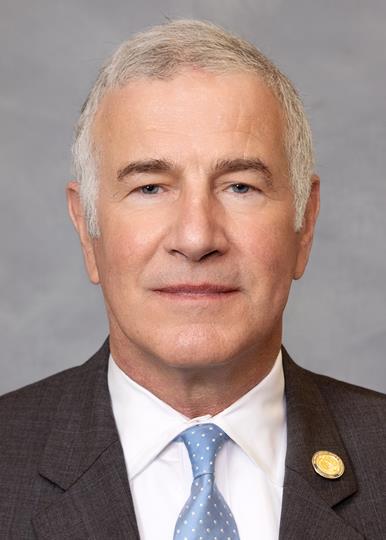
Photo of John Blust
R North Carolina House · District 62 On the 2026 ballot

Rep. John Blust

Compare
Total votes
481
all sessions
Attendance
84%
77 missed
Near the chamber average
With party
97%
of cast votes
Near the chamber average
Bipartisan score
1%
crosses aisle rarely
Near the chamber average
Sponsored
82
bills & resolutions
Near the chamber average
Committees
8
assignments
82 bills and resolutions

Sponsored bills

Total
82
Primary
9
Co-sponsor
73
This page
82
matching current filters
Co-sponsor HB 310
In committee · North Carolina House · Co-sponsor
Eminent Domain.

Maddy summaryHB 310 proposes a constitutional amendment to North Carolina that would require all eminent domain takings (government seizure of private property) to serve a "public use" and mandate fair compensation determined by a jury. It directly affects property owners, local governments, and utilities by restricting when property can be taken and ensuring compensation is set through a jury trial. The bill also updates existing law (G.S. 40A-3) to clarify which entities (like utilities or local governments) may exercise eminent domain for specific projects. The amendment must be approved by voters in the 2026 general election to take effect.

In committee Mar 6, 2025 1 co-sponsor
Primary HB 142
In committee · North Carolina House · Lead sponsor
Implement Zero-Based Budgeting.

Maddy summaryHB 142 requires North Carolina state agencies to adopt zero-based budgeting for the 2031-2033 fiscal biennium, starting with a phased implementation beginning July 1, 2027. This means agencies must justify every funding request from scratch each budget cycle - starting with a $0 baseline - rather than carrying over previous appropriations. Agencies must submit detailed justifications for each budget item, including explanations of their functions, performance data, and goals. The bill directly affects all state agencies in the executive branch, requiring them to re-evaluate all programs and costs annually. The full zero-based budget will apply to the entire state budget starting in 2031-2033.

In committee Mar 4, 2025 0 co-sponsors
Co-sponsor HB 222
In committee · North Carolina House · Co-sponsor
Close Out Operations Provide Emergency Relief (C.O.O.P.E.R.) Accountability Act.

Maddy summaryHB 222 appropriates $217 million from the State Emergency Response Fund to North Carolina's Office of Recovery and Resiliency (NCORR) for homeowner recovery projects related to Hurricanes Matthew and Florence. The bill requires NCORR to submit detailed monthly reports on fund usage, including expenditures and project progress, and mandates weekly financial reports to the State Auditor for oversight. It also establishes a public online dashboard tracking funds versus actual spending and includes a clawback provision to return unused funds to the Savings Reserve after projects conclude. The law revises NCORR's responsibilities, ending its role in future storm recovery programs.

In committee Mar 4, 2025 1 co-sponsor
Co-sponsor HB 235
In committee · North Carolina House · Co-sponsor
Fraudulent Deeds.

Maddy summaryHB 235 targets fraudulent real estate deeds and property transfers in North Carolina. It creates a new civil process allowing property owners to file lawsuits (without lawyers) to have false recordings removed from public records, with courts able to issue emergency orders within 72 hours. The bill also requires tax certification from county tax collectors before recording deeds in 30 specific counties (like Buncombe and Wake), unless handled by a licensed attorney. Violating these rules can lead to criminal charges, with penalties ranging from Class G (under $100k property) to Class C felonies (over $100k).

In committee Feb 27, 2025 1 co-sponsor
Co-sponsor HB 130
In committee · North Carolina House · Co-sponsor
Agriculture Crops Disaster Relief.

Maddy summaryHB 130 establishes a $475 million program to provide financial assistance to North Carolina farmers who suffered crop losses from natural disasters in 2024. It directly affects farmers in counties designated by the USDA as disaster areas, requiring verified losses of eligible agricultural commodities (like crops, livestock, or specialty plants) planted but not harvested by January 1, 2024. The program uses county and state yield/price averages to calculate payments, mandates submission of USDA Form 578 or equivalent documentation within 30 days, and allocates funds from state reserves (Stabilization, IT, and Economic Development) to cover verified losses. Farmers must provide documentation for verification, and the Department of Agriculture may audit claims to ensure proper use of funds, with refunds required for inaccurate information.

In committee Feb 26, 2025 1 co-sponsor
Co-sponsor HB 177
In committee · North Carolina House · Co-sponsor
Reduce Barriers to State Employment.

Maddy summaryHB 177 requires North Carolina's State Human Resources Commission (SHRC) to review job requirements across state agencies and identify positions where a four-year college degree is unnecessary. The bill directs the SHRC to replace degree requirements with alternative qualifications like military service, apprenticeships, or trade school training where appropriate, and to remove unnecessary degree language from job postings. This policy change directly affects state job applicants who may qualify through non-degree pathways. The SHRC must report annually starting October 2025 on progress toward reducing these barriers.

In committee Feb 25, 2025 1 co-sponsor
Primary HB 154
In committee · North Carolina House · Lead sponsor
Reclaim State Assets from NCInnovation.

Maddy summaryHB 154 requires NCInnovation, a state entity, to return all state funds and assets it acquired using state money to the North Carolina State Controller. The State Controller must then transfer these funds into the General Fund, where they remain unappropriated until the General Assembly votes to use them for specific purposes. This bill dissolves the financial relationship between the state and NCInnovation by repealing related statutes, effective 60 days after enactment. It directly affects NCInnovation’s financial obligations and the state’s treasury, with no new spending authorized by the transfer.

In committee Feb 21, 2025 0 co-sponsors
Co-sponsor HB 72
In committee · North Carolina House · Co-sponsor
Attorney General/Restrict Challenge to Presidential Executive Orders.

Maddy summaryHB 72 prohibits North Carolina's Attorney General from participating in any court case (as a party, amicus, or otherwise) that argues a presidential executive order should be invalidated. The law directly affects the Attorney General's office, restricting their ability to challenge federal executive actions in state or federal courts. Key provisions state the Attorney General cannot advance arguments leading to the invalidation of any presidential executive order, applying to all pending or future litigation. This is a procedural limitation on state legal actions, not a change to federal executive power. The bill becomes effective upon enactment for cases filed after that date.

In committee Feb 17, 2025 1 co-sponsor
Co-sponsor HB 102
In committee · North Carolina House · Co-sponsor
Real Property Appraisal - Owner Notification.

Maddy summaryHB 102 requires North Carolina property assessors to send clear, plain-language notifications to property owners during revaluations. It mandates that these notices include: (1) a simple explanation of why the revaluation is happening, (2) the projected percentage change in the property's appraised value compared to the previous year, (3) the projected percentage change in the property's tax bill, and (4) a website link, QR code, or phone number for additional information or appeals. This applies to all property owners receiving revaluation notices under state law, including those in municipalities spanning multiple counties. The bill takes effect for notices issued on or after its effective date, aiming to improve transparency in property tax assessments.

In committee Feb 12, 2025 1 co-sponsor
Co-sponsor HB 101
In committee · North Carolina House · Co-sponsor
Property Tax Appeal Process Transparency.

Maddy summaryHB 101 requires county and municipal property tax boards to notify property owners in simple language about their right to appeal appraisals that increase by 30% or more compared to prior years. It mandates boards to automatically review such properties and provide written notices within a timeframe allowing owners to act on their appeal rights. The bill directly affects property owners with significant appraisal increases, ensuring they receive clear information about the appeals process. It applies to both county boards of equalization and municipal tax review bodies, aiming to make the system more transparent without changing tax rates or assessment standards.

In committee Feb 12, 2025 1 co-sponsor
Showing 71 to 80 of 82 bills
Previous 1 7 8 9 Next