

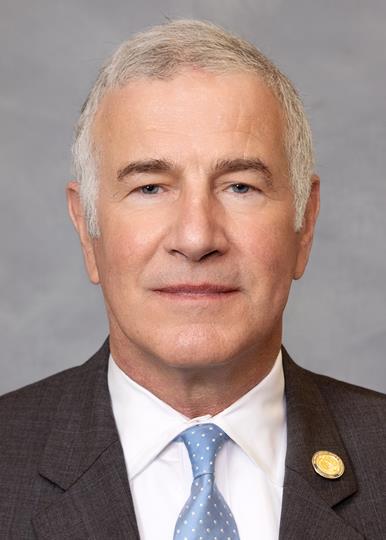
Photo of John Blust
R North Carolina House · District 62 On the 2026 ballot

Rep. John Blust

Compare
Total votes
481
all sessions
Attendance
84%
77 missed
Near the chamber average
With party
97%
of cast votes
Near the chamber average
Bipartisan score
1%
crosses aisle rarely
Near the chamber average
Sponsored
82
bills & resolutions
Near the chamber average
Committees
8
assignments
82 bills and resolutions

Sponsored bills

Total
82
Primary
9
Co-sponsor
73
This page
82
matching current filters
Co-sponsor HB 958
Vetoed · North Carolina House · Co-sponsor
Election Law Changes.

Maddy summaryHB 958 updates North Carolina's election laws with several key changes. It prohibits the State Board from using voter education to influence party affiliation (Section 1), requires most challenged ballots to still count unless the voter died before election day (Section 2), and mandates at least one early voting site per 30,000 registered voters with specific security and staffing rules (Section 4). The bill also requires random hand-counting of ballots for statewide elections to verify electronic results (Section 5) and clarifies timelines for counting provisional ballots (Section 6). These changes directly affect voters, county election boards, and the State Board of Elections in administering elections.

Vetoed Aug 31, 2026 1 co-sponsor
Co-sponsor HB 133
Signed into law · North Carolina House · Co-sponsor
NC Farmland and Military Protection Act.

Maddy summaryHB 133, the NC Farmland and Military Protection Act, bans U.S.-designated adversarial foreign governments from buying, leasing, or holding interests in agricultural land or land within 75 miles of major military installations like Fort Bragg and Camp Lejeune. It directly affects foreign governments identified by the U.S. State Department as adversaries under arms regulations, preventing them from acquiring land critical to food production or near military sites. The law excludes agricultural research leases under 250 acres and makes any violating land transfer legally void. This focuses on restricting foreign control of strategic land without altering existing domestic land transactions.

Signed into law Jul 8, 2026 1 co-sponsor
Co-sponsor HB 56
Signed into law · North Carolina House · Co-sponsor
2026 Budget Technical Corrections.

Maddy summaryHB 56 (incorrectly titled "UNC Enrollment" in the query; actual focus is school transparency) requires North Carolina local school boards to publicly post detailed compensation and position information for central office staff on their websites by August 15, 2025. It mandates publishing total compensation (salary, bonuses, travel reimbursements), position titles, department assignments, and creation dates for each role. The law applies directly to all central office employees, including administrators, finance staff, and third-party contractors working at school districts. This transparency measure aims to make school district spending and staffing more visible to the public, with records updated annually. The bill does not affect student enrollment or university operations (UNC system).

Signed into law Jul 7, 2026 1 co-sponsor
Co-sponsor HB 258
Signed into law · North Carolina House · Co-sponsor
Worker Safety Act of 2026.

Maddy summaryHB 258, the Utility Worker Protection Act, increases penalties for assaulting utility and communications workers by designating such assaults as Class A1 misdemeanors - the highest misdemeanor level - when the worker is visibly identifiable (e.g., wearing company-logoed uniforms) and performing duties. It directly affects workers providing electricity, gas, telecommunications, or internet services, including those employed by public, private, or cooperative entities. The bill adds specific language to North Carolina’s assault statute, requiring prosecutors to apply this enhanced penalty for assaults meeting these criteria, without needing other legal provisions. The law takes effect December 1, 2025, applying to offenses committed on or after that date.

Signed into law Jun 22, 2026 1 co-sponsor
Co-sponsor HB 1089
Signed into law · North Carolina House · Co-sponsor
Constitutional Amendment Property Tax Levy Limit.

Maddy summaryThis bill proposes a constitutional amendment that would require the North Carolina legislature to establish a statewide limit on how much local property tax levies can increase each year. The measure also mandates that any local government wanting to raise property taxes beyond this limit must first obtain approval from a majority of voters in that specific area. Because this change alters the state constitution, it will not take effect immediately but will instead be placed on the November 3, 2026, ballot for voters to decide whether to adopt. If approved by the public, the amendment would legally bind the General Assembly to create the specific tax increase caps mentioned in the text.

Signed into law May 21, 2026 1 co-sponsor
Co-sponsor HB 1032
In committee · North Carolina House · Co-sponsor
Repeal Two Percent Local Grocery Tax.

Maddy summaryThis bill repeals the authority for North Carolina counties to collect a one percent local sales tax on groceries, effectively exempting food from these local taxes. By removing the option for voters to approve this specific tax, the legislation directly affects county governments and consumers who currently pay this surcharge on food purchases. The change applies to sales made on or after October 1, 2026, and does not alter the existing state sales tax rules.

In committee Apr 22, 2026 1 co-sponsor
Co-sponsor HB 491
Failed · North Carolina House · Co-sponsor
Medicaid Rebase Funding.

Maddy summaryHB 491 prepares North Carolina's Medicaid program to implement work requirements if authorized by the federal Centers for Medicare and Medicaid Services (CMS). It requires the state's Division of Health Benefits to negotiate with CMS, notify oversight committees within 30 days of starting talks, and submit detailed reports after CMS approves any work requirements plan. The bill does not enact work requirements itself but establishes procedures for future implementation, including timelines for reporting funding needs. This would directly affect current Medicaid recipients if CMS approves work requirements, though the bill is procedural and conditional on federal approval. The legislation is currently in committee review and has not yet become law.

Failed Oct 23, 2025 1 co-sponsor
Co-sponsor HB 192
Passed · North Carolina House · Co-sponsor
Defund Planned Parenthood and Cost Transparency.

Maddy summaryThe bill title "Defund Planned Parenthood and Cost Transparency" does not match the actual content of HB 192, which is focused on education funding. This bill raises teacher salaries for the 2025-2026 school year using a new salary schedule (e.g., $5,000 for 0 years experience, $6,823 for 25+ years) and reinstates education-based supplements for advanced degrees ($126-$253 monthly). It appropriates $1.597 billion for salary increases and $8 million for supplements, while directing the North Carolina Collaboratory to study a student-based funding system by February 2026. The bill directly affects public school teachers, instructional support staff, and school psychologists. The title appears to be incorrect based on the provided bill text.

Passed Sep 22, 2025 1 co-sponsor
Co-sponsor HB 305
Signed into law · North Carolina House · Co-sponsor
Guilford County Sales Tax Distribution Modifications.

Maddy summaryHB 305 modifies sales tax distribution rules for Guilford County municipalities that do not levy property taxes (ad valorem taxes). It allows qualifying municipalities to receive 25% of their per capita sales tax share - calculated under existing law - by adopting a resolution by October 1, 2025. The bill requires the state to deduct this allocation from Guilford County’s total tax proceeds before distributing remaining funds per current rules, ensuring other taxing districts (like fire districts) receive their full share. This change applies only to qualifying Guilford municipalities and expires if Guilford County repeals its Article 46 quarter-cent sales tax.

Signed into law Jul 31, 2025 1 co-sponsor
Co-sponsor HB 402
Signed into law · North Carolina House · Co-sponsor
Limit Rules With Substantial Financial Costs.

Maddy summaryHB 402 requires North Carolina state agencies to assess the financial impact of proposed permanent rules. If a rule would cost affected individuals or businesses $20 million or more over five years, it must be approved by the General Assembly before taking effect. For rules with a $1 million or more annual cost impact, agencies must prepare a fiscal note for review by the Office of State Budget and Management. The bill also mandates a two-thirds vote by agency boards to adopt rules exceeding the $1 million cost threshold. This directly affects state agencies creating regulations and the businesses or residents who would bear the costs of those rules.

Signed into law Jul 29, 2025 1 co-sponsor
Showing 1 to 10 of 82 bills
1 2 3 9 Next