

Maddy summaryHB 211, "The Kelsey Smith Act," authorizes wireless telecommunications carriers to provide a device's location information to law enforcement under specific emergency circumstances. This includes situations where a 911 call was made or there is reasonable suspicion of an emergency involving risk of death or serious physical harm. Wireless carriers are required to submit their emergency contact information to the State Bureau of Investigation, which will maintain a database for public safety answering points. The bill protects carriers from legal action if they provide this information in good faith.
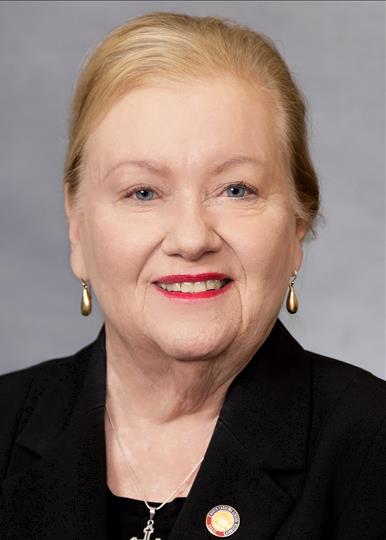
Rep. Diane Wheatley
Sponsored bills
Maddy summaryHouse Bill 272, known as "The Sergeant Mickey Hutchens Act," allows certain law enforcement, probation/parole, and correctional officers in North Carolina to purchase additional retirement service credit. Officers who hold an advanced law enforcement or corrections certificate and have at least five years of membership service can buy up to four years of creditable service. This purchase applies to members of the Teachers' and State Employees' Retirement System or the Local Governmental Employees' Retirement System. To do so, they must pay a lump sum covering the full cost of the increased retirement system liability and an administrative fee, with the option for their employer to contribute to this cost.
Maddy summaryHB 113 creates a joint legislative committee to study potential changes to North Carolina's Medicaid program if federal funding decreases. The 12-member committee (six senators appointed by the Senate President Pro Tempore, six representatives appointed by the House Speaker) will examine cost-saving options like reducing optional services, adjusting provider payments, or improving managed care efficiency. It must submit a final report with recommendations to the General Assembly by April 30, 2026, but the bill itself does not make any direct policy changes to Medicaid. This is a procedural measure establishing a study body, not a policy enactment.
Maddy summaryHB 399 increases fees for nursing licensure applications, renewals, and reinstatements with most fees doubling (e.g., registered nurse application fees rise from $75 to $150, renewal fees from $100 to $200). It directly affects nurses seeking initial licensure, renewing licenses, or reinstating lapsed licenses in North Carolina. The bill establishes a 20% annual cap on future fee increases and specifies no refunds will be issued. These changes apply to all applications, renewals, or reinstatements processed on or after October 1, 2025. The bill does not alter nursing practice standards or create new regulatory requirements.
Maddy summaryHB 888 appropriates $1 million from the General Fund to the North Carolina Community Health Worker Association (a nonprofit) for the 2025-2026 fiscal year. The funds will directly support the Association's work in mobilizing, training, and certifying community health workers across North Carolina. This grant enables the Association to expand its workforce development efforts, specifically targeting the training and certification of community health workers. The bill affects the Association's operations and the community health workers they certify, but does not change health service delivery or eligibility for residents. The appropriation becomes effective July 1, 2025.
Maddy summaryHB 884 increases the gross receipts threshold for artisanal bakeries to remain exempt from North Carolina's sales tax on prepared foods. Specifically, it raises the annual revenue limit from $1.8 million to $2.4 million (combined with related persons), while maintaining the requirement that bakeries derive over 80% of revenue from bakery items like bread, pastries, and cakes. This change directly affects small bakeries that previously exceeded the $1.8 million limit but now qualify for tax exemption under the new threshold. The bill modifies existing tax law (G.S. 105-164.13B) to expand the exemption to more small bakeries, effective October 1, 2025.
Maddy summaryHB 950 would modify North Carolina's property tax relief for elderly and disabled homeowners by raising the age requirement from 65 to 70, eliminating income eligibility requirements, and expanding the tax exclusion to cover 100% of a home's appraised value. Currently, applicants must be 65 or older (or disabled), meet income limits, and occupy the home as a primary residence; the bill removes income caps and requires applicants to be 70 or older. This means qualifying homeowners would pay no property tax on their primary residence under the new rules, as the entire home value would be excluded. The changes would take effect for tax years beginning July 1, 2026.
Maddy summaryThis bill requires public schools and charter schools in North Carolina to allow students from nonpublic schools to enroll part-time for access to specific courses, programs, or services. The law mandates that local school boards create policies for this enrollment and make them available on their websites, while charter schools must also post relevant information online. Schools will receive state funding for part-time students, with full per-pupil funding for those attending one-third or more of instructional time and half funding for those attending less. The legislation also clarifies that part-time nonpublic school students will not count toward a charter school's enrollment growth metrics.
Maddy summaryHB 974 requires North Carolina's Department of Health and Human Services (DHHS) to study how hospice care facilities handle complaints from patients and families. The study will analyze complaint data, engage hospice administrators and care associations, and identify common issues and best practices for improving complaint procedures, investigations, communication, and family involvement. DHHS must submit findings and recommendations to legislative committees by April 2026, focusing on actionable steps for hospice facilities to enhance accountability. This bill does not change current laws but mandates a review to inform future policy.
Maddy summaryHB 968 requires all North Carolina public K-12 schools to provide emergency preparedness education, beginning in grade 3 for elementary students and continuing through high school. It mandates state-developed standards for each grade level: elementary students learn about disaster types and school response plans, middle school students research past disasters and mass casualty events, and high school students are introduced to FEMA’s Community Emergency Response Team (CERT) materials. Local school boards must integrate this instruction into existing courses without adding new funding requirements. The law applies to all public schools statewide and takes effect for the 2025-2026 school year.