

Maddy summaryHB 402 requires North Carolina state agencies to assess the financial impact of proposed permanent rules. If a rule would cost affected individuals or businesses $20 million or more over five years, it must be approved by the General Assembly before taking effect. For rules with a $1 million or more annual cost impact, agencies must prepare a fiscal note for review by the Office of State Budget and Management. The bill also mandates a two-thirds vote by agency boards to adopt rules exceeding the $1 million cost threshold. This directly affects state agencies creating regulations and the businesses or residents who would bear the costs of those rules.
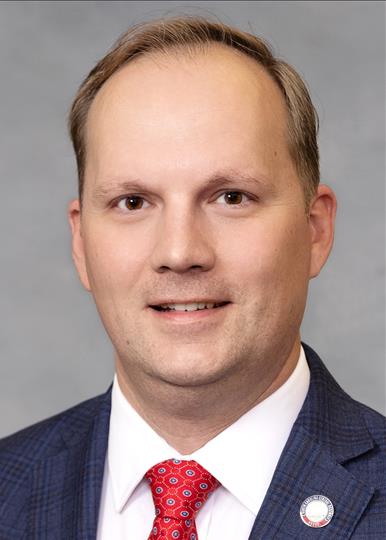
Rep. Allen Chesser
Sponsored bills
Maddy summaryHB 907 creates a new Disaster Readiness and Response Fund within the Office of the State Treasurer in North Carolina. This fund is designed to be separate from the state's General Fund and other existing reserves, providing a dedicated financial resource for disaster-related activities. The bill does not specify how the money will be used or who will administer it, leaving those details for future legislation. It applies to the state government and establishes a new financial mechanism for potential future disaster preparedness and response efforts.
Maddy summaryHB 546 modernizes North Carolina's Medicaid program by requiring the state to develop team-based care coordination for individuals with alcohol and opioid use disorders, including screening, medication, and recovery support. The bill also allows telehealth-only providers to enroll in Medicaid without needing a physical office in the state and mandates a statewide specialty plan for children in foster care or receiving adoption assistance, to be implemented by December 2025. These changes directly affect Medicaid beneficiaries with substance use disorders, telehealth providers, and eligible children and families. The Department of Health and Human Services must report on the implementation of the substance use care and telehealth provisions by October 1, 2025.
Maddy summaryHB 928 allows physical therapists licensed in North Carolina to evaluate student athletes for concussions and provide written clearance for returning to play or practice after a head injury during school sports. It directly affects student athletes in North Carolina public schools who exhibit concussion symptoms during athletic activities. The bill amends existing law to specifically include licensed physical therapists as authorized professionals (alongside doctors and other specialists) who can assess head injuries and issue the required written clearance. This change expands the pool of qualified healthcare providers available for school concussion protocols without altering the core requirement that athletes must be cleared before returning to sports.
Maddy summaryThis bill establishes an Interstate Medical Licensure Compact in North Carolina, allowing physicians who meet specific qualifications to obtain medical licenses in multiple participating states through a streamlined process. The law creates an Interstate Commission to oversee the compact and sets clear standards for physician eligibility, including requirements for medical school graduation, passing licensing exams, specialty certification, and a clean disciplinary record. While the compact simplifies licensing for qualified doctors, it maintains that each state retains authority to regulate medical practice within its borders and can take disciplinary action against physicians licensed through the compact. The bill does not alter existing state medical practice laws but adds an additional pathway for physicians to practice across state lines.
Maddy summaryHB 612, the "Fostering Care in NC Act," updates North Carolina's laws governing child abuse, neglect, and dependency cases. It expands the definition of "abused juveniles" to include specific offenses like sexual crimes, human trafficking, and certain violent acts, affecting how cases are classified. The bill requires county social services directors to use either a family-centered assessment or a formal investigation when reviewing reports, and to collect military affiliation details of the juvenile's caregiver. It also clarifies that court jurisdiction over juveniles continues until age 18, emancipation, or death. These changes standardize responses to child welfare reports and improve information gathering for safety decisions.
Maddy summaryHB 373 allows University of North Carolina (UNC) institutions to offer tuition discounts to two specific groups: military students receiving federal or North Carolina National Guard tuition assistance, and students enrolled in employer-sponsored financial support programs approved by UNC. The discount covers the difference between the military/employer funding and full tuition, without creating new free tuition programs. UNC must report annually to the legislature on the number of students receiving these discounts and their financial impact on institutions. The policy takes effect for the 2025-2026 academic year.
Maddy summaryHB 480 creates a new pathway for doctors, physician assistants, and anesthesiologist assistants to obtain North Carolina medical licenses by transferring licenses from other states ("licensure by endorsement"). To qualify, applicants must have held an active license in another U.S. jurisdiction for at least five years (with two years of practice post-residency for doctors), have a verified full-time job offer in North Carolina, maintain good standing with no recent disciplinary actions, and meet practice hour requirements. The bill increases application fees for endorsement (e.g., $825 for physicians vs. $400 for standard licensure) and requires additional documentation within 180 days to keep the license active. This directly affects out-of-state medical professionals seeking to practice in North Carolina without retaking exams.
Maddy summaryHB 468 regulates kratom products in North Carolina by establishing licensing requirements for businesses, setting age restrictions, and mandating safety measures. It prohibits sales to anyone under 21 (requiring age verification for those under 30), bans unlicensed sales, and requires all kratom products to be sold in child-resistant "exit packages." Businesses must use independent labs accredited under ISO 17025 or DEA standards to test products for safety and compliance. The Alcohol Law Enforcement Division enforces these rules, imposing escalating civil penalties for violations, including license suspensions or revocations for repeated offenses.
Maddy summaryHB 829 requires all locksmith businesses (including corporations, sole proprietorships, and partnerships) and individual locksmiths to obtain and renew a license annually from the North Carolina Locksmith Licensing Board. It updates apprentice rules to mandate 16 hours of training, a background check, and a visible badge for apprentices working under a licensed locksmith, with a three-year limit to complete the licensing exam. The bill clarifies that locksmiths must be licensed when providing services in facilities holding sensitive records (like hospitals, schools, or government offices), and unlicensed work is punishable by fines or imprisonment, starting as a Class 1 misdemeanor for a first offense.