

Maddy summaryHB 250 modifies the annual report filing requirements and fees for certain business entities in North Carolina. It directly affects domestic and foreign corporations and Limited Liability Companies (LLCs) where more than 50% of the ownership is held by one or more deployed members of the U.S. Armed Forces. The bill waives the annual report requirement and associated fees for these businesses while the owner is deployed. Instead, qualifying businesses must file a notice of deployment and can submit their annual report after the deployment ends (90 business days for corporations, April 15 of the following year for LLCs).
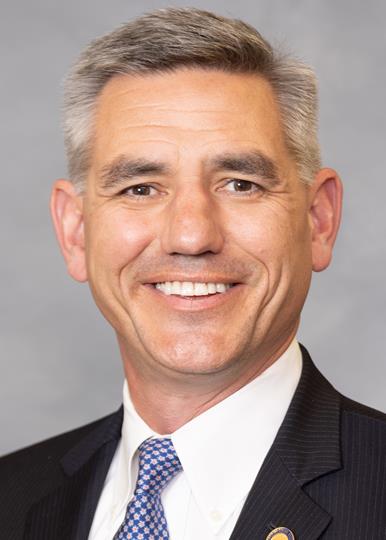
Rep. Brian Turner
Sponsored bills
Maddy summaryHB 830, "The Rolling Ink Act," proposes to allow motor vehicles to operate as mobile tattoo parlors in North Carolina. It establishes a permitting process through the Department of Health and local health departments, requiring an initial $5,000 fee and annual renewals, along with mandatory inspections. The bill outlines specific facility and equipment standards, such as functional sinks and sterilization devices, and requires compliance with existing tattoo parlor laws, motor vehicle regulations, and hazardous waste disposal rules. Tattooing is prohibited while the vehicle is in motion, and operators must maintain detailed records for inspection. Violations can result in civil penalties, permit suspension or revocation, or misdemeanor charges, with most provisions taking effect on July 1, 2026.
Maddy summaryHouse Bill 272, known as "The Sergeant Mickey Hutchens Act," allows certain law enforcement, probation/parole, and correctional officers in North Carolina to purchase additional retirement service credit. Officers who hold an advanced law enforcement or corrections certificate and have at least five years of membership service can buy up to four years of creditable service. This purchase applies to members of the Teachers' and State Employees' Retirement System or the Local Governmental Employees' Retirement System. To do so, they must pay a lump sum covering the full cost of the increased retirement system liability and an administrative fee, with the option for their employer to contribute to this cost.
Maddy summaryHouse Bill 820 requires health benefit plans in North Carolina to provide coverage for early refills of prescription eye drops. This means insurers cannot deny a refill for a 30-day supply if at least 21 days have passed since the last fill, or if the patient has used 70% of the medication according to their healthcare provider's instructions. The bill also specifies that the requested refill must not exceed the total number of refills indicated on the original prescription. These requirements apply to all health benefit plans, including the State Health Plan, with an effective date of October 1, 2025, or the subsequent plan year.
Maddy summaryHB 246, also known as "Liam's Law," increases penalties for specific driving offenses. The bill elevates reckless driving that causes serious bodily injury to a Class I felony. For street racing, it establishes new felony classifications for causing serious injury (Class F felony) or death (Class B2 felony), and mandates longer driver's license revocations, including permanent revocation for fatalities. Additionally, the bill increases the penalty for hit-and-run offenses that result in death to a Class D felony. These provisions directly affect drivers involved in such incidents.
Maddy summaryHB 927 allocates $31.7 million in state funds to Durham City and County for specific projects in the 2025-2026 fiscal year. It provides $30 million for Durham County to upgrade wastewater infrastructure in Research Triangle Park, $500,000 for city park maintenance, and $500,000 for repairing rural roads in Durham County. The bill also funds court system modernization, including $503,481 for eCourts staffing and $500,000 for a legal support center to improve access to justice. Additionally, it requires the Department of Transportation to study road funding criteria for rural areas to ensure equitable project prioritization. These funds directly support Durham residents through enhanced infrastructure, public services, and court efficiency.
Maddy summaryHB 938, the Right to Repair Digital Electronics Act, requires manufacturers of digital electronics sold or used in North Carolina to provide independent repair shops and product owners with free access to diagnostic tools, repair information, and service parts at fair and reasonable prices. It mandates that manufacturers make available the same diagnostic software, firmware updates, and repair documentation they provide to their own authorized repair networks. The law prohibits manufacturers from forcing authorized repair providers to use proprietary formats if standardized alternatives exist, while protecting trade secrets and existing repair agreements. This directly affects independent repair businesses, owners of digital devices (like smartphones and computers), and manufacturers selling such products in the state.
Maddy summaryHB 952 establishes the North Carolina Child Care Finance Agency to provide loans and bonds for constructing or rehabilitating childcare facilities. The agency will prioritize small providers (under 10 locations), high-quality licensed centers, faith-based organizations, and businesses offering on-site childcare for employees. It directly affects childcare providers, employers with childcare programs, and families seeking affordable, accessible care by financing facility development. This policy change creates a dedicated state mechanism to address North Carolina’s childcare shortage through targeted infrastructure investment.
Maddy summaryHB 933 increases Medicaid rates to ensure direct care workers for people with intellectual or developmental disabilities earn at least $18 per hour, affecting home/community providers, group homes, and waiver programs like NC Innovations. It adds 1,000 slots to the NC Innovations waiver program (with $36 million in annual state funding) and requires a 10-year plan to address unmet service needs. The bill also removes income and resource limits for Medicaid eligibility under the Health Coverage for Workers with Disabilities program. These changes take effect July 1, 2025, with $183 million in annual state funding supporting the wage increases and $36 million for new waiver slots.
Maddy summaryHB 890 requires North Carolina's Department of Public Instruction to create an Emergency Internet Service Plan (EISP) ensuring public schools can access temporary internet during state emergencies, like natural disasters. The bill establishes a dedicated Emergency Internet Service Fund with $3.9 million in initial funding for equipment and service contracts, which schools cannot be charged to activate. Key provisions include requiring the plan to cover activation conditions, equipment needs, data protection, and third-party partnerships, while ensuring the fund is nonreverting (unused money carries over). This directly affects all public school units by guaranteeing emergency internet access without requiring school-level funding. The plan must be updated annually and reported to the legislature.