

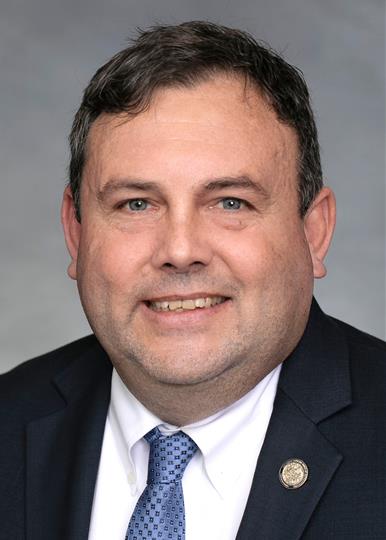
Photo of Eric Ager
D North Carolina House · District 114 On the 2026 ballot

Rep. Eric Ager

Compare
Total votes
1,281
all sessions
Attendance
99%
8 missed
Near the chamber average
With party
95%
of cast votes
Lower than 80% of chamber peers
Bipartisan score
3%
crosses aisle rarely
Higher than 79% of chamber peers
Sponsored
603
bills & resolutions
Higher than 92% of chamber peers
Committees
9
assignments
603 bills and resolutions

Sponsored bills

Total
603
Primary
24
Co-sponsor
579
This page
603
matching current filters
Co-sponsor HB 603
In committee · North Carolina House · Co-sponsor
Workforce Housing Loans - Preconstruction Costs.

Maddy summaryHB 603 creates a $40 million revolving loan fund within North Carolina's Housing Finance Agency to cover preconstruction costs (like land surveys, permits, and site work) for workforce housing projects. It directly affects developers building housing affordable to households earning 60%-120% of local median income, requiring them to contribute 20%-35% in project equity. The fund reserves 80% of loans for high-priority counties (tier 1-2) and 20% for other counties, with each loan capped at $1 million. The program requires annual reporting on loan details and becomes effective July 1, 2025.

In committee Apr 1, 2025 1 co-sponsor
Co-sponsor HB 604
In committee · North Carolina House · Co-sponsor
Rural and Downtown Community Economic Development Grants.

Maddy summaryHB 604 creates two grant programs to support economic development: the Rural Community Development Grant Program and the Downtown Revitalization Grant Program. Both programs allocate $40 million each from the state budget for 2025-2026, providing grants to local governments (counties and municipalities) to fund projects that improve community amenities like grocery stores, childcare, parks, or downtown infrastructure. Grants require a 1:1 local match, max $2 million per award, and must align with comprehensive plans for revitalization or community growth. The programs aim to reverse rural depopulation, attract business investment, and enhance downtown livability through targeted, competitive funding.

In committee Apr 1, 2025 1 co-sponsor
Co-sponsor HB 617
In committee · North Carolina House · Co-sponsor
Supporting Small Farmers for NC's Future Act.

Maddy summaryHB 617 creates a $20 million grant program for North Carolina small farmers with gross income under $300,000, funding equipment (like harvest machinery), infrastructure (such as fencing), and cold storage. It also lowers the income threshold for farm sales tax exemption from $10,000 to $7,500 annually, expanding eligibility for tax relief. The bill directly affects small farmers meeting these income criteria by providing financial support through grants and reduced tax burdens. Grants require applications and prioritize those facing economic hardship, with funding allocated for specific purposes like equipment and the FarmsSHARE program.

In committee Apr 1, 2025 1 co-sponsor
Co-sponsor HB 571
In committee · North Carolina House · Co-sponsor
Posttraumatic Stress Disorder Treatment for Police Officers/Funds.

Maddy summaryHB 571 appropriates $500,000 from the state General Fund to the Department of Public Safety for a grant program treating police officers diagnosed with PTSD. It directly affects North Carolina police officers who have received a clinical PTSD diagnosis. The key provision establishes a state-funded grant program to cover treatment costs, with funds allocated for the 2025-2026 fiscal year. The program becomes effective July 1, 2025, and focuses solely on providing financial support for treatment, not on expanding eligibility or altering diagnosis standards.

In committee Apr 1, 2025 1 co-sponsor
Co-sponsor HB 609
died · North Carolina House · Co-sponsor
Option for Raw Milk Consumption.

Maddy summaryHB 609 allows licensed farms in North Carolina to sell unpasteurized milk and raw milk products directly to consumers under strict safety conditions. It requires farms to obtain a Department of Agriculture license, pass annual inspections for disease (tuberculosis/brucellosis), meet water safety standards, and undergo regular testing for bacteria and pathogens in milk. Sales can only occur at the farm of origin or a small farm stand (max 1,000 sq ft), with mandatory labeling stating "Raw milk: not pasteurized and may contain organisms injurious to your health." The bill does not permit raw milk sales in restaurants or general retail settings, and all requirements must be met before the law takes effect on January 1, 2026.

died Apr 1, 2025 1 co-sponsor
Co-sponsor HB 564
In committee · North Carolina House · Co-sponsor
State Retirees Cost-of-Living Increase/Funds.

Maddy summaryHB 564 provides a 2% cost-of-living adjustment for retirees in North Carolina's Teachers' and State Employees' Retirement System, Consolidated Judicial Retirement System, and Legislative Retirement System. It increases retirement payments for retirees who retired on or before specific dates (July 1, 2024, for most systems, or January 1, 2025, for the Legislative system) and offers a prorated increase for those retiring between July 1, 2024, and June 30, 2025. The bill appropriates $106.2 million from the General Fund to fund this adjustment, effective July 1, 2025. This policy change directly affects current retirees in these systems by increasing their monthly benefits.

In committee Mar 31, 2025 1 co-sponsor
Co-sponsor HB 521
In committee · North Carolina House · Co-sponsor
Healthy Families and Workplaces/Paid Sick Leave.

Maddy summaryHB 521 would require most North Carolina employers to provide earned paid sick leave to workers. It mandates that employees accrue one hour of paid sick time for every 30 hours worked, with limits of 32 hours per year for small businesses (10 or fewer employees) and 56 hours for larger employers. The leave covers the employee's own health needs, care for immediate family members, or situations related to domestic violence, sexual assault, or stalking. Exemptions include volunteers, certain exempt employees under wage laws, and domestic workers employed in a private residence. The bill directly affects over 1.6 million private-sector workers in North Carolina, particularly low-wage and high-contact industry workers who currently lack access to paid sick days.

In committee Mar 27, 2025 1 co-sponsor
Co-sponsor HB 532
In committee · North Carolina House · Co-sponsor
County Service Districts/Research and Urban Research Service Districts.

Maddy summaryHB 532 creates special districts in North Carolina called "Research and Production Service Districts" (for research parks) and "Urban Research Service Districts" (URSDs). It allows counties to establish these districts to provide services like utilities, parks, or transportation - beyond standard county offerings - financed through local taxes. Key provisions require counties to form advisory committees (with at least 10 members, including a developer representative), clarify multi-county district rules, and let developers act as agents to contract for services within the district. This directly affects counties, developers of research parks, and property owners in these designated zones.

In committee Mar 27, 2025 1 co-sponsor
Co-sponsor HB 529
In committee · North Carolina House · Co-sponsor
Clean Repeal of HB2.

Maddy summaryHB 529 is a straightforward repeal bill that removes two specific provisions from North Carolina law that were part of the original HB 2 (2016). It repeals Article 81A of Chapter 143 (related to public accommodations) and G.S. 95-25.1(d) (a non-discrimination provision). The bill directly affects how public accommodations and non-discrimination protections were previously defined under HB 2. This is a clean repeal with no new provisions or mechanisms; it simply eliminates those specific sections of law.

In committee Mar 27, 2025 1 co-sponsor
Co-sponsor HB 523
In committee · North Carolina House · Co-sponsor
School Social Workers/Master's Pay.

Maddy summaryHB 523 allows certified school social workers in North Carolina public schools to qualify for education-based salary supplements if they hold a master's degree (or higher), regardless of whether a master's degree is required for their state license. This directly affects school social workers who meet the degree requirement but previously might have been ineligible due to licensure rules. The bill amends state law to include them in the eligibility group for these supplements, which were previously limited to certain roles like school nurses or personnel where a master's degree was licensure-required. The law appropriates $500,000 for the 2025-2026 school year to fund this change and takes effect July 1, 2025.

In committee Mar 27, 2025 1 co-sponsor
Showing 251 to 260 of 603 bills
Previous 1 … 25 26 27 … 61 Next