

Maddy summaryHB 208 allows New Mexico residents applying for a hunting or fishing license at the Department of Game and Fish to register to vote simultaneously. It adds the department of game and fish to existing state agencies (like motor vehicle offices) where eligible voters can register or update their registration during service interactions. The bill requires the department to appoint license vendors to accept voter registration forms, with all registrations transmitted to election officials within 10 days. This policy change directly affects people seeking hunting/fishing licenses who are not already registered to vote, expanding access points for voter registration without altering voting rights or requirements.
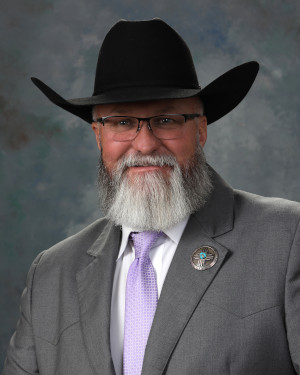
Rep. Harlan Vincent
Sponsored bills
Maddy summaryHB 380, the "Women's Safety and Protection Act," proposes requiring single-sex spaces in domestic violence shelters, public schools, and juvenile detention facilities to protect privacy and safety. It mandates that these facilities designate separate sleeping quarters and restrooms for males and females, while allowing reasonable accommodations like single-occupancy rooms for individuals who cannot use sex-designated spaces. The bill explicitly prohibits access to opposite-sex spaces when people of that sex are present, with exceptions for emergencies, medical aid, or ADA accommodations. The legislation remains pending after being postponed indefinitely in June 2025.
Maddy summaryHB 326 creates a $5,000 state income tax credit for small businesses in New Mexico that suffered significant revenue losses due to a governor-declared disaster. To qualify, businesses must have operated for two years, experienced at least a 30% drop in gross revenue from the disaster, and have under $2 million in annual revenue. Businesses must apply for certification through the Economic Development Department, which verifies eligibility before the credit can be claimed. The credit reduces tax liability directly, with any excess refunded, and applies to taxable years starting January 1, 2025.
Maddy summaryThis bill (HM 18) is a House Memorial requesting New Mexico’s state auditor to create a task force addressing the shortage of certified public accountants (CPAs) in the state. The task force, including state departments and stakeholders like the American Institute of CPAs, will study solutions such as integrating accounting into STEM education, expanding K-12 and college programs, and improving workforce training. It specifically aims to tackle barriers like the 150-hour education requirement and declining interest in accounting careers, with recommendations due by November 2025. The bill directly affects New Mexico’s CPA workforce, accounting employers, and students pursuing accounting careers.
Maddy summaryHB 412, the Emergency Medical Services Personnel Licensure Interstate Compact, allows licensed emergency medical technicians (EMTs), paramedics, and related personnel to practice across state lines in participating states without obtaining separate licenses. It directly affects EMS professionals who work in multiple states and patients receiving emergency care in those states. The bill establishes a system where a "home state" license is recognized as valid in "remote states" (other member states), requiring states to share adverse action information and maintain standardized licensing practices. Key mechanisms include mutual recognition of licenses, shared complaint investigations, and protocols for handling disciplinary actions to ensure public safety while improving access to emergency care.
Maddy summaryHB 543 clarifies that New Mexico's Reproductive and Gender-Affirming Health Care Freedom Act does not override existing laws requiring parental consent for minors seeking reproductive or gender-affirming health care. The bill amends the Act to explicitly state that it does not allow minors to access such care without parental consent in any manner not already permitted by current law. This maintains current consent requirements, directly affecting minors, parents, and health care providers. The bill was introduced in the 2025 New Mexico legislature and was postponed indefinitely on June 3, 2025.
Maddy summaryHB 176 creates a tax credit covering 50% of the purchase and installation costs for New Mexico residents and businesses that permanently install backup power generators (devices that provide power during main grid failures). The credit is limited to $5 million total per calendar year, with applications processed in order of receipt until the cap is reached. It applies to taxable years beginning on or after January 1, 2025, and expires on January 1, 2035. Taxpayers must apply for certification through the state Energy, Minerals and Natural Resources Department, and any unused credit amount exceeding a taxpayer's liability will be refunded.
Maddy summaryHB 322 increases penalties for severe sexual crimes in New Mexico, specifically adding the death penalty for aggravated criminal sexual penetration of children under 13 and human trafficking of minors under 18. The bill amends statutes to create new first-degree felony charges for these offenses, with the death penalty as a potential sentence. It also imposes stricter penalties for school employees committing sexual crimes against students, making such acts a first-degree felony regardless of the child's age. The law directly affects perpetrators of these specific crimes, particularly those involving children under 18 in trafficking or sexual assault cases.
Maddy summaryHB 351 provides $200 million in zero-interest loans to political subdivisions (like cities or counties) in Chaves County for repairing or replacing public infrastructure damaged by the October 19, 2024 storm, including flood or debris flow damage. The state funds these loans from the general fund for fiscal years 2026-2027, requiring recipients to repay the loan first using federal funds they receive for the same projects. Any unused funds by the end of 2027 would revert to the state general fund. This bill directly affects Chaves County entities that qualify for federal storm recovery assistance.
Maddy summaryHB 277 modifies how much local funding school districts must contribute for state-funded building projects. It specifically reduces the required local share for small, high-poverty districts with limited ability to raise funds through property taxes. To qualify, districts must have residential tax rates of $8 or less per $1,000 valuation, fewer than 800 students, and over 70% of students eligible for free/reduced lunch. The bill adjusts the existing funding formula to provide greater state support to these districts, making capital projects more accessible. This change directly affects struggling school districts that cannot meet standard local contribution requirements.