

Maddy summaryHB 334, the "Rural Electric Co-op Wildfire Liability Act," requires New Mexico's rural electric cooperatives to create and maintain detailed wildfire prevention plans. These plans must cover risk assessments, vegetation management, system inspections, emergency procedures, and public safety considerations, and must be reviewed by the Forestry Division and approved by the Public Regulation Commission. If approved, the cooperative can limit liability for wildfire-related damages (including economic and noneconomic losses) and claims must be filed within two years. The law also mandates public posting of the plans and annual compliance reports on the cooperatives' websites.
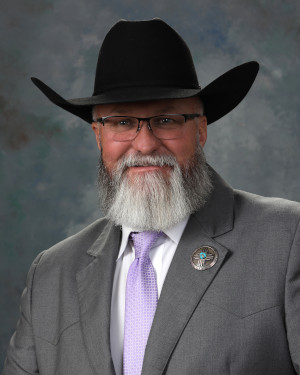
Rep. Harlan Vincent
Sponsored bills
Maddy summarySB 15 creates a $1,000 income tax credit for New Mexico residents who volunteer at least 52 times yearly with a certified emergency medical services (EMS) agency. To qualify, volunteers must provide proof of service and obtain certification from the Emergency Medical Systems Bureau. The credit is limited to $4 million total annually across all claimants, and applicants must not also claim the separate volunteer firefighter tax credit for the same year. This policy directly supports unpaid EMS volunteers by reducing their state tax liability.
Maddy summaryHB 374 amends the definition of "occurrence" in New Mexico's Medical Malpractice Act. Currently, the law defines "occurrence" as all claims for damages from harm to a single patient, regardless of how many health care providers or errors contributed to the harm. This bill changes that definition, which would affect how malpractice claims are grouped and processed in court. The change directly impacts patients filing claims, health care providers (including hospitals and outpatient facilities), and insurers handling these cases.
Maddy summaryHB 466, the "Hormone Therapy and Puberty Blocker Child Protection Act," prohibits health care providers and public bodies from knowingly performing or administering hormone therapy or puberty blockers to minors for the purpose of helping them live as a gender different from their sex assigned at birth, except for treating congenital defects, precocious puberty, or existing medical conditions ending by December 2025. The bill requires health care providers to notify parents in writing before a minor receives gender-affirming care, defines "gender-affirming action" broadly to include name/pronoun changes or seeking related services, and overrides minors' ability to consent to such care. It also creates a private right of action for parents to sue providers or public bodies for violations. The bill was referred to committees in February 2025 but was postponed indefinitely on June 3, 2025.
Maddy summaryHB 566 exempts certain law enforcement personnel from New Mexico's standard 7-day firearm waiting period. It specifically applies to active certified law enforcement officers, former/retired officers, commissioned officers with arrest powers, and tribal law enforcement officers who are not disqualified from firearm possession. The bill amends existing law to remove the waiting period requirement for these individuals when purchasing firearms, while maintaining the 7-day waiting period for all other buyers. This change directly affects qualified law enforcement personnel during firearm purchases, without altering the general waiting period for the public.
Maddy summaryHM 55 (House Memorial 55) is a non-binding resolution urging New Mexico's Office of Superintendent of Insurance to approve proposed changes to the state's FAIR plan property insurance program. The resolution seeks to increase residential coverage limits under the FAIR plan to $750,000 for homeowners in high-risk wildfire areas like Lincoln County, where recent fires destroyed homes. This change would provide higher coverage than the current actual-cash-value basis, helping affected residents secure insurance to rebuild. The memorial does not create new law but formally requests timely approval of these specific coverage adjustments.
Maddy summaryHB 207 would expand New Mexico's adoption tax credit to apply to the adoption of any child (not just those deemed "special needs"), increasing the credit amount from $1,500 to $7,000 per adopted child. The bill allows taxpayers who adopt a child to claim this credit against their state income tax liability, with any excess credit refunded if it exceeds the tax owed. It applies to taxpayers filing individual New Mexico income tax returns who adopt a child on or after January 1, 2025. The credit would be available for each year the child qualifies as a dependent for federal tax purposes.
Maddy summaryHB 177 creates a New Mexico income tax credit for parents homeschooling children who meet specific age and educational criteria. It allows eligible parents to claim a credit equal to their annual spending on approved curriculum materials (like textbooks and workbooks), up to $2,500 per child, after certification by the public education department. The credit is refundable if it exceeds the taxpayer’s liability, and must be claimed within three years of certification. This bill directly affects homeschooling families in New Mexico who qualify under the Public School Code.
Maddy summaryHB 388 creates a state-funded program providing financial accounts for low-income students in New Mexico to cover education expenses at private schools or approved services. Eligible students must be New Mexico residents, not yet graduated from high school, and have household income under 200% of the federal poverty level. The state deposits monthly funds into these accounts - equal to the average public school spending per grade - to pay for private school tuition, tutoring, textbooks, assessments, and transportation, but not exceeding actual costs. Unspent funds remain in the account until graduation, withdrawal, or after two years (with possible extensions), after which they revert to the state general fund.
Maddy summaryHB 315 allocates $250,000 from the general fund to New Mexico State University's Board of Regents to create a statewide archaeology field school education program. The program will be developed collaboratively by the Department of Agriculture, Soil and Water Conservation Commission, and Cultural Affairs Department, targeting students and educators through hands-on archaeological training. The funding is restricted to fiscal year 2026, with any unspent balance reverting to the general fund. This is a program-specific appropriation, not a policy change affecting broader legislation.