

Maddy summaryThis bill designates June 10, 2026, as "Christina Grimmie Day" in New Jersey to honor the late singer and songwriter who was a native of the state. The resolution recognizes Grimmie's musical achievements and her legacy as a New Jersey artist, particularly noting that the date marks the tenth anniversary of her passing. It requests the Governor to issue a proclamation for the day, serving as a commemorative gesture rather than a change to laws or regulations.
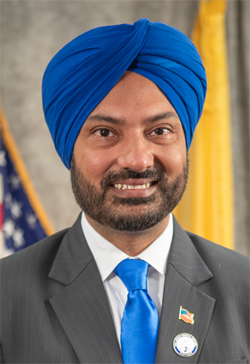
Asm. Balvir Singh
Sponsored bills
Maddy summaryThis bill formally approves the Fiscal Year 2027 financial plan for the New Jersey Infrastructure Bank. The resolution authorizes the bank to proceed with funding loans and debt guarantees for eligible environmental projects, including clean water, drinking water, and stormwater management initiatives. By passing this measure, the Legislature ratifies the bank's budgetary strategy for the upcoming fiscal year as required by state law. The document does not alter the bank's operations but rather provides the necessary legislative consent for its planned financial activities.
Maddy summaryThis bill authorizes the New Jersey Infrastructure Bank to lend up to $3.85 billion to local governments and public water utilities for environmental infrastructure projects in fiscal year 2027. The funds are intended to help pay for the construction of facilities that manage water supply, wastewater treatment, and other environmental systems. Additionally, the legislation allows the bank to increase its lending capacity by including interest earned, administrative fees, and money transferred from specific state trust funds. These loans will be jointly managed by the Infrastructure Bank and the Department of Environmental Protection to ensure projects meet federal and state standards.
Maddy summaryThis bill directs the New Jersey Department of Environmental Protection to use specific state funds to finance environmental infrastructure projects in fiscal year 2027. The legislation authorizes the department to provide zero-interest or principal forgiveness loans to sponsors for clean water and drinking water initiatives, utilizing money from various revolving funds and federal grants. Additionally, it permits the transfer of funds between different state revolving accounts to address urgent public health threats and meet future financing needs. Ultimately, the act ensures that available capital is allocated to support essential water and wastewater infrastructure improvements through the state's lending programs.
Maddy summaryThis bill approves the Fiscal Year 2027 financial plan for the New Jersey Infrastructure Bank, a state agency that provides loans and debt guarantees for environmental projects. The resolution authorizes the bank to fund specific initiatives such as clean water, drinking water, stormwater management, and pollution control projects based on eligibility lists created by the Department of Environmental Protection. By passing this concurrent resolution, the Legislature formally validates the bank's budget and financing strategy for the upcoming fiscal year, allowing the agency to proceed with its authorized lending activities.
Maddy summaryThis bill authorizes the New Jersey Infrastructure Bank to lend $13.093 million to local governments for specific hazard mitigation and resilience projects in fiscal year 2027. The funds are designated for four approved initiatives in Jersey City, Brigantine, Highlands, and Manasquan, which include park resilience, living shorelines, flood mitigation, and coastal protection. To receive these loans, project sponsors must certify that their plans comply with existing emergency management laws and regulations, and the loans must be repaid within 30 years of completion. Additionally, the bill allows the bank to grow its lending capacity by using interest earned on loans and other program fees.
Maddy summaryThis joint resolution commemorates the 100th anniversary of the Benjamin Franklin Bridge, a major transportation link between Camden, New Jersey, and Philadelphia, Pennsylvania. The bill directs the Governor and the New Jersey Legislature to officially recognize this milestone and requires sending copies of the resolution to the Delaware River Port Authority, which manages the bridge. The text highlights the bridge's historical significance, engineering achievements, and role as a cultural symbol without imposing new laws or regulations.
Maddy summaryAJR 150 designates September 21 of each year as "New Jersey Pedestrian Crosswalk Safety Day" to honor Bruce Morlack, a Burlington crossing guard who died protecting students. The resolution requests the Governor issue an annual proclamation encouraging residents, schools, and communities to observe the day with safety-focused activities. It does not create new laws or funding but commemorates Morlack's legacy and promotes pedestrian safety awareness. This ceremonial resolution affects all New Jersey residents and public officials through its annual observance.
Maddy summaryThis bill requires licensed private detectives in New Jersey to notify the State Police when they work for foreign governments or foreign nationals. It adds a new registration requirement to existing licensing rules, mandating that detectives inform the State Police about their foreign employers - supplementing existing federal laws. The State Police must maintain a confidential registry of these detectives, including their business details and employer information, but access is limited to the Attorney General and State Police personnel. The law applies only to licensed private detectives, not other professionals, and takes effect six months after enactment.
Maddy summaryThis bill imposes a temporary five-year surtax on corporations in New Jersey that receive refunds for specific federal tariffs, with the goal of funding consumer relief programs. The tax requires businesses to pay an amount equal to 90 percent of the refunds they get from the U.S. government for tariffs linked to national security concerns, such as those addressing illegal drug flows or trade deficits. All money collected from this surtax must be placed into a special fund to provide grants to small businesses affected by price hikes, issue rebates to low- and moderate-income households, and support consumer protection enforcement. The measure applies to privilege periods starting on or after January 1, 2026, and ends before January 1, 2031.