

Maddy summaryThis bill clarifies that certain licensed professionals in New Jersey may be treated as independent contractors under state law if they have a written agreement designating them as such. It specifically applies to licensed insurance producers, securities professionals (like broker-dealers and investment advisers), freight drivers at marine terminals/rail facilities meeting unemployment law exemptions, and others meeting specific criteria. The law prevents these professionals from being reclassified as employees for any purpose under state law during the term of their written agreement and prohibits requiring additional tests to maintain independent contractor status. It applies retroactively to all existing agreements for enforcement purposes.
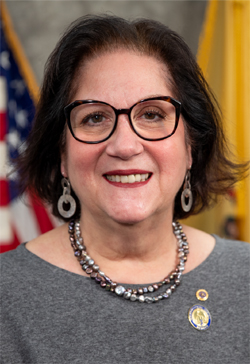
Asm. Melinda Kane
Sponsored bills
Maddy summaryThis bill bans businesses in New Jersey from owning, controlling, installing, managing, selling, or offering for sale cryptocurrency ATMs. These are defined as physical, internet-connected kiosks that let users buy, sell, or exchange digital currency using cash, debit, or credit cards. The law directly affects businesses operating such kiosks, prohibiting them under the state's consumer fraud act with penalties up to $20,000 per violation. It targets a surge in fraud - citing FTC data showing $110 million in losses linked to these machines in 2023 - aimed at protecting consumers, especially older adults who face higher risks.
Maddy summaryThis bill (A 1649) allows owners of guide or service dogs in New Jersey to obtain a free, non-expiring identification card when applying for or renewing their dog's license. The card, developed by the Department of Health, serves as official proof the dog has been trained as a guide or service dog and must be accepted by all municipalities. Owners must submit a written statement confirming the dog's training, with a $500 penalty for false claims. The bill also exempts guide/service dogs from standard licensing fees and appropriates $100,000 to fund the card program.
Maddy summaryThis New Jersey bill (A 1642) protects registered medical cannabis patients from employment discrimination. It prohibits employers from taking adverse actions (like firing, refusing to hire, or changing pay) based solely on an employee’s medical cannabis use or positive drug test, unless the employer proves the use impaired job performance. Employees with a valid medical cannabis card can explain a positive test by providing a doctor’s recommendation or card within three business days, and may request a retest at their own expense. The law does not override federal restrictions, allowing employers to still enforce rules against intoxicating substances during work hours or if federal funding is at risk.
Maddy summaryThis New Jersey bill (A1647) invalidates most geographic restrictions that prevent physicians from practicing medicine in a specific area after leaving a job. It directly affects physicians by making non-compete clauses in employment contracts unenforceable, unless specific exceptions apply. Key exceptions include restrictions for large hospital systems (30+ physicians), federally qualified health centers (5-mile radius for up to 4 years), or when a "unique incentive" (like a $50,000 bonus) was clearly stated in the contract. The law applies immediately to new employment contracts and does not void other non-restrictive contract terms.
Maddy summaryThis bill requires New Jersey's electric public utilities to submit detailed infrastructure improvement plans to the Board of Public Utilities (BPU) within 120 days. The plans must address reopening closed or restricted electric distribution circuits - currently limiting renewable energy installations - to allow more solar and storage projects, using smart inverter technology to manage electricity flow. Utilities must also report on new renewable interconnection approvals and complete required work as soon as possible. The BPU will review and approve these plans within 300 days, focusing on expanding access to distributed renewable energy systems.
Maddy summaryThis bill clarifies that owners of self-driving vehicles must follow existing automobile insurance requirements in New Jersey. It directly affects owners of self-driving private passenger cars that meet SAE automation standards (like those using sensors or GPS for driving). The key mechanism is updating the definition of "automobile" in insurance law to explicitly include self-driving vehicles, ensuring they fall under current coverage rules. This means self-driving car owners cannot avoid standard insurance policies required for conventional vehicles. The bill does not create new insurance rules but confirms existing ones apply to this technology.
Maddy summaryThis bill requires New Jersey Medicaid to cover fertility preservation services (like egg or sperm freezing) for individuals who develop infertility as a direct result of medically necessary treatments, such as cancer therapy. It directly affects Medicaid beneficiaries facing treatment-induced infertility who would otherwise pay out-of-pocket for these services. The key provision amends Medicaid coverage to include these services under "comprehensive medical care" when recommended by a physician prior to treatments known to cause infertility. The policy change ensures coverage for fertility preservation as part of standard medical care, without adding new administrative burdens to existing Medicaid services.
Maddy summaryThis bill revises the composition of New Jersey's State Board of Cosmetology and Hairstyling. It reduces public members from three to two, adds representation for public school cosmetology programs and private cosmetology schools, and changes professional licensing requirements to include any licensed profession regulated by the board (instead of specifying barbering or beauty culture roles). The board will now include two hair braiding shop owners, one state executive department member, and six licensed professionals with at least five years' experience in their field. The changes take effect immediately upon enactment.
Maddy summaryThis bill establishes two new entities in New Jersey: the Office of Healthcare Affordability and Transparency (within the Department of Health) and the Health Care Cost Containment and Price Transparency Commission. It requires hospitals, health insurers, and other healthcare providers to publicly report detailed pricing data for services like inpatient care, emergency visits, and physician services. The Commission will set annual benchmarks for healthcare cost growth and hospital pricing, monitor entities exceeding these benchmarks, and may impose public transparency requirements or civil penalties for noncompliance. These provisions directly affect all New Jersey hospitals, health insurers, and healthcare providers by mandating transparency in pricing and cost reporting to promote affordability.