

Maddy summaryThis New Jersey bill requires food service businesses to clearly inform customers about major food allergens present in each menu item. Covered establishments, such as restaurants, cafés, and grocery stores, must display this information directly on menus, via digital codes linking to websites, or through separate written materials like charts and booklets. The law mandates that allergen notices use common names or approved standardized symbols and applies to both permanent and temporary menu items, while exempting prepackaged foods already regulated by federal labeling rules. Enforcement is handled by the Department of Health or local health boards, which can issue written notices and order corrective action if violations occur.
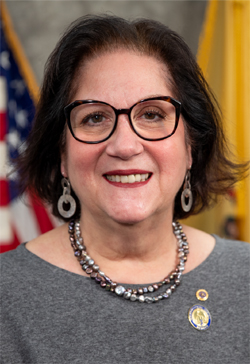
Asm. Melinda Kane
Sponsored bills
Maddy summaryThis bill expands the definition of human trafficking crimes in New Jersey and removes the statute of limitations for prosecuting these offenses, allowing authorities to pursue cases regardless of how much time has passed. It also creates specialized human trafficking response teams to coordinate investigations and support services, while increasing training and education requirements for law enforcement and related professionals. Additionally, the bill appropriates $1 million to the Commission on Human Trafficking to fund these initiatives and improve victim support systems.
Maddy summaryThis bill, "Used Car Buyers' Bill of Rights," prohibits dealers from selling used vehicles as "certified" or similar terms if they conceal specific issues like odometer fraud, flood damage, frame repairs, or undisclosed title problems (e.g., "salvage" or "Lemon Law Buyback"). It also requires dealers to offer buyers a contract cancellation option, allowing returns within a defined timeframe (with a minimum 250-mile allowance) for a capped fee based on the vehicle’s price (e.g., $250 for $10k-$30k vehicles). The law directly affects used car dealers and consumers purchasing vehicles under $40,000, excluding high-value, salvage, or insurance-total-loss vehicles. Key provisions include mandatory disclosures of vehicle defects and standardized return terms to reduce misleading sales practices.
Maddy summaryThis bill directs the New Jersey Department of Veterans Affairs to partner with law firms to provide free federal appellate legal services to eligible disabled veterans seeking disability compensation from the U.S. Department of Veterans Affairs. The program would be open to veterans with a net worth under $2 million and would require law firms to specialize in veteran benefits law, have at least ten years of experience in this area, and maintain physical offices across northern, central, and southern New Jersey. Eligible veterans could request representation through their next-of-kin, friends, or fellow veterans, and the state would require participating firms to submit periodic reports on their services.
Maddy summaryThis bill requires New Jersey public schools to create policies for administering nasal seizure rescue medication and using manual vagus nerve stimulators for students with seizure disorders during emergencies. It defines specific roles for school nurses as primary responders while allowing them to designate at least two additional trained staff members to assist when the nurse is not present. The legislation mandates that designated staff receive CPR and defibrillator training, obtain written parental consent, and includes provisions protecting school employees from liability when acting in good faith during emergency medical situations.
Maddy summaryThis bill requires drivers to stop at least 25 feet from school buses loading/unloading children or individuals with developmental disabilities on undivided highways, and to slow to 10 mph on divided highways. It establishes that violations captured by school bus monitoring systems (like cameras) will result in a $300 civil penalty instead of criminal charges or license points. The law directly affects drivers near school buses, school bus operators, and enforcement agencies. Key provisions include standardized stopping distances, speed limits for divided highways, and shifting penalties for monitored violations to a civil fine system. This changes enforcement by prioritizing evidence from monitoring systems to reduce penalties for documented violations.
Maddy summaryThis bill requires mattress producers (manufacturers, importers, or brands) to join a nonprofit stewardship organization within one year of the law taking effect. The organization will manage the collection and environmentally sound disposal of discarded mattresses through a program funded by a small "stewardship assessment" added to each mattress purchase price. Retailers and renovators selling mattresses must also register with the organization. The program aims to ensure discarded mattresses are recycled, renovated, or disposed of safely, reducing landfill waste and environmental harm.
Maddy summaryThis bill prohibits licensed child care providers and registered family day care providers in New Jersey from charging parents fees for services on days they cannot operate due to staff contracting or being exposed to COVID-19. It directly affects parents who paid fees during such closures and requires providers to reimburse them for any fees charged since December 1, 2021. The law applies to all staff, including substitutes and assistants, and takes effect immediately with retroactive coverage. This ensures parents aren't charged for days child care services were unavailable due to COVID-19-related staff issues.
Maddy summaryThis bill changes New Jersey law to allow (but not require) physicians to report patients aged 16+ with persistent epilepsy or related conditions - such as recurrent seizures, unconsciousness, or motor coordination issues despite treatment - to the Motor Vehicle Commission (MVC). Currently, physicians must report such cases within 24 hours; this bill makes reporting optional. The MVC Chief Administrator would still receive reports using prescribed forms, and the State Health Commissioner would collaborate on form design. The change affects physicians treating qualifying patients and alters the reporting obligation without modifying MVC's underlying safety standards.
Maddy summaryBill A 1645 clarifies that veterinarians are excluded from New Jersey's telemedicine and telehealth law. The bill amends existing statute (P.L.2017, c.117) to explicitly state that veterinary services are not covered under the definition of "health care provider" for telehealth purposes. This means veterinarians providing remote care will not be subject to the same licensing, standards, or regulatory requirements as human medical providers using telehealth. The change directly affects veterinarians and the veterinary care industry by removing them from the scope of the telehealth law.