

Maddy summaryThis bill requires public utilities (like gas, electric, or water companies) to provide daily status updates to municipal officials - such as mayors or clerks - about their service work occurring within a municipality's boundaries. This applies to all utility work, including emergency repairs affecting municipal buildings (like schools or fire stations), from the start until completion date. The Board of Public Utilities will create specific rules for how these updates must be delivered, including during emergencies. The law directly affects utilities performing work in New Jersey municipalities and aims to improve local transparency about service disruptions.
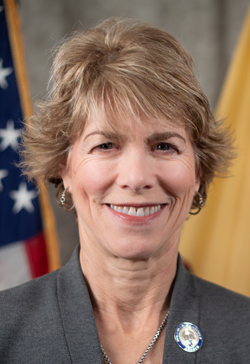
Asm. Lisa Swain
Sponsored bills
Maddy summaryThis bill (A 1940) required manufacturers of menstrual products sold in New Jersey to list all non-confidential ingredients on product packaging and their websites, with ingredients ordered by quantity. It applied to all menstrual products - like tampons, pads, cups, and underwear - packaged for individual retail sale, giving manufacturers 18 months to comply after the law took effect. Manufacturers could exclude confidential business information but had to list it by common name. Non-compliant products faced civil penalties of up to $1,000 per package, based on 1% of annual in-state sales. The bill was withdrawn after being approved as P.L.2025, c.232 and enacted into law.
Maddy summaryThis New Jersey bill (A 3585) makes it a crime to knowingly share manipulated videos or audio that falsely depict a candidate or election issue within 90 days of an election, with penalties including up to a fourth-degree offense (or third-degree for repeat violations). It directly affects voters (by aiming to prevent deception), candidates (who can seek legal relief for false depictions), and content creators (who face criminal or civil liability). Key provisions require clear disclaimers for minor edits or news/satire content, and exempt social media platforms, traditional media, and news outlets under federal law. The law does not apply to accidental edits, news reporting, or content with prominent disclaimers identifying manipulation.
Maddy summaryThis bill (A 2066) establishes the "New Jersey STEM Scholars Grant Pilot Program" to provide competitive grants to public school districts, renaissance schools, and charter schools. The program funds three specific STEM education approaches: project-based learning, after-school STEM activities, and out-of-school STEM experiences. Schools applying must detail how funds will enhance existing programs or create new ones, recruit students, support educators, and ensure long-term sustainability. Grants must supplement, not replace, existing STEM funding and are subject to annual state appropriations. The program runs for four years, with funding sourced from state appropriations and private donations.
Maddy summaryThis bill removes an exemption in New Jersey's Smoke-Free Air Act that previously allowed smoking in casinos and casino simulcasting facilities. Currently, these venues could permit smoking in areas used for gambling (like slot machine rooms or table games), but the bill would eliminate that exception. After passage, all indoor areas of casinos and simulcasting facilities open to the public for gambling would be required to be smoke-free. This change aligns these venues with the state's general indoor smoking ban, which applies to most public workplaces and spaces.
Maddy summaryThis bill makes it a fourth-degree crime to intentionally tamper with or interfere with someone else's electronic device (including smart home systems, security systems, phones, or cameras) with the purpose of harassing them. It defines "electronic device" broadly to cover any device capable of transmitting or recording information electronically. Violations carry penalties of up to 18 months in jail, a $10,000 fine, or both. The law applies directly to individuals who engage in such interference, not to the devices or systems themselves.
Maddy summaryThis bill requires all New Jersey solid waste management districts (including counties and the Hackensack Meadowlands District) to create a strategy reducing food waste by 50% by 2035 compared to 2022 levels. Districts must submit these strategies as amendments to their waste management plans, counting food donations, composting, and anaerobic digestion toward the goal. The Department of Environmental Protection (DEP) must publish a list of actionable measures for districts (like donation programs, composting infrastructure, and public campaigns) and establish tiered regulations for composting facilities. The policy directly affects local waste management systems and aims to divert food waste from landfills, reducing methane emissions.
Maddy summaryThis bill establishes a Train the Trainer Program within New Jersey's Department of Education to prepare educators to lead school-wide mental health training for teachers and staff. It appropriates $1 million to fund the program, which will teach evidence-based methods like trauma-informed approaches, recognizing mental health challenges, restorative practices, and crisis de-escalation. The program requires training on topics including fostering positive school climates, addressing bullying, and accessing mental health resources - though school districts may choose not to participate. The Commissioner of Education must annually evaluate the program and report on its effectiveness to the Governor and Legislature within three years.
Maddy summaryThis bill requires all New Jersey high school students to complete a one-semester financial literacy course as part of their curriculum. The course must cover budgeting, savings, credit, debt, taxes, college financial planning, and other personal finance topics, while excluding primarily business or economic instruction. Teachers must hold specific endorsements (e.g., in Finance, Social Studies, or Business) to teach the course, and school districts must integrate it into graduation requirements for state-endorsed diplomas. The requirement applies to students entering 12th grade in the 2027-2028 school year.
Maddy summaryThis New Jersey bill requires hospitals providing breast cancer surgical treatments (like mastectomy or lumpectomy) to give patients written notice at diagnosis - before surgery consent - about their rights to consult with any board-certified plastic surgeon (regardless of hospital or insurance network) and coverage for reconstructive surgery under state/federal law. It also prohibits health insurance contracts from blocking doctors from recommending plastic surgeons outside their network or denying reconstructive surgery coverage based solely on a surgeon’s network status. The policy applies specifically to patients undergoing treatment for breast cancer, breast cancer genes, or other breast abnormalities. Hospitals must provide this notice upon diagnosis, ensuring patients understand their options for reconstruction and coverage.