

Maddy summaryThis bill changes how New Jersey fills vacancies in its U.S. House of Representatives seat. It requires the Governor to issue a writ of election within 10 days of a vacancy, replacing the current unspecified timeframe. The bill establishes clear timelines based on the remaining term: for vacancies with 180+ days remaining, it mandates a special primary election followed by a special election; for 135-180 days remaining, it mandates a special election without a primary; and for less than 135 days remaining, the seat remains vacant until the next term. This provides more predictable scheduling for voters, candidates, and election officials.
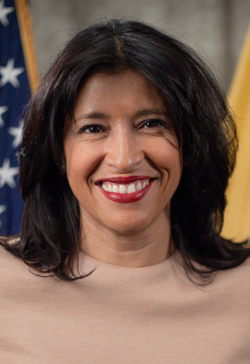
Asm. Alixon Collazos-Gill
Sponsored bills
Maddy summaryThis bill makes it a crime to possess, sell, or manufacture machine gun conversion devices, which are defined as devices designed to modify semiautomatic firearms to fire multiple shots with a single trigger pull. It establishes a third-degree crime for possessing such devices, punishable by 3-5 years in prison and/or a $15,000 fine, and creates a separate third-degree crime for manufacturing, selling, or distributing these devices. The bill clarifies that firearms equipped with machine gun conversion devices are considered machine guns under existing law, which is currently a second-degree crime. This law applies to anyone who possesses, sells, or manufactures these conversion devices, regardless of whether they are also in possession of a firearm.
Maddy summaryThis bill prohibits New Jersey food service businesses from automatically providing single-use plastic utensils and condiments to customers. Instead, businesses must only provide these items upon explicit customer request. Restaurants and similar establishments with 50 or more on-site seats must offer reusable, washable utensils for dine-in customers, who must return them after use. Businesses that exclusively use eco-friendly alternatives are exempt, and violations could result in fines up to $5,000 per offense, with penalty funds going to litter prevention programs.
Maddy summaryThis bill requires owners of solar and photovoltaic energy systems (like rooftop panels or ground-mounted arrays) to remove and recycle these facilities when they are retired, including related equipment. The New Jersey Department of Environmental Protection must create rules for safe removal and recycling, covering standards and processes. Owners who fail to comply face a civil penalty of up to $1,000 per violation. The law directly affects solar facility owners and operators, not the general public or new installations.
Maddy summaryThis bill requires New Jersey's Division of Medical Assistance and Health Services (DHS) and the State Board of Medical Examiners to create a faster process for reviewing applications from doctors who want to join NJ FamilyCare (the state's Medicaid and children's health insurance program). Specifically, the medical board must share a physician's license number with DHS within 5 days of issuing it (or provide denial documentation within 5 days if licensure is denied), and DHS must begin processing applications immediately if they include license details or proof of pending licensure. DHS must also notify applicants within 10 days of receiving the license number if additional documents are needed. The bill does not change existing licensing or enrollment requirements and clarifies that approval cannot be granted before DHS receives a National Provider Identifier number.
Maddy summaryThis bill requires New Jersey's Commissioner of Human Services to appoint a State Dementia Services Coordinator. The coordinator will develop a master plan for dementia care, coordinate existing state programs, prevent service duplication, identify gaps in care, and improve access to quality treatment for people with Alzheimer's and other dementias. The position is authorized to request data from state agencies and consult with experts, with all departments required to cooperate. The bill appropriates $150,000 from the General Fund to the Department of Human Services to implement these changes. It directly affects individuals with dementia, their families, and the state agencies providing related services.
Maddy summaryThis bill clarifies that New Jersey real estate salespersons and broker-salespersons may form limited liability companies (LLCs) or other legal entities to receive their commissions, without changing their business relationship with their employing broker. It explicitly permits salespersons to accept commissions directly from their own LLC or entity, provided this arrangement aligns with their written agreement with the broker. The New Jersey Real Estate Commission will establish a registration process for these entities to ensure compliance. The law takes immediate effect.
Maddy summaryThis bill requires New Jersey's solid waste management districts (including counties and the Hackensack Meadowlands District) to develop and implement a strategy to reduce food waste by at least 50% by 2030, compared to waste levels in the year the law takes effect. Districts must adopt this strategy as an amendment to their existing solid waste management plans, subject to DEP approval. The Department of Environmental Protection (DEP) must also publish a public list of specific methods districts can use, including food donation programs, composting facilities, source separation, and public awareness campaigns. These measures aim to divert food waste from landfills and reduce methane emissions.
Maddy summaryThis bill requires water suppliers to immediately notify specific entities when drinking water quality standards are violated. Affected groups include municipalities, school districts, charter schools, and nonpublic schools within the affected area. Suppliers must provide detailed information via phone and email, including contaminant names, test dates, locations, exceedance levels, and suggested remedies. The law takes effect immediately upon passage.
Maddy summaryThis New Jersey bill would require restaurants and other food service businesses to stop automatically providing single-use utensils (like forks and knives) and condiments (such as ketchup and mustard packets) to customers, instead offering them only when specifically requested. Businesses with 50 or more on-site seats would need to provide reusable utensils for dine-in customers who must return them for cleaning and reuse. The bill includes exemptions for schools (for five years), food courts (for two years), and health care facilities during infectious disease outbreaks or outdoor events. Violations would result in penalties of $2,500 for second offenses and $5,000 for third or subsequent offenses, with funds going to environmental cleanup programs.