

Maddy summaryThis bill changes how New Jersey public employees receive cash payments for unused sick leave upon retirement. It caps these payments at $15,000 (the previous limit) and stops payments for sick leave earned after the bill's effective date. It also limits how much unused vacation leave can be carried forward and requires suspension of payments if an employee is indicted for certain crimes, with full forfeiture if convicted of qualifying offenses. These changes directly affect public employees in school districts, government agencies, and other public workplaces covered by New Jersey's sick leave laws.
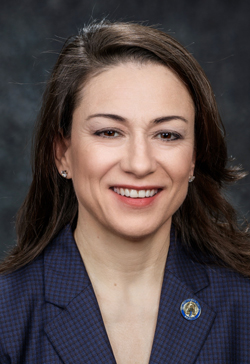
Asm. Aura Dunn
Sponsored bills
Maddy summaryThis bill establishes a two-year Mental Health Awareness Pilot Program within New Jersey's Department of Education, directly affecting middle and high school students in participating school districts. School districts must apply with detailed data on student enrollment, absenteeism, academic performance, socioeconomic status, and current mental health staffing to be selected. The Commissioner will choose six districts - representing all regions and urban/suburban/rural settings - to implement innovative mental health awareness initiatives and teach students coping skills for stress management. After two years, the Commissioner must report to the Governor and Legislature on the program's implementation and whether it should continue or expand.
Maddy summaryThis bill creates a $50 million grant program within New Jersey's Department of State to protect Revolutionary War sites (battlefields, encampments, and skirmish locations) threatened by development. Local governments and qualifying nonprofit organizations can apply for competitive grants to fund preservation, expansion, or management plans for these historically significant sites. The program requires applicants to submit detailed plans demonstrating public benefit and administrative capability, with the Department of State establishing application guidelines and monitoring grant use. The legislation appropriates $50 million from the General Fund immediately upon enactment to implement this preservation effort.
Maddy summaryThis bill (A-2360) requires the New Jersey Motor Vehicle Commission (MVC) to operate a telephone call center within New Jersey. The call center must provide real-time assistance during weekday hours (8:30 a.m. to 4:30 p.m.) to help residents navigate the MVC's website and complete online transactions, with services offered in both English and Spanish. The MVC must also publish quarterly performance reports online detailing call volume, wait times, call purposes, and call durations. This directly affects New Jersey residents using MVC's online services by adding a dedicated support option.
Maddy summaryNew Jersey's bill A 3160 creates special license plates displaying Autism Awareness messaging for motor vehicle owners. Vehicle owners applying for these plates must pay a $50 initial fee plus a $10 annual renewal fee, with all fees deposited into the "Autism Awareness License Plate Fund." The fund directs monies annually to the University of Medicine and Dentistry of New Jersey for autism research, in consultation with the Governor's Council for Medical Research and Treatment of Autism. The bill specifies that initial costs for plate design and implementation cannot be covered by state funds, requiring contributions from the Governor's Council or other donors.
Maddy summaryThis bill creates a New Jersey state income tax credit for child care staff and registered family day care providers. Eligible workers must have worked continuously for six months in their current role and directly supervise children. The credit amount varies by income level (ranging from $500 to $1,500 annually) and depends on whether they care for infants/toddlers (under 30 months) or older children, with higher credits for infant care. To qualify for the full infant care credit, workers must spend at least 50% of their time providing direct child care services.
Maddy summaryThis bill establishes a voluntary certification program for sober living homes (recovery residences) in New Jersey. It requires the Department of Community Affairs (DCA) to approve a nonprofit credentialing entity to develop standards and administer certification for both recovery residences and their administrators. The program includes on-site inspections, annual recertification requirements, criminal background checks for staff, and a public website listing certified facilities. This affects sober living homes and their managers by creating optional certification standards, without mandating participation.
Maddy summaryThis bill permits licensed organizations in New Jersey (such as charities, churches, and veterans groups) to conduct "Queen of Hearts" raffle games under existing raffle regulations. The raffle uses a board with 54 shuffled cards; participants select cards weekly until someone finds the Queen of Hearts. If they don't find it, they win a cash prize immediately; if they do, they receive 50% of the prize with the rest going to the organizer. The Legalized Games of Chance Control Commission must establish rules for these games, including prize schedules.
Maddy summaryThis bill changes how energy tax payments are handled in New Jersey. It requires energy companies (like gas, electric, and utility providers) to pay their taxes directly to local municipalities instead of the state, ensuring the full $740 million annual property tax relief aid is distributed directly to towns and cities. The State Treasurer will determine each municipality's share based on historical payments and direct energy taxpayers to make payments to specific local governments. This replaces the previous system where the state collected taxes and redistributed funds, aiming to streamline relief for municipalities.
Maddy summaryThis bill establishes a New Jersey grant program within the Department of Military and Veterans Affairs to fund veteran gravesite maintenance. It provides grants to tax-exempt veterans' organizations (like 501(c)(3) groups or federally chartered veterans' service groups) for maintaining gravesites across the state. The program requires the department to create application guidelines, monitor grant use, and collect annual reports from recipients on how funds were spent. Implementation depends on future legislative funding, as the bill states the program would be subject to appropriation.