

Maddy summaryACR 66 is a New Jersey Assembly resolution asking Congress and the President to enact specific gun control measures. It requests federal action to require background checks for all gun sales (including gun shows), reinstate an assault weapons ban, fund smart gun research, establish a federal gun buy-back program, and repeal the Dickey Amendment to allow CDC research on gun violence. This resolution does not create new laws but urges federal lawmakers to adopt these measures. It cites New Jersey’s existing strict gun laws and high gun violence costs as context for the request. The resolution is directed at the federal government, not New Jersey residents or state law.
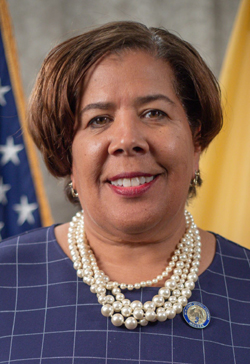
Asm. Linda Carter
Sponsored bills
Maddy summaryThis bill establishes a three-year pilot program to improve sickle cell disease care in New Jersey, appropriating $10.2 million from the General Fund. The Department of Health will competitively select federally qualified health centers (FQHCs), prioritizing those in Jersey City, Newark, Paterson, Plainfield, Trenton, Camden, and other high-need areas, to develop comprehensive treatment programs. The program requires participating centers to provide coordinated care (including telehealth where permitted), build specialized medical workforce capacity, conduct outreach, promote awareness, and collect state-wide data on sickle cell disease incidence and healthcare use. Funds must be used for these purposes during the three-year pilot, with unspent funds reverting to the General Fund after expiration.
Maddy summaryNew Jersey's A1775 prohibits the sale and distribution of nail polish and nail hardeners containing dibutyl phthalates, toluene, or formaldehyde, directly affecting nail product manufacturers, retailers, and distributors in the state. The bill requires immediate recalls by sellers/distributors upon discovery of prohibited chemicals, mandates retailers to remove affected products from shelves within 48 hours, and requires disposal of recalled items within 60 days. Violations trigger penalties under the Consumer Fraud Act, including fines up to $20,000 per offense and potential cease-and-desist orders. The law aims to remove specific chemical exposures from consumer nail products without specifying health outcome predictions.
Maddy summaryThis bill requires New Jersey's Secretary of Higher Education to impose a $10,000 fine on any public or private college or university that fails to properly investigate a student's allegation of sexual assault committed by another enrolled student. Institutions must also take appropriate disciplinary action against the perpetrator if the allegation is proven true. The fine is enforced through summary proceedings under New Jersey's Penalty Enforcement Law. This directly affects all higher education institutions in New Jersey that receive state funding or oversight.
Maddy summaryThis bill (A3171) requires the New Jersey Veterans' Memorial Homes in Paramus and Menlo Park to convert at least one section in each facility to single-occupancy rooms and upgrade their heating, ventilation, and air conditioning systems to infection control standards. The Adjutant General may also require additional modifications like negative pressure ventilation for infectious disease control. Funding will come first from federal block grants (including American Rescue Plan Act funds) allocated to the Department of Military and Veterans Affairs, with state General Fund money covering shortfalls if needed. The changes directly affect veterans residing at these two specific facilities.
Maddy summaryThis bill requires New Jersey professional licensing boards to calculate the national average time other states take to approve initial credentials for each regulated profession or occupation. Boards must collect this data from other states (or national associations) within six months of the bill's effective date, then use the approved national average as their processing standard for new applications. If a board fails to meet the national average after one year, it must use licensing fees to hire a third-party expert to identify best practices for faster processing, which must be implemented immediately. The Division of Consumer Affairs reviews compliance annually to ensure boards meet the established timelines.
Maddy summaryThis bill establishes a new Department of Early Childhood as a principal department within New Jersey's Executive Branch. It transfers numerous early childhood-related responsibilities from the Departments of Education, Human Services, Children and Families, and Health to this new department. The transfer includes programs for children from pregnancy through age eight, such as preschool education, child care services, home visitation programs, and early intervention services. The bill specifies the structure of the new department, including the role of the Commissioner of Early Childhood, and requires coordination among existing departments for an orderly transition of programs and staff.
Maddy summaryAR 61 is a symbolic resolution urging recreational programs, swim schools, and swim teams in New Jersey to increase participation by African-American youth in swimming. It cites higher drowning rates among Black children (five times higher for ages 5-19) and historical barriers like segregation that limited access to pools in Black communities. The resolution has no legal force but encourages these organizations to promote inclusive swim programs to address disparities. It specifically references the 1% African-American membership rate in USA Swimming as context for its call to action.
Maddy summaryThis bill requires that when appointing members to state boards, commissions, or similar bodies established by law, the appointing official (such as the Governor, Senate President, or Assembly Speaker) must prioritize achieving racial and gender diversity that reflects New Jersey’s population. The goal of diversity becomes a primary consideration for all appointments made after the bill’s effective date, unless it conflicts with specific circumstances or the law creating the body. The bill defines "gender" to include gender identity and "race" as based on physical characteristics or shared ancestry. This policy change directly affects how officials select members for these state entities, aiming to improve representation without mandating specific quotas.
Maddy summaryThis bill appropriates $1 billion in supplemental funding for after-school recreation programs in urban areas. It directs the Commissioner of Education to allocate these funds through a competitive application process to improve playgrounds, pools, and recreational infrastructure; reopen closed parks; and support mentorship programs with computer science, home economics, and life skills education. The funding directly affects urban communities and schools by expanding access to safe after-school activities and educational resources. The bill creates no new programs but provides concrete financial support for existing infrastructure and educational initiatives in underserved urban neighborhoods.