

Maddy summaryThis bill would expand privileges for craft alcoholic beverage manufacturers (including those with limited brewery, cidery, meadery, and craft distillery licenses) by allowing them to hold up to 25 off-premises special events annually, unlimited on-premises special events and private parties, and serve alcohol tableside with certified staff. It removes the current requirement that these manufacturers must offer tours to serve alcohol on-premises, and increases the annual production limit for restricted brewery licenses from 10,000 to 300,000 barrels. The bill also permits these manufacturers to offer limited food items, coordinate with food vendors (with restrictions), and show televised events without special permits. Additionally, it allows for outdoor consumption with approved tap systems and provides flexibility for promotional discounts.
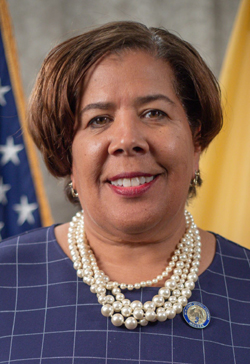
Asm. Linda Carter
Sponsored bills
Maddy summaryThe "John R. Lewis Voting Rights Act of New Jersey" establishes a state-level voting rights law to protect racial, color, and language-minority groups' voting rights. It requires election policies to be narrowly tailored to compelling justifications and prohibits methods that impair protected class members' ability to elect their preferred candidates. The bill creates a preclearance process for political subdivisions with prior voting rights violations before implementing election policies, mandates language assistance for language-minority groups meeting census thresholds, and provides remedies including alternative election processes and redistricting changes.
Maddy summaryThis bill creates a voluntary online resume bank for New Jersey residents with disabilities who wish to be appointed to state boards, commissions, authorities, or similar entities (like special committees or task forces). The Governor must establish a webpage listing available appointments and allow individuals to submit their resumes, including personal contact details, disability-related information, and preferred state entities. The resume bank will be accessible to the executive branch and Legislature to help identify qualified candidates for these roles. It does not mandate appointments but aims to streamline the application process for state positions.
Maddy summaryThis bill expands the scope of practice for optometrists in New Jersey by allowing them to prescribe more pharmaceutical agents (including some controlled substances), administer certain immunizations (for coronaviruses, influenza, and varicella-zoster virus), and perform simple ophthalmologic procedures like non-invasive laser treatments. It clarifies that optometrists must complete specific training and credentialing to provide these expanded services, including evidence of competence through accredited education programs. The bill directly affects licensed optometrists in New Jersey and their patients, who will have access to a broader range of eye care services from optometrists. The legislation updates the legal definition of optometry practice to better align with optometrists' doctoral education and clinical training.
Maddy summaryThis bill (A3991) directs New Jersey's State Board of Education to create a new "general science" endorsement for teaching certificates. This endorsement would allow certified teachers to teach any high school science course (grades 9-12), rather than being restricted to specific subjects like biology or chemistry. To qualify, teachers must hold a science-related degree (biology, chemistry, physics, or equivalent), maintain a 3.0 GPA, pass basic skills and subject matter tests, and meet other commissioner requirements. Existing science teachers with specialized endorsements (e.g., biology, chemistry) can apply for this general endorsement if they meet the new standards.
Maddy summaryThis bill requires New Jersey's Secretary of Higher Education to revoke the license of for-profit colleges that fail to meet specific graduation rate targets. By the sixth year after the law takes effect, these schools must achieve a 75% graduation rate for full-time students in four-year degree programs and a 75% rate for two-year programs. If a school is not on track after five years but demonstrates sufficient progress, the Secretary may grant additional time to meet the requirements before revoking the license. The law directly affects for-profit colleges authorized to offer degree programs in New Jersey.
Maddy summaryThis bill establishes the New Jersey Student Teacher Scholarship Program to help reduce financial barriers for future teachers. It provides eligible students up to $7,200 per semester for full-time clinical practice in teacher preparation programs, covering a maximum of two academic semesters. To qualify, students must be New Jersey residents enrolled full-time in approved education programs and complete required steps for clinical practice. The program requires participants to maintain good academic standing, and scholarships terminate if students are dismissed or withdraw due to illness (without requiring repayment). The Higher Education Student Assistance Authority will manage applications and collect annual data on program participants.
Maddy summaryThis bill prohibits New Jersey institutions of higher education and degree-granting proprietary institutions from asking about applicants' criminal history on admission applications, with exceptions for serious offenses including sexual assault, kidnapping, human trafficking, and criminal homicide. It establishes a 24-member Universal College Application Development Task Force to create a standard application that allows students to apply to multiple institutions with a single form. After admission, institutions may inquire about criminal history for counseling services or campus participation decisions, but must consider factors like the nature of the offense, time passed since the offense, and evidence of rehabilitation. Law schools are exempt from these requirements, and the task force must submit its final report within one year.
Maddy summaryThis bill requires New Jersey school boards to directly employ certified professionals (such as teachers and specialists) rather than contracting for their services, with specific exceptions for personnel like substitute teachers, business administrators, and those providing specialized instruction (e.g., financial literacy). It permits virtual or remote instruction for individual students or classes when equivalent in-person instruction isn't available, requiring commissioner approval through a formal application process that includes staff notification and comment periods. The bill specifies that virtual instruction may be used for certain graduation requirements, individualized learning opportunities (like internships and credit recovery), and summer school programs under defined circumstances. It establishes processes for school boards to apply for exemptions from direct employment requirements and for the Commissioner of Education to approve virtual instruction requests. The legislation aims to balance direct employment of qualified staff with necessary flexibility for specific educational needs.
Maddy summaryThis bill requires New Jersey's Department of Human Services, in collaboration with the Department of Health, to create a public awareness campaign about period poverty. The campaign must provide clear information on the definition, causes, and scale of period poverty (a lack of access to menstrual products, education, and sanitation) in New Jersey and the U.S., along with practical solutions. It mandates developing multilingual educational materials (including English and Spanish) and distributing them through state websites, health clinics, libraries, and community organizations. The departments must also report annually on campaign activities and results to the Governor and Legislature starting 24 months after the bill takes effect.